





















Runway Intelligence is OpenMetal’s executive insight series for late-stage startups and their investors, exploring how cloud economics, infrastructure design, and operational strategy shape valuation, margins, and time to exit.
Every engineering org has the same story. Someone runs a cost audit, finds 20-30% waste, and leads a heroic optimization sprint. Reserved instances get purchased. Idle resources get terminated. Oversized VMs get rightsized. The CFO is happy. The team moves on.
Six months later, costs are back where they started — or higher. New services launched without cost context. The reserved instances expired and nobody renewed them. The engineer who led the sprint changed teams.
The problem isn’t that the optimization failed. It’s that there was no system to sustain it. Optimization without a cadence is a project. Optimization with a cadence is a capability. The difference between teams that hold their gains and teams that don’t isn’t effort, tooling, or talent. It’s rhythm.
This article lays out a 90-day operating rhythm that synchronizes Engineering, FinOps, and Finance into a single repeating motion. Every element is designed to protect product velocity, not tax it. No savings that slow releases.
Key Takeaways
- Cost discipline is a cadence, not a project. Without a repeating rhythm, savings erode within two quarters as new services launch, commitments expire, and accountability decays.
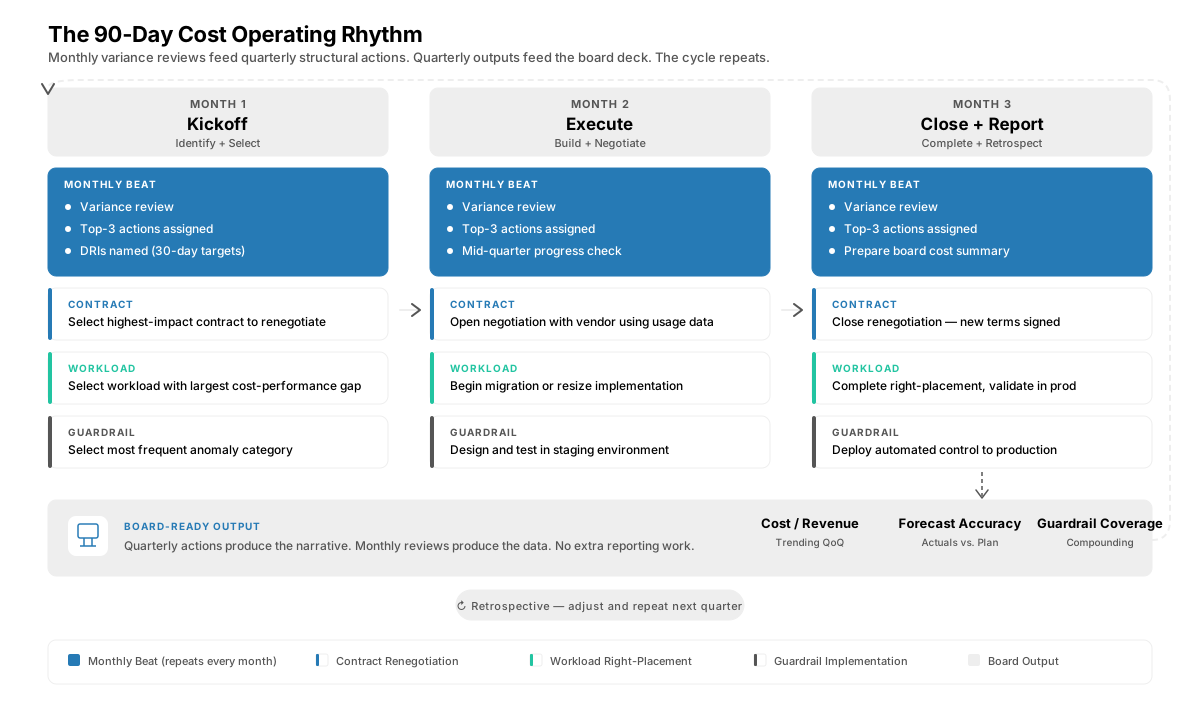
- Monthly: variance review + top-3 actions. Quarterly: 1 contract, 1 workload, 1 guardrail. This is the entire operating rhythm. It fits on one page.
- Three personas must be synchronized. Engineering, FinOps, and Finance each own different parts of the cadence — with named DRIs, not vague shared responsibility.
- The cadence protects product velocity as a first-class constraint. Every action is designed to remove friction (budget surprises, fire drills, emergency freezes), not add it.
- Quarterly actions produce board-ready metrics as a natural byproduct. The cadence generates the data the CFO needs for the board deck without extra reporting work.
Why One-Time Optimization Fails
One-time cost optimization has a structural problem: it creates a point-in-time fix without a feedback loop to maintain it. Infrastructure environments are dynamic. Teams ship new features, spin up new environments, adopt new services, and change workload patterns every week. A cost baseline set in January is obsolete by April.
The pattern is predictable. Month 1: savings captured. Month 3: drift begins as new resources launch outside the original scope. Month 6: costs have returned to their pre-optimization level, often with additional complexity layered on top. The Flexera State of the Cloud Report consistently finds that organizations estimate 28-30% of their cloud spend is wasted — a number that hasn’t meaningfully declined despite years of growing FinOps adoption. The tools aren’t the problem. The missing rhythm is.
The Missing Feedback Loop
Without a monthly variance review, cost drift is invisible until it surfaces in a quarterly finance report. By then, three months of unchecked spending have already hit the books. The team scrambles to explain a variance they didn’t see forming. Corrective action is reactive, expensive, and disruptive — the opposite of what good engineering culture looks like.
A monthly feedback loop catches drift in weeks, not quarters. That’s the difference between a small adjustment and a fire drill.
Accountability Without Cadence Is Just a Memo
Most cost optimization initiatives start with a kickoff where DRIs are named, a Slack channel is created, and responsibilities are assigned in a slide deck. Without a recurring meeting where those DRIs report progress against specific actions, the mandate decays. Within a few weeks, cost ownership becomes everyone’s responsibility in theory and nobody’s in practice.
Accountability needs a recurring trigger. The cadence provides it.
The Monthly Beat: Variance Review and Top-3 Actions
The monthly motion is the heartbeat of the operating rhythm. It’s a single meeting — 45 minutes, not a half-day — where Eng, FinOps, and Finance align on what changed, why, and what to do about it.
Running the Variance Review
The variance review compares actual infrastructure spend against the forecast or baseline, segmented by service, team, or environment — whichever lens gives the clearest signal. The goal isn’t to review every line item. It’s to surface the top 3 variances by dollar impact and determine the root cause of each.
For each variance, the review should produce three outputs: a root cause explanation, a named owner, and a 30-day resolution target. That’s it. If the meeting generates more than three action items, you’re overloading the system. Three is enough to make meaningful progress. Three is few enough that each action actually gets completed.
A variance might be a new service that launched without a cost estimate, a workload that scaled beyond its expected range, an expired commitment that reverted to on-demand pricing, or an environment that should have been decommissioned. The review identifies which variances matter most this month and assigns owners to resolve them.
The Top-3 Actions Rule
Why three? Teams that leave a meeting with ten action items complete zero of them. Teams that leave with three complete two or three. The constraint is the feature.
Each action gets:
- A named DRI (a person, not a team)
- A 30-day deadline (resolved before the next monthly review)
- A clear definition of done (cost reduced by $X, resource decommissioned, commitment renewed)
Actions unresolved after 30 days escalate to the quarterly review for a decision: absorb, reprioritize, or kill.
Who’s in the Room
Keep the monthly review small. The right attendees are:
| Role | Owns | Brings |
|---|---|---|
| Eng lead (VP/Director level) | Workload decisions, architecture trade-offs | Context on why spend changed (new features, scaling events, technical debt) |
| FinOps lead | Cost data, tooling, anomaly detection | Variance report, trend analysis, utilization data |
| Finance partner | Forecast, budget, board reporting | Budget vs. actual, rolling forecast, board timeline |
Five to seven people total. If the room has more than that, the meeting becomes a readout instead of a working session.
Monthly Review Template:
| Step | Owner | Output |
|---|---|---|
| Pull spend vs. forecast data | FinOps | Variance report by service/team/environment |
| Identify top-3 variances | FinOps + Eng | Ranked list with root causes |
| Assign resolution DRIs | Eng lead | Named owners + 30-day targets |
| Update rolling forecast | Finance | Adjusted projection for the quarter |
| Flag items for quarterly review | All | Escalation list for unresolved or systemic issues |
The Quarterly Beat: Contract, Workload, Guardrail
The monthly rhythm captures drift and assigns corrections. The quarterly rhythm makes structural improvements. Each quarter, the team completes three deliberate actions:
- Renegotiate 1 contract
- Right-place 1 workload
- Implement 1 cost guardrail
One of each. Not ten. Not “as many as we can.” The constraint is intentional. These actions are designed to be completable within a quarter alongside normal engineering work. They compound: after four quarters, you’ve renegotiated four contracts, right-placed four workloads, and built four guardrails. That’s a fundamentally different cost posture than where you started.
Renegotiate 1 Contract
Pick the highest-impact vendor contract based on three months of variance data. This could be a reserved instance commitment that doesn’t match actual usage, a SaaS tool with unused seats, a data transfer agreement with rates that predate your current volume, or a committed use discount that’s about to expire.
The goal isn’t to renegotiate every contract every quarter. It’s to renegotiate the one that matters most right now, using real usage data from the monthly reviews to negotiate from a position of knowledge rather than estimation.
Common contract actions: renew with adjusted terms, consolidate multiple agreements, cancel an underused service, or switch pricing tiers based on actual consumption patterns.
Right-Place 1 Workload
Identify one workload that’s running on the wrong infrastructure tier. This might be:
- Oversized VMs — a staging environment running production-grade instances
- Wrong region — a data processing pipeline in a region far from its data sources
- Cloud service that should be on dedicated infrastructure — a sustained compute workload paying on-demand hourly rates when fixed-cost bare metal would be more economical
- Dev/test resources running 24/7 — environments that should scale down or shut off outside business hours
Pick the workload with the largest gap between what it costs and what it should cost. Migrate or resize it within the quarter. One workload per quarter is manageable. Four per year is transformative.
Implement 1 Cost Guardrail
Add one automated control that prevents a specific category of cost incident. Guardrails are proactive — they stop problems before they generate variances in next month’s review.
Examples of effective guardrails:
- Budget alert thresholds — notify the team when a service exceeds 80% of its monthly allocation
- Auto-scaling ceilings — cap the maximum number of instances a service can scale to
- Pre-commit spend approval — require sign-off for any new resource that will cost more than $X/month
- Tagging enforcement — block deployment of untagged resources so every cost is attributable to a team and service
One guardrail per quarter. After four quarters, you have four automated controls preventing four categories of cost surprises. Each new guardrail reduces the noise in future monthly variance reviews.
Quarterly Action Card:
| Action | Selection Criteria | DRI | Inputs | Output |
|---|---|---|---|---|
| Renegotiate 1 contract | Highest spend variance; expiring terms; unused commitments | FinOps + Finance | 3 months of spend data, contract terms | New terms, cancellation, or tier change |
| Right-place 1 workload | Largest cost-performance mismatch | Eng lead | Utilization data, performance metrics | Migration or resize completed |
| Implement 1 guardrail | Most frequent anomaly category from monthly reviews | FinOps + Eng | Monthly anomaly log | Automated control deployed to production |
Mapping the Cadence to Board Reporting
Quarterly board decks typically need three infrastructure cost data points: (1) spend vs. plan, (2) cost efficiency per unit of product delivery, and (3) a forward-looking projection. The 90-day cadence produces all three as natural byproducts of the work you’re already doing.
Board-Ready Metrics
Monthly variance reviews generate the spend-vs.-plan data. Quarterly actions generate the narrative. When the CFO presents the infrastructure slide, the story writes itself: “This quarter, we renegotiated our compute commitment to align with actual usage (saving $X/month), migrated our data pipeline to right-sized infrastructure (reducing cost by Y%), and implemented auto-scaling guardrails to prevent the kind of spike we saw in Q2.”
The core metrics the cadence produces:
- Infrastructure cost as % of revenue — trending quarter over quarter
- Cost per customer or cost per deployment — efficiency metric tied to product growth
- Forecast accuracy — how close monthly actuals landed to the rolling forecast
- Guardrail coverage — how many cost categories now have automated controls
No Surprises
The monthly cadence ensures that cost variances are identified, explained, and assigned within 30 days of occurrence. By the time the board meeting arrives, there are no unexplained spikes, no scrambled explanations, and no emergency analyses. The CFO walks in with a story, not a surprise.
This is worth more than any single cost savings initiative. Board-level trust in infrastructure cost management is built through predictability, not heroics.
Protecting Product Velocity: The Non-Negotiable Constraint
Cost optimization that slows product delivery is not optimization. It’s a tax. Every element of this cadence is designed to be velocity-positive:
- Variance reviews catch runaway costs before they trigger emergency budget freezes that halt deployments
- Contract renegotiations free up budget that engineering can reinvest in new infrastructure
- Workload right-placement improves performance alongside cost — a faster, cheaper workload accelerates the product, it doesn’t slow it
- Guardrails prevent the fire drills (emergency cost reviews, deployment freezes, retroactive chargebacks) that actually slow teams down
The anti-patterns to avoid are real and common. Cost approval gates that add a 48-hour review to every deployment. Mandatory cost-impact analyses before merging a PR. Savings targets that pull senior engineers off product work for weeks. These aren’t cost discipline — they’re organizational drag wearing a FinOps label.
The cadence replaces reactive friction with proactive structure. Pre-approved budgets, pre-negotiated rates, and automated guardrails mean engineers can ship without waiting for cost approval on every change. The monthly review catches anything that slips through. The system handles cost discipline so individual engineers don’t have to pause their work to think about it.
The 90-Day Operating Rhythm Checklist
Copy this checklist and adapt it to your organization. It maps the full quarterly cycle across monthly and quarterly actions.
Month 1 (Quarter Kickoff)
- Run monthly variance review (Eng + FinOps + Finance, 45 min)
- Identify top-3 variances and assign DRIs with 30-day targets
- Select this quarter’s contract to renegotiate (highest-impact by dollar value)
- Select this quarter’s workload to right-place (largest cost-performance gap)
- Select this quarter’s guardrail to implement (most frequent anomaly category)
- Update rolling forecast with Month 1 actuals
Month 2 (Execution)
- Run monthly variance review
- Identify top-3 variances and assign DRIs
- Execute contract renegotiation (open discussion with vendor, present usage data)
- Begin workload migration or resize (implementation underway)
- Design and test guardrail in staging environment
- Mid-quarter check: are quarterly actions on track?
Month 3 (Close and Report)
- Run monthly variance review
- Identify top-3 variances and assign DRIs
- Close contract renegotiation (signed new terms or completed cancellation)
- Complete workload right-placement (validated in production)
- Deploy guardrail to production
- Prepare board-ready cost summary (spend vs. plan, efficiency metrics, forward projection)
- Run quarterly retrospective: what worked, what to adjust, what to carry into next quarter
DRI Assignment Template
| Cadence Action | Eng DRI | FinOps DRI | Finance DRI |
|---|---|---|---|
| Monthly variance review | ___________ | ___________ | ___________ |
| Top-3 action assignment | ___________ | ___________ | ___________ |
| Contract renegotiation | ___________ | ___________ | |
| Workload right-placement | ___________ | ___________ | |
| Guardrail implementation | ___________ | ___________ | |
| Board cost summary | ___________ | ___________ |
Where OpenMetal Fits: Infrastructure That Rewards the Cadence
This cadence works on any cloud, any infrastructure, any tooling stack. But when teams run it consistently, certain patterns emerge — patterns that point toward dedicated infrastructure.
Predictable Billing and Cleaner Variance Reviews
The single largest source of monthly variance in cloud environments is billing unpredictability: burst charges, egress fees, spot instance interruptions, and auto-scaling events that exceed projections. When your infrastructure runs on fixed-cost dedicated servers, the biggest source of noise in the variance review disappears. The monthly conversation shifts from “why did the bill spike?” to “where can we reinvest?”
OpenMetal’s Bare Metal Servers deliver fixed monthly pricing regardless of utilization. No per-query charges, no egress surprises, no throttling penalties. For teams running the monthly cadence, that predictability means variance reviews focus on application-level decisions rather than infrastructure billing artifacts.
Quarterly Right-Placement on Dedicated Infrastructure
The “right-place 1 workload” quarterly action is where dedicated infrastructure becomes a concrete option. After a few monthly reviews, patterns emerge: workloads with sustained utilization paying hourly rates, databases with high egress costs serving BI tools across network boundaries, compute-heavy services where cloud VM pricing scales linearly but performance doesn’t.
These workloads have crossed the cost tipping point where dedicated infrastructure is more economical than cloud. Each quarter’s right-placement action is an opportunity to evaluate one of these workloads and, if the math works, migrate it to OpenMetal bare metal or Hosted Private Cloud.
Guardrails That Start at the Infrastructure Layer
Some guardrails are most effective when implemented at the infrastructure level. Fixed-cost infrastructure is itself a guardrail: there’s no runaway auto-scaling bill on a bare metal server. The cost is the cost. OpenMetal’s OpenStack-based private cloud gives teams the orchestration APIs and programmability of a cloud environment with a cost ceiling that can’t be exceeded by a misconfigured auto-scaler at 2 AM.
Contract Simplicity
Quarterly contract renegotiation is simpler when your infrastructure pricing is transparent. There are no layered discount tiers, no committed use discount schedules that require a spreadsheet to decode, and no surprise overages that invalidate the commitment you thought you made. When the pricing model is straightforward, the FinOps team spends the quarterly contract action on vendor agreements that genuinely need renegotiation — not on deciphering their own infrastructure bill.
Conclusion
The difference between organizations that sustain cost discipline and those that don’t isn’t budget, headcount, or tooling. It’s cadence. A repeating 90-day rhythm — monthly variance reviews with top-3 actions, quarterly structural improvements across contracts, workloads, and guardrails — turns sporadic cost heroics into an operating capability that compounds over time.
The cadence is lightweight by design. One 45-minute meeting per month. Three quarterly actions that fit alongside normal engineering work. Board-ready metrics as a byproduct. No savings that slow releases.
The first step isn’t a tool purchase, a reorg, or a strategy offsite. It’s simpler than that.
Adopt the cadence: name your DRIs from Eng, FinOps, and Finance, and book the first three monthly checkpoints.
That’s the entire activation cost. Three calendar invites and three names. Everything else builds from there.
For teams whose cadence reveals workloads ready for dedicated infrastructure, OpenMetal’s Bare Metal Dedicated Servers and Hosted Private Cloud are built for the kind of sustained, predictable workloads that the rhythm surfaces. Talk to an OpenMetal infrastructure engineer when you’re ready.
Frequently Asked Questions
What is a cloud cost operating rhythm?
A cloud cost operating rhythm is a repeating cycle of reviews and actions that keeps infrastructure spending aligned with business goals. It typically includes monthly variance reviews (comparing actual spend to forecast and assigning corrective actions) and quarterly structural improvements (renegotiating contracts, right-placing workloads, and implementing automated cost guardrails). The rhythm synchronizes Engineering, FinOps, and Finance teams into a shared cadence rather than relying on one-time optimization projects.
How often should you review cloud costs?
Monthly reviews strike the right balance between catching cost drift early and not consuming excessive engineering time. Weekly reviews are too frequent for most organizations — the data doesn’t change enough to justify the meeting overhead. Quarterly reviews are too infrequent — by the time you identify a variance, three months of excess spend have already hit the books. A monthly variance review with a 45-minute time box, focused on the top 3 variances by dollar impact, gives teams enough signal to act without becoming a drain on productivity.
What should a monthly cloud cost review include?
An effective monthly review produces three outputs for each of the top 3 spend variances: a root cause explanation, a named DRI responsible for resolution, and a 30-day deadline. The meeting should compare actual spend against forecast by service, team, or environment. Attendees should include an Engineering lead (for workload context), a FinOps lead (for cost data and analysis), and a Finance partner (for forecast updates and board reporting alignment). Keep the meeting to 45 minutes and no more than 5-7 attendees.
How do you reduce cloud costs without slowing engineering?
Design the cost cadence to remove friction rather than add it. Variance reviews catch runaway costs before they trigger emergency budget freezes. Contract renegotiations free up budget for new infrastructure. Guardrails prevent cost incidents before they happen — which eliminates the fire drills that actually slow teams down. Avoid anti-patterns like cost approval gates on every deployment, mandatory cost-impact analyses before merging pull requests, or savings targets that pull engineers off product work. The goal is pre-approved budgets and pre-negotiated rates so engineers can ship without per-change cost reviews.
What is a cost guardrail in cloud infrastructure?
A cost guardrail is an automated control that prevents a specific category of cost incident. Examples include budget alert thresholds that notify teams when a service exceeds 80% of its monthly allocation, auto-scaling ceilings that cap maximum instance counts, pre-commit spend approvals for resources above a dollar threshold, and tagging enforcement policies that block untagged deployments. Implementing one guardrail per quarter builds cumulative protection: after a year, four automated controls are preventing four categories of cost surprises, reducing noise in monthly variance reviews.