



















This page compares the OpenMetal XL v5 (2x Intel Xeon 6530P, 1 TB DDR5-6400, 25.6 TB persistent NVMe, bare metal, fixed monthly pricing) against AWS m7i.metal-48xl (96 vCPU, 384 GB RAM, EBS-only storage, on-demand or RI pricing). The comparison is structural — different pricing models, different tenancy models, different storage models — not just “we are cheaper per hour.” We also note the cases where AWS is the right answer.
Key Takeaways
- Dedicated bare metal vs dedicated cloud metal: both are single-tenant, but OpenMetal owns the hardware while AWS leases hypervisor-free hardware on-demand. OpenMetal gives full BIOS / IPMI access; AWS does not expose a BMC equivalent.
- Fixed monthly vs metered hourly: OpenMetal XL v5 is a single line-item with price-lock available up to 5 years. AWS m7i.metal-48xl is on-demand / 1-yr RI / 3-yr RI.
- Persistent NVMe included vs EBS purchased separately: XL v5 ships with 25.6 TB of persistent Micron 7500 MAX NVMe at no incremental cost. m7i.metal does not include instance NVMe — all persistent storage is EBS, purchased and billed separately.
- 95th-percentile egress vs per-GB metered: OpenMetal bills public egress on sustained Mbps; AWS bills per-GB egress to the internet. The cost gap widens substantially with steady, voluminous traffic.
- Intel TDX capable at base vs Nitro Enclaves: XL v5 is TDX-capable at its base configuration (you enable it in the server BIOS); AWS uses Nitro Enclaves with a different threat model and architecture.
- HIPAA org-level + BAA across all 4 regions vs per-service eligibility: OpenMetal may be able to sign a BAA with covered entities covering the whole infrastructure; AWS HIPAA eligible services must be cross-checked individually.
→ See deployment options and pricing at the bottom of this page, or view the full bare metal catalog at openmetal.io/bare-metal-pricing.
Spec Comparison
| Component | OpenMetal XL v5 | AWS m7i.metal-48xl (us-east-1) | AWS i4i.metal (NVMe-included alternative) |
|---|---|---|---|
| Tenancy | Dedicated bare metal (no hypervisor) | Dedicated bare metal (no hypervisor) | Dedicated bare metal |
| CPU | 2x Intel Xeon 6530P (Granite Rapids, Intel 3) | 4th Gen Intel Xeon Scalable (Sapphire Rapids) | 3rd Gen Intel Xeon Scalable (Ice Lake) |
| Physical cores | 64 (32 per socket) | 96 vCPU (logical) | 128 vCPU |
| RAM | 1024 GB DDR5-6400 | 384 GB | 1024 GB |
| Storage (included) | 25.6 TB persistent NVMe | None — EBS only | 30 TB instance NVMe (ephemeral) |
| Storage persistence | Persistent across reboots | EBS persistent (separate purchase) | Instance NVMe is ephemeral — lost on stop |
| Remote management | Full IPMI / iDRAC-class | SSM, no BMC | SSM, no BMC |
| Boot/data isolation | Dedicated boot RAID 1 + data pool | Shared EBS backend | N/A (different model) |
| Private networking | 20 Gbps default (2x 10 Gbps LACP), 40 Gbps optional (4x 10 Gbps) | ENI throughput per instance | Same |
| Public egress | 95th-percentile Mbps | Per-GB metered | Per-GB metered |
Selection rationale: m7i.metal-48xl is the closest cloud-bare-metal compute match by tenancy model and CPU class, but it ships with no NVMe. i4i.metal is shown because it is the AWS instance most often offered as an “NVMe-included” comparison, but the NVMe is ephemeral instance storage — fundamentally different from XL v5’s persistent NVMe.
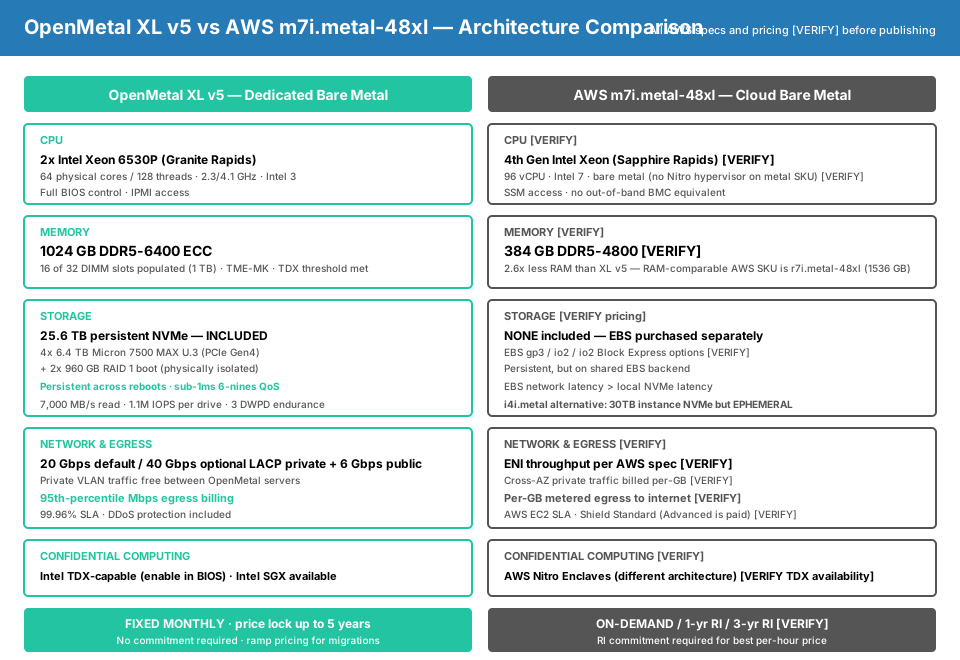
Processor: Dedicated Granite Rapids Cores vs Cloud Sapphire Rapids
The XL v5 runs Intel Xeon 6530P processors on Granite Rapids, fabricated on Intel 3 — a full process-node shrink from Sapphire Rapids (Intel 7) used in the m7i family. Both are dual-socket bare metal, so neither carries hypervisor overhead, but the architectural delta matters: Granite Rapids brings a chiplet design, higher memory bandwidth, and improved per-core IPC vs Sapphire Rapids. AMX, AVX-512, AES-NI, and DL Boost are available on both, but their throughput on Granite Rapids is meaningfully higher.
The other structural difference: on the XL v5 you have full BIOS access and IPMI. You can pin cores, set Speed Select profiles, disable hyperthreading, configure NUMA balancing — all without filing a ticket. AWS m7i.metal-48xl does not expose a BMC; CPU configuration is limited to what AWS allows via instance metadata and OS-level tunables. For workloads where you actually need to control the BIOS (some HFT, some real-time, some HPC), this is a hard requirement, not a preference.
Memory: 1 TB DDR5-6400 vs 384 GB on m7i.metal-48xl
The XL v5 ships with 1024 GB of DDR5-6400 across 16 of its 32 DIMM slots. m7i.metal-48xl is 384 GB — meaningfully less. For large in-memory databases, dense KVM tenancy, in-memory analytics (Spark, ClickHouse, Trino) and OLAP workloads, the 2.6x RAM gap matters more than the raw vCPU count.
For a RAM-comparable AWS metal SKU you need to step to r7i.metal-48xl (1536 GB) or u-class instances — both significantly more expensive than m7i.metal-48xl on hourly pricing. The XL v5’s 1 TB is included in the fixed monthly price; AWS RAM scaling requires moving to a different instance family.
DDR5-6400 vs the m7i family’s DDR5-4800 is another structural delta — roughly 33% more memory bandwidth per channel, which is the difference between “bandwidth-bound workloads bottleneck on RAM” and “they don’t.” TME-MK is active on both platforms.
The XL v5 is also TDX-capable at its base configuration (you enable it in the server BIOS) because the 1 TB configuration meets the trust domain threshold — a confidential-computing capability that is not the default on m7i (AWS uses Nitro Enclaves as its primary confidential-computing primitive, a different architecture entirely).
Storage: Persistent NVMe vs EBS-Only / Ephemeral Instance NVMe
Boot and data isolation
The XL v5 has two dedicated 960 GB NVMe drives in RAID 1 for the OS, physically isolated from the data drive pool. An OS rebuild, kernel update, or boot-drive failure cannot touch your data; conversely, a data drive failure cannot stall the OS. AWS m7i.metal-48xl boots from EBS — there is no physical boot/data separation, and the OS lives on the same EBS backend that hosts your data volumes.
Micron 7500 MAX data drives
This is the most consequential structural difference.
OpenMetal XL v5 includes 25.6 TB of persistent Micron 7500 MAX NVMe at no incremental cost. The drives are physically attached to the server, persist across reboots, persist across OS rebuilds, and are part of the fixed monthly rate.
AWS m7i.metal-48xl has no included NVMe. All storage is EBS, purchased separately at per-GB-month rates (plus per-IOPS pricing for io2 or io1, plus per-MB/s throughput pricing for gp3 above the included baseline). EBS storage is persistent, but it lives on a shared backend, traverses the network, and carries significantly higher latency than local NVMe.
AWS i4i.metal includes 30 TB of instance NVMe — but this NVMe is ephemeral. When you stop the instance, the data is gone. Persistent data on i4i.metal still requires EBS. This is a different storage model entirely from XL v5’s persistent local NVMe.
Micron 7500 MAX U.3 NVMe specs (per drive, 6.4 TB capacity, source: Micron 7500 Tech Prod Spec Rev. A 10/2023):
| Metric | 6.4 TB Model |
|---|---|
| Sequential Read | 7,000 MB/s |
| Sequential Write | 5,900 MB/s |
| Random Read (4K) | 1,100,000 IOPS |
| Random Write (4K) | 400,000 IOPS |
| Mixed 70/30 (4K) | 650,000 IOPS |
| Read Latency (typ) | 70 μs |
| Write Latency (typ) | 15 μs |
| QoS | sub-1ms @ 99.9999% (6-nines) up to QD128 |
Per-server raw IOPS (4 drives x 1.1M random read) exceeds 4.4 million 4K random reads. AWS EBS gp3 provides up to 16,000 IOPS / 1,000 MB/s per volume (with higher tiers via io2 Block Express at additional cost). To match XL v5’s raw IOPS profile on AWS, you would need to stripe many EBS volumes — adding cost and operational complexity.
Cost framing
For a workload that needs ~25 TB of persistent fast storage:
- OpenMetal XL v5: Included in the monthly rate. $0 incremental.
- AWS m7i.metal-48xl + 25 TB EBS gp3: EBS at gp3 published rates adds a meaningful monthly line-item (per-GB-month for capacity, plus baseline IOPS/throughput included, plus paid extension for higher tiers). It is not included in the instance hourly rate.
Networking
The XL v5 has 20 Gbps of LACP-bonded private bandwidth by default (upgradeable to 40 Gbps, a v2+ option) to other OpenMetal servers in the same region — east-west traffic between your XL v5, your Hosted Private Cloud, your storage nodes, and other bare metal servers is on the private fabric and does not count toward billable egress. Public-facing bandwidth is 6 Gbps with 99.96% SLA and DDoS protection included.
AWS m7i.metal-48xl networking is metered differently. ENI throughput per instance is published by AWS, but private traffic between instances in different AZs does cost per-GB (cross-AZ data transfer), and private traffic to other AWS services may carry its own NAT Gateway / VPC endpoint charges. This is a structural difference: on OpenMetal, “your private VLAN to your private services” is free; on AWS, “your private VPC traffic across AZs” is often not.
Egress pricing: 95th-percentile billing, not per-GB transfer.
OpenMetal bills public egress on the 95th-percentile of sustained Mbps over the billing period — the same model used by Tier 1 transit providers. AWS bills public egress per-GB to the internet, at tiered rates that step down at high volume but remain non-trivial at any volume.
A workload doing 5 TB/month of public egress on AWS sits in AWS’s per-GB-to-internet rate band — meaningful but absorbable. The same workload on OpenMetal might fit inside the included 95th-percentile band.
A workload doing 50 TB/month — a busy CDN origin, a video streaming endpoint, an S3-compatible API serving large objects, a blockchain RPC endpoint at scale — scales the AWS egress line linearly with GB transferred, while on OpenMetal the 95th-percentile band only moves up if the sustained rate moves up. For any workload with steady-but-voluminous egress, this is the largest single line item on a multi-year cost projection.
Security and Confidential Computing
| Feature | OpenMetal XL v5 | AWS m7i.metal-48xl |
|---|---|---|
| Confidential computing primary | Intel TDX (capable at base, enable in BIOS) | AWS Nitro Enclaves |
| Confidential computing alternate | Intel SGX (available at base memory config) | Nitro Enclaves only |
| TDX availability | Yes — capable at base (enable in BIOS) | Limited TDX availability on EC2 |
| Measured boot | Intel Boot Guard | AWS Nitro hypervisor measurement |
| Physical isolation | Single-tenant bare metal | Single-tenant bare metal |
| Operator-blind workloads | TDX trust domains exclude OpenMetal staff | Nitro Enclave model is different — see AWS docs |
| Memory encryption | TME-MK + per-TD AES inside trust domains | Nitro hypervisor + EBS encryption |
| AES-NI / AMX / AVX-512 | Yes — on bare metal, no hypervisor overhead | Yes — but EC2 metal still has Nitro hypervisor virtualization layer |
The structural difference is the confidential computing architecture. Intel TDX is a hardware capability that isolates entire VMs from the host; AWS Nitro Enclaves isolate a partition of an EC2 instance from the rest of that instance. They address different threat models and have different developer ergonomics. For workloads where “Intel TDX-attested trust domain” is a procurement requirement (Azure Confidential VMs migration, sovereign cloud, certain financial compliance regimes), OpenMetal XL v5, TDX-capable at its base configuration (you enable it in the server BIOS), is more direct than current AWS offerings.
HIPAA and Regulatory Compliance
| Compliance dimension | OpenMetal XL v5 | AWS m7i.metal-48xl |
|---|---|---|
| HIPAA posture | Org-level + BAA across all 4 regions | Per-service eligibility; BAA required for HIPAA Eligible Services |
| Facility certifications (US-East / Ashburn) | NTT VA1: SOC 1/2/3, ISO 27001, PCI DSS, NIST 800-53 HIGH, HIPAA (facility-level) | AWS us-east-1: AWS published certifications |
| Facility certifications (EU / Amsterdam) | Digital Realty AMS3: SOC 1/2, PCI DSS, ISO 27001 / 50001 / 22301 | AWS eu-west / eu-central |
| Facility certifications (APAC / Singapore) | Digital Realty SIN10: BCA Green Mark Platinum | AWS ap-southeast-1 |
| FedRAMP | Not a current OpenMetal certification | AWS GovCloud (separate offering) |
| Workload portability across regions | Same SKU, same compliance posture | Different regional service availability |
HIPAA-specific note: OpenMetal HIPAA compliance is at the organizational level. The Ashburn NTT VA1 facility holds facility-level HIPAA; Los Angeles, Amsterdam, and Singapore facilities do not list facility-level HIPAA — OpenMetal’s org-level HIPAA + BAA is the compliance vehicle at those sites. AWS HIPAA, by contrast, is service-by-service: only services on the AWS HIPAA Eligible Services list can host PHI under a BAA, and the rest of the AWS estate cannot.
When Each Platform Wins
When OpenMetal Wins
- Sustained 24/7 workloads above ~$10-20k/month in equivalent cloud spend — fixed monthly + 5-year price lock becomes structurally cheaper.
- Egress-heavy workloads — CDN origins, video streaming, large-object APIs, blockchain RPC endpoints — where 95th-percentile billing structurally beats per-GB.
- Confidential computing on Intel TDX — capable at base (enable in BIOS), no premium SKU, no separate confidential-VM family.
- Compliance / isolation requirements — HIPAA-facility (Ashburn), single-tenant bare metal, full IPMI for forensic / DR access, BAA across all regions.
- Persistent local NVMe at the 25 TB+ scale — included in the rate vs EBS as a separate budget item.
- VMware migration — ramp pricing, no VMware licensing, OpenStack as the new control plane (Hosted Private Cloud XL v5).
- Predictable budgeting — finance can model exact monthly costs years out, no surprise egress bills.
When AWS Wins
- Scale-to-zero workloads — Lambda, Fargate, Cloud Run-equivalents. OpenMetal does not have a serverless layer.
- Sub-$10k/month spend where running your own platform is not amortizable against ops effort.
- Deep AWS-native service integration — Bedrock, SQS, Glue, Athena, Lake Formation, Redshift, DynamoDB. OpenMetal does not replicate these.
- Global edge presence — CloudFront, Global Accelerator, 30+ regions. OpenMetal is 4 regions.
- Bursty / unpredictable traffic — per-minute billing absorbs spikes more gracefully than 95th-percentile, especially for very short bursts on otherwise quiet workloads.
- FedRAMP High — AWS GovCloud has FedRAMP High; OpenMetal does not currently hold FedRAMP.
- Managed-everything operating model — RDS, ElastiCache, MSK as turnkey services. OpenMetal is closer to “managed cluster, self-managed services on top.”
OpenMetal is honest about this. The XL v5 is the right answer when you have a steady, predictable, performance-sensitive workload that benefits from dedicated hardware and predictable monthly cost. It is not the right answer for “I’m still figuring out my traffic shape.”
Ready to Compare Costs for Your Workload?
Tell us about your current cloud spend and workload profile. We’ll provide a side-by-side cost analysis for the XL v5 vs AWS m7i.metal-48xl vs your current AWS deployment.
Get a XL v5 vs AWS m7i.metal-48xl Quote Schedule a Consultation
Cost Model and TCO
Cost Model Comparison
| Cost line | OpenMetal XL v5 | AWS m7i.metal-48xl |
|---|---|---|
| Compute pricing | Fixed monthly | On-demand / 1-yr RI / 3-yr RI |
| Storage (25 TB persistent fast) | Included | EBS purchased separately |
| Public egress | 95th-percentile Mbps | Per-GB metered |
| Private traffic (same region) | Included | Cross-AZ data transfer charges |
| IPMI / out-of-band management | Included | Not available (SSM only) |
| Licensing (OpenStack / hypervisor) | None — bare metal | None on m7i.metal (bare metal) |
| Commitment for best price | None or 5-yr price-lock at customer option | RI 1-yr or 3-yr commitment for best discount |
| Ramp pricing for migration | Available (VMware / cloud migration) | Not applicable |
| DDoS protection | Included | AWS Shield Standard included; Shield Advanced is a paid add-on |
| Network SLA | 99.96% | AWS EC2 SLA |
Illustrative 12-month TCO
The compute, storage, and egress cost lines above set the structural shape of the comparison. The dollar totals depend on three workload-specific inputs that vary too much to publish as a static table: your monthly compute commitment shape (on-demand vs 1-yr vs 3-yr RI), your persistent storage profile (gp3 vs io2, IOPS, throughput, snapshots), and your egress curve (steady vs spiky, intra-region vs inter-region, % to internet vs to other AWS services). For a workload-specific dollar comparison, send us a representative slice of your current AWS bill (compute, EBS, data transfer) and we will model a like-for-like XL v5 deployment with fixed monthly pricing — see the cost-comparison form at the bottom of this page.
Key insight: the cost gap between OpenMetal and AWS widens substantially with egress volume. At 5 TB/month of public egress, the comparison is closer to “compare the compute lines”; at 50 TB/month, the AWS egress line alone often exceeds the OpenMetal monthly total. The break-even depends on workload shape, but OpenMetal’s public cloud comparison guidance puts the structural break-even around $10-20k/month of equivalent cloud spend.
XL v5 vs AWS m7i.metal-48xl Deployment Options
Bare Metal Dedicated Server
Single-server or multi-server XL v5 deployments. Fixed monthly, full IPMI, 25.6 TB persistent NVMe, 20 Gbps LACP private (upgradeable to 40), 6 Gbps public, TDX-capable (enable in BIOS). See the primary XL v5 spec page.
Where to deploy
Deploy in Ashburn (VA, US-East), Los Angeles (CA, US-West), Amsterdam (Netherlands, EU-West), or Singapore (Asia). All four sites are Tier III data centers with the certifications listed in the compliance section above.
→ View pricing: openmetal.io/bare-metal-pricing
Hosted Private Cloud
3-node OpenStack + Ceph cluster on XL v5 hardware. 192 cores, 3 TB DDR5-6400, ~25.6 TB usable Ceph storage, OpenMetal-managed Day 2 ops, 45-second deploy. See the Hosted Private Cloud XL v5 page.
→ View pricing and configuration: openmetal.io/cloud-deployment-calculator
Both deployment paths: available across OpenMetal’s Tier III data center locations. Fixed monthly pricing applies regardless of utilization. No per-hour, per-query, or per-GB billing.
Get a XL v5 vs AWS m7i.metal-48xl Quote
Tell us about your infrastructure needs and we’ll provide a custom quote for the XL v5 vs AWS m7i.metal-48xl — as a standalone bare metal server or as part of a Hosted Private Cloud cluster.
- Bare metal: Single-server or multi-server deployments with full root access and IPMI
- Hosted Private Cloud: Three-node OpenStack + Ceph clusters with Day 2 operations included
- Custom configurations: RAM upgrades, additional NVMe drives, TDX enablement
Ramp pricing available for migrations. All deployments include fixed monthly pricing, 99.96%+ network SLA, and DDoS protection.
Product specifications, pricing, and availability may change due to market conditions and other factors. For the most current information, please contact the OpenMetal team directly.AWS specifications and pricing are sourced from publicly available documentation and may not reflect current rates or configurations.