




















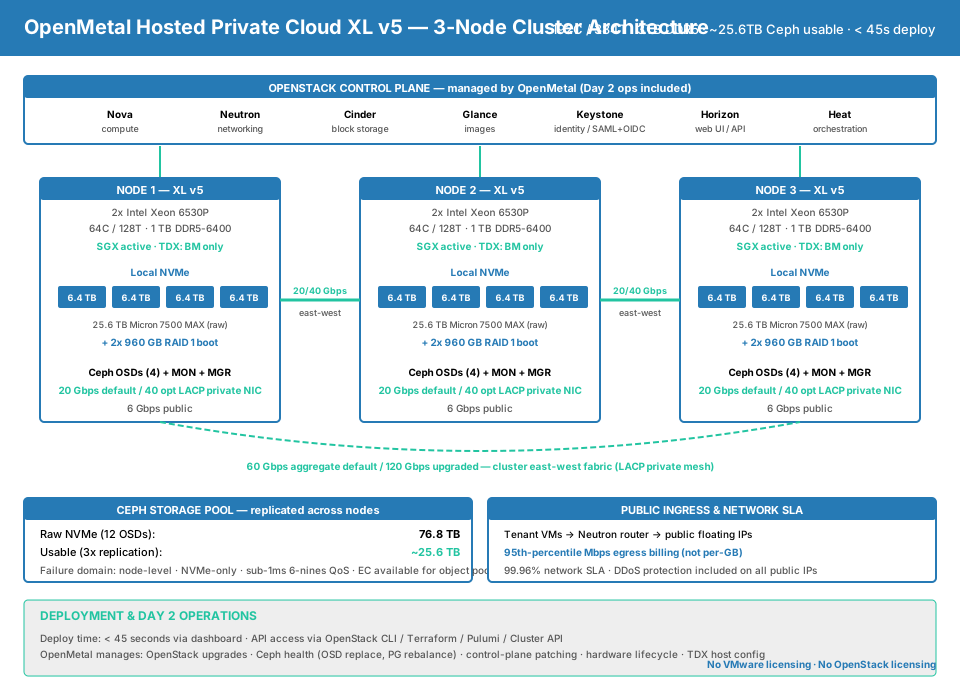
The Hosted Private Cloud XL v5 is a three-node OpenStack + Ceph cluster built from OpenMetal’s flagship Granite Rapids bare metal. Each node is an XL v5 — dual Intel Xeon 6530P, 1 TB DDR5-6400, 25.6 TB NVMe — and the three nodes together deliver 192 physical cores, 3 TB of RAM, and a Ceph-replicated NVMe pool with the OpenStack control plane fully managed by OpenMetal. Cluster deployment completes in under 45 seconds from the dashboard, with no VMware licensing, no OpenStack licensing fees, and full root access to every node.
Key Takeaways
- 192 cores / 384 threads and 3 TB DDR5-6400 across the cluster — enough capacity to run a dense multi-tenant SaaS, replace a small to mid-sized VMware vSphere estate, or host a production-scale managed-Kubernetes platform on a single 3-node footprint.
- OpenStack + Ceph fully deployed and managed by OpenMetal — patching, version upgrades, Ceph rebalancing, control-plane HA, and quarterly OpenStack releases are part of the monthly rate, not a separate professional services line.
- No vSphere, no ESXi, no vCenter licensing — and no OpenStack licensing either, because OpenMetal does not license its OpenStack distribution per core or per socket.
- Cluster deploys in under 45 seconds through the OpenMetal dashboard, with API access to OpenStack via Horizon and Heat / Terraform / Pulumi / Kubernetes provider for OpenStack.
- Intel SGX available at the base memory configuration on every node — application-level enclaves (128 GB EPC per CPU) for confidential computing inside tenant VMs. VM-level Intel TDX is not available on Hosted Private Cloud; for trust-domain isolation, pair the cluster with bare metal XL v5 TDX Edition servers on the same private network.
- Fixed monthly pricing — see openmetal.io/cloud-deployment-calculator/. The Cloud Core XL v5 SKU is not yet in the public calculator; contact OpenMetal for current pricing.
Cluster Configuration at a Glance
| Component | Per Node | Cluster Total (3 nodes) |
|---|---|---|
| Server SKU | XL v5 | 3x XL v5 |
| Processor | 2x Intel Xeon 6530P (Granite Rapids) | 6x CPU sockets |
| Cores / Threads | 64C / 128T | 192C / 384T |
| Base / Max Turbo | 2.3 / 4.1 GHz | — |
| Memory | 1024 GB DDR5-6400 | 3 TB DDR5-6400 |
| Boot Storage | 2x 960 GB NVMe RAID 1 | 3x boot pairs |
| Data Storage (raw) | 4x 6.4 TB Micron 7500 MAX (25.6 TB) | 76.8 TB raw NVMe |
| Data Storage (Ceph-replicated, 3x) | — | ~25.6 TB usable |
| Private Bandwidth | 20 Gbps/node default (2x 10 Gbps LACP); 40 Gbps optional (4x 10 Gbps) | 60 Gbps aggregate default (120 Gbps upgraded) |
| Public Bandwidth | 6 Gbps | — |
| Intel TDX | Bare metal XL v5 only — not on Hosted Private Cloud | — |
| Intel SGX | Available at base memory config | Available on all 3 nodes |
| OpenStack Components | Nova, Neutron, Cinder, Glance, Keystone, Horizon, Heat | Managed |
| Ceph Components | OSDs, MONs, MGRs, RGW (optional S3) | Managed |
| Deploy Time | — | < 45 seconds via dashboard |
| Pricing | See cloud deployment calculator |
What OpenMetal Manages on a Hosted Private Cloud XL v5
The single biggest reason teams move from self-managed OpenStack to OpenMetal Hosted Private Cloud is Day 2 operations. The OpenMetal team owns:
- OpenStack version upgrades on the standard cadence (typically every two upstream releases), with rolling upgrades that do not require tenant downtime.
- Ceph cluster health — OSD replacement, PG rebalancing, MON / MGR resilience, and capacity expansion when you add nodes.
- Control-plane patching — Nova, Neutron, Cinder, Glance, Keystone, Horizon, Heat — applied during maintenance windows with notice.
- Hardware lifecycle — drive replacement, NIC swaps, firmware updates, BMC management, OS-level kernel patching on the underlying hosts.
- 24/7 monitoring and incident response with a published SLA.
You retain full tenant-level control: launching VMs through Horizon or the OpenStack APIs, managing Cinder volumes, defining Neutron networks, deploying Kubernetes (via Magnum or Cluster API), running your own configuration management, and integrating with your own CI/CD, observability, and identity providers.
Processor
The Hosted Private Cloud XL v5 is a hyperconverged cluster — every node runs Nova compute, Ceph OSDs, and a share of the OpenStack control plane on the same hardware, rather than separating compute and storage tiers. Each of the three nodes is a full XL v5: two Intel Xeon 6530P (Granite Rapids, Intel 3) processors, 32 P-cores per socket at 2.3 GHz base / 4.1 GHz max turbo, with AMX, AVX-512, AES-NI, and DL Boost active. Across the three-node cluster that adds up to 6 sockets, 192 physical cores, and 384 hyperthreads available to the Nova scheduler — meaningful capacity for replacing a small-to-mid VMware estate, hosting a tenant-facing managed-Kubernetes platform, or running a dense multi-tenant SaaS on a single 3-node footprint.
OpenMetal manages BIOS, kernel, and host-level tuning on every node so that NUMA topology, hyperthreading, and Speed Select profiles are configured consistently across the cluster. Tenant VMs see a virtual CPU model passed through with the full P-core ISA available — vectorized inference, in-CPU TLS termination at line rate, and AMX INT8 throughput work inside guests without special host configuration. Granite Rapids’ chiplet architecture and significantly higher memory bandwidth vs the Emerald Rapids XL v4 cluster show up most clearly on memory-bound multi-tenant workloads — many small VMs collectively saturating memory channels — where the upgrade is roughly a third more headroom per node.
Memory
Each XL v5 node ships with 1024 GB of DDR5-6400 ECC memory populated across 16 of its 32 DIMM slots (8 channels per socket, 1 DIMM per channel). The three-node cluster aggregates to 3 TB of DDR5-6400 for tenant VMs, the OpenStack control plane, and Ceph OSD caches — the ratio that lets the platform host hundreds of small VMs per node without spilling to swap. DDR5-6400 is a roughly 33% bandwidth improvement over the XL v4 cluster’s DDR5-4800, and on a dense multi-tenant cluster that improvement is consistently visible in Phoronix-style bandwidth-bound benchmarks and in real-world OpenStack tenancy throughput.
ECC is on by default across the cluster, which matters more on an OpenStack + Ceph platform than on standalone bare metal: a single-bit memory error on a Ceph monitor or an OSD process can cascade into placement-group state corruption, so silent error correction at the DRAM level is a real availability lever. TME-MK is active per node, providing AES-XTS hardware encryption of memory contents across the cluster. Note that VM-level Intel TDX is not offered on the Hosted Private Cloud — TDX trust domains are supported on bare metal XL v5 servers only. Customers needing VM-level confidential computing deploy bare metal XL v5 TDX Edition servers alongside the cluster on the same private network, while Intel SGX enclaves (available at the base memory configuration on every node) cover application-level confidential computing inside HPC tenant VMs.
Storage
Boot and data isolation
Micron 7500 MAX data drives
Storage on the Hosted Private Cloud XL v5 is end-to-end NVMe, hyperconverged across the three nodes. Each node has the same boot and data drive layout as a standalone XL v5:
- 2x 960 GB NVMe in RAID 1 for boot — physically isolated from the data drives. A kernel update or a host reimage never touches Ceph state.
- 4x 6.4 TB Micron 7500 MAX U.3 NVMe for data (25.6 TB raw per node) — feeds 4 Ceph OSDs per node, 12 OSDs cluster-wide.
The cluster aggregates to 76.8 TB of raw NVMe behind Ceph. The Micron 7500 MAX is Gen4, 232-layer 3D TLC, rated mixed-use at 3 DWPD across a 5-year warranty:
| Metric | 6.4 TB Model |
|---|---|
| Sequential Read | 7,000 MB/s |
| Sequential Write | 5,900 MB/s |
| Random Read (4K) | 1,100,000 IOPS |
| Random Write (4K) | 400,000 IOPS |
| QoS | sub-1ms @ 99.9999% (6-nines) up to QD128 |
| Endurance | 35,040 TBW (3 DWPD) |
| Warranty | 5 years |
Per-drive 1.1M random read IOPS at sub-1ms 6-nines QoS is what lets Ceph behave more like a SAN array than the HDD-backed Ceph deployments most operators remember from the early 2010s. There is no SSD journal tier, no HDD bulk pool — every Ceph write hits NVMe, and every read returns from NVMe.
Ceph Storage Architecture
The 3-node XL v5 cluster runs Ceph across the 12 data NVMe drives (4 per node x 3 nodes = 12 OSDs at 6.4 TB each, 76.8 TB raw). With the default 3-replica configuration:
- Raw capacity: 76.8 TB
- Replicated usable capacity: ~25.6 TB
- OSD count: 12 (Micron 7500 MAX NVMe, sub-1ms 6-nines QoS)
- Failure domain: node-level (the cluster survives a full XL v5 node failure)
For workloads where lower replication overhead is acceptable, erasure coding can be configured per pool — typically 4+2 EC trades some write performance for a usable-capacity gain, suitable for object storage and archival pools served via RADOS Gateway. Block storage (Cinder) and ephemeral VM disks (Nova) default to the replicated pool for latency reasons; object storage (RGW) is typically EC.
The NVMe-only OSD layout is meaningful: a Hosted Private Cloud XL v5 does not have an HDD bulk tier or a separate SSD journal tier — every Ceph operation is end-to-end NVMe, which is what makes the cluster behave more like a SAN array than a typical Ceph deployment from the early 2010s.
Networking
Each XL v5 node has 20 Gbps of LACP-bonded private bandwidth by default (2x 10 Gbps), upgradeable to 40 Gbps (4x 10 Gbps) as a v2+ option, plus 6 Gbps of public bandwidth. Inside the Hosted Private Cloud, east-west traffic between Nova VMs on different nodes flows over the private fabric at 20 Gbps per node by default (40 Gbps upgraded) — meaningful for live migration, Ceph replication, and chatty distributed workloads. The cluster’s aggregate east-west bandwidth is 60 Gbps by default (120 Gbps when upgraded).
Public traffic from tenant VMs egresses via floating IPs through the OpenStack Neutron router; public egress is billed at 95th-percentile Mbps, not per-GB, just like a standalone XL v5. For workloads with steady but voluminous egress (CDN origin, video streaming, large-scale API endpoints, blockchain RPC at scale), this is structurally cheaper than equivalent traffic on AWS or Azure.
DDoS protection and the 99.96% network SLA apply to the cluster’s public IPs as they do to any standalone bare metal server.
Egress pricing: 95th-percentile billing, not per-GB transfer.
Public-facing bandwidth is metered at the 95th-percentile rate, not by raw gigabytes transferred — structurally cheaper than per-GB hyperscaler egress for the steady throughput typical of multi-tenant cloud workloads.
OpenStack API and Horizon Access
Every Hosted Private Cloud XL v5 ships with the full OpenStack control plane and standard tenant interfaces:
- Horizon (web UI) for VM launch, network management, volume operations, image management
- OpenStack CLI (
openstack,nova,neutron,cinder, etc.) via the published auth endpoint - Heat orchestration templates for declarative cluster build-out
- Terraform support via the OpenStack provider
- Pulumi support via the OpenStack provider
- Kubernetes Cluster API provider for OpenStack, for tenant-managed K8s clusters running on top of the OpenStack tenancy layer
Identity integration with SAML / OIDC providers (Okta, Auth0, Azure AD, Google Workspace) is supported via Keystone federation, so tenant access can be wired into existing SSO without separate user management.
Why 45-Second Cluster Deploys Matter
OpenMetal’s 45-second cluster build is not a marketing demo — it changes the deployment economics of OpenStack. Teams using OpenMetal for VMware migration, ephemeral PoC environments, and per-customer dedicated clouds in regulated industries can stand up and tear down full OpenStack + Ceph clusters as part of normal operations, not as a major event. The deploy is fully API-driven; the same dashboard action also gives you the OpenStack endpoint, admin credentials, and a healthy Ceph cluster.
Recommended Workloads on the Hosted Private Cloud XL v5
VMware migration (vSphere / ESXi / vCenter replacement)
The most direct fit. A 3-node Hosted Private Cloud XL v5 is a meaningful chunk of a VMware estate — 192 cores, 3 TB RAM, ~25.6 TB usable Ceph block storage — with no VMware licensing, no Broadcom uncertainty, and OpenStack APIs as the new control plane. Existing VMware tooling that talks to vSphere APIs needs to be re-pointed at OpenStack, but the underlying virtualization model (KVM under Nova) is mature and well-tooled. Ramp pricing is available specifically for VMware migrations.
Multi-tenant SaaS
64-core nodes with 1 TB RAM each let you run hundreds of small tenant VMs per node, with Neutron security groups isolating tenant networks and Cinder volumes providing per-tenant persistent storage. The Granite Rapids memory bandwidth jump over Emerald Rapids (DDR5-6400 vs 4800) is most visible exactly here, where lots of small VMs collectively saturate memory channels.
Managed Kubernetes platform
Standing up a tenant-facing Kubernetes service on top of OpenStack — using Cluster API Provider OpenStack — gives you a self-service K8s offering where each tenant gets a real cluster (not a namespace), with Ceph-backed PVs via the OpenStack Cinder CSI. This is the architecture pattern used by several large-enterprise internal-platform teams who do not want to be in the business of managing K8s control planes themselves.
CI/CD infrastructure and ephemeral environments
OpenStack’s API + the 45-second cluster build + fixed monthly cost makes XL v5 HPC a viable home for high-volume CI/CD where ephemeral build environments and short-lived integration test stacks would otherwise be expensive on cloud per-minute billing. The persistent NVMe + Ceph back-end also means build caches survive between runs without separate cache infrastructure.
Ready to Deploy a Hosted Private Cloud XL v5?
Tell us about your workload and we’ll help you configure the right deployment — bare metal or Hosted Private Cloud, in any of our four data center regions.
Get a Hosted Private Cloud XL v5 Quote Schedule a Consultation
Hosted Private Cloud XL v5 vs Self-Managed OpenStack
| Dimension | OpenMetal Hosted Private Cloud XL v5 | Self-managed OpenStack on rented bare metal |
|---|---|---|
| Deploy time | < 45 seconds via dashboard | Days to weeks; ongoing tuning |
| Control plane | Managed by OpenMetal | Customer ops team |
| OpenStack upgrades | OpenMetal-managed, rolling | Customer-planned, often skipped |
| Ceph operations | OpenMetal-managed | Customer DBA / SRE team |
| Day 2 ops effort | ~0 FTE | 1-3 FTE depending on scale |
| Pricing model | Fixed monthly per node | Hardware + licensing + ops salaries |
| Hardware refresh | Included | Capex / lease cycle |
For teams whose differentiator is what runs on top of the cluster, not the cluster itself, the managed-Day-2 model collapses 1-3 FTEs of ongoing platform work into a fixed monthly line item.
Hosted Private Cloud XL v5 Deployment Options
Hosted Private Cloud XL v5 (3-node minimum)
Standard configuration — three XL v5 nodes, OpenStack + Ceph, managed Day 2 ops, 45-second deploy. Suitable for workloads up to roughly the capacity of the cluster.
Hosted Private Cloud XL v5 — scaled out (4+ nodes)
Additional XL v5 nodes can be added to the cluster, expanding compute, memory, and Ceph capacity linearly. Common patterns: 6 nodes for production + DR, 9 nodes for a tenant-facing managed platform, larger node counts for VMware estate replacement.
Mixed-tier clusters
XL v5 nodes can run alongside Large v4 / Large v5 nodes in the same Hosted Private Cloud for cost optimization — XL v5 hosts memory-heavy workloads, Large hosts general workloads. Cluster heterogeneity is supported but worth a planning conversation; the OpenMetal team can model the right ratio.
Standalone bare metal XL v5
For workloads that do not benefit from OpenStack — high-core-count single-machine databases, blockchain validators, dedicated GPU-adjacent inference, single-tenant TDX confidential apps — the standalone bare metal XL v5 is the right choice. The two SKUs use identical hardware; the difference is whether OpenStack is layered on top.
Where to deploy
Deploy a Hosted Private Cloud XL v5 in Ashburn, Los Angeles, Amsterdam, or Singapore. All four sites support the same OpenStack version cadence. Proof of Concept clusters are available for testing the OpenStack + Ceph control plane and the migration approach before commitment.
→ View pricing and configuration: openmetal.io/cloud-deployment-calculator (XL v5 SKU pricing pending in API)
All deployments: available across OpenMetal’s Tier III data center locations in Ashburn, Los Angeles, Amsterdam, and Singapore. Fixed monthly pricing applies regardless of utilization. No per-hour, per-query, or per-GB billing.
Get a Hosted Private Cloud XL v5 Quote
Tell us about your infrastructure needs and we’ll provide a custom quote for the Hosted Private Cloud XL v5 — as a standalone bare metal server or as part of a Hosted Private Cloud cluster.
- Bare metal: Single-server or multi-server deployments with full root access and IPMI
- Hosted Private Cloud: Three-node OpenStack + Ceph clusters with Day 2 operations included
- Custom configurations: RAM upgrades, additional NVMe drives, TDX enablement
Ramp pricing available for migrations. All deployments include fixed monthly pricing, 99.96%+ network SLA, and DDoS protection.
Product specifications, pricing, and availability may change due to market conditions and other factors. For the most current information, please contact the OpenMetal team directly.