
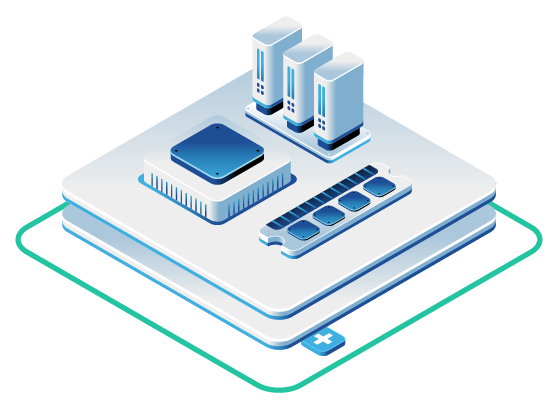



















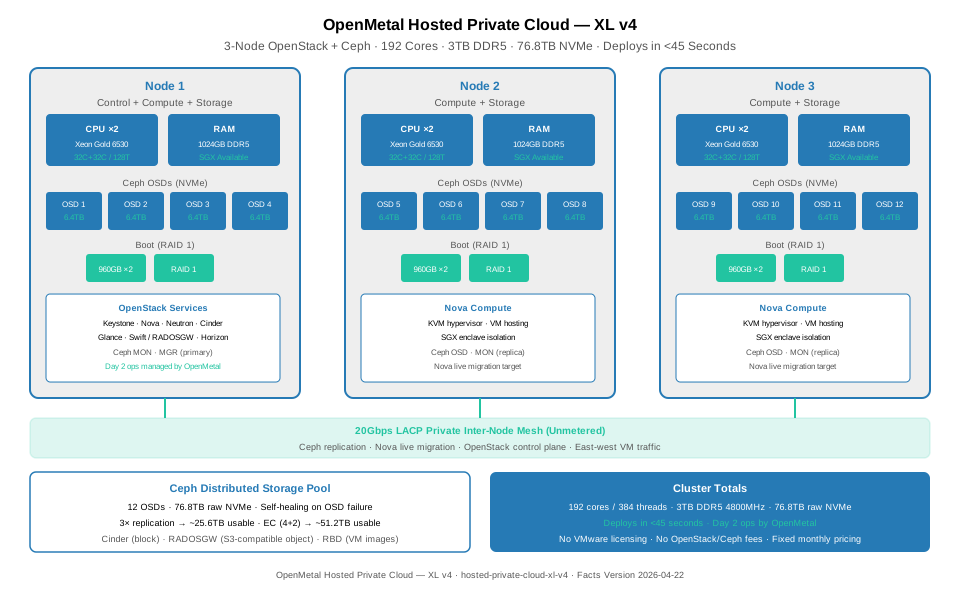
The OpenMetal Hosted Private Cloud XL v4 is a three-node OpenStack and Ceph cluster, each node running dual Intel Xeon Gold 6530 processors with 1TB DDR5 4800MHz RAM and 25.6TB of Micron 7500 MAX NVMe. Across the cluster, that is 192 physical cores, 3TB of pooled RAM, and 76.8TB of raw NVMe delivered through Ceph’s distributed storage layer — deployed in under 45 seconds via the OpenMetal control plane, with Day 2 operations handled by OpenMetal. There are no OpenStack licensing costs, no Ceph licensing costs, and no VMware fees. For teams running large-scale virtualization or multi-tenant SaaS on VMware, the XL v4 Hosted Private Cloud provides the OpenStack API surface and Ceph storage architecture with a fraction of the operational overhead.
Key Takeaways
- 192 physical cores / 384 threads across 3 nodes — no vCPU oversubscription at the hypervisor level; VM cores map to physical cores on dedicated hardware
- 3TB DDR5 4800MHz pooled RAM with Ceph distributed storage across 76.8TB raw NVMe — supports large-scale multi-tenant VM fleets, CI/CD infrastructure, and data-intensive OpenStack workloads
- Deploys in under 45 seconds via the OpenMetal control plane — full OpenStack + Ceph cluster with Horizon dashboard, OpenStack API, and S3-compatible object storage available immediately
- Day 2 operations included — OpenMetal monitors, alerts, and maintains the OpenStack and Ceph platform layer; customers manage workloads, not platform infrastructure
- No licensing overhead — no VMware vSphere, no NSX, no vSAN fees; OpenStack and Ceph are fully open source with no per-VM or per-socket licensing
Cluster Configuration
| Component | Per Node | Cluster Total (3 Nodes) |
|---|---|---|
| Processor | 2x Intel Xeon Gold 6530 | 6x Intel Xeon Gold 6530 |
| Cores / Threads | 64 / 128 | 192 / 384 |
| Memory | 1024GB DDR5 4800MHz ECC | 3072GB (3TB) DDR5 |
| Data NVMe | 4x 6.4TB Micron 7500 MAX | 12x 6.4TB (76.8TB raw) |
| Boot Drives | 2x 960GB RAID 1 | — (per node) |
| Private Network | 20Gbps LACP | 20Gbps inter-node mesh |
| Public Bandwidth | 6 Gbps | 6 Gbps (shared cluster uplink) |
| TDX | Bare metal only (not an HPC/OpenStack guest) | Available on all individual bare metal nodes |
| Pricing | Fixed monthly — see openmetal.io/cloud-deployment-calculator | |
Ceph pools the 76.8TB of raw NVMe across all three nodes. Usable capacity depends on Ceph replication factor: at 3x replication, usable capacity is approximately 25.6TB; at erasure coding (4+2), approximately 51.2TB. OpenMetal configures the replication policy at deployment.
What OpenMetal Manages
- Ceph cluster health monitoring — OSD status, pool utilization, replication health, recovery operations
- OpenStack platform updates — controller upgrades, API endpoint maintenance, Horizon dashboard updates
- Alerting and incident response — OpenMetal monitors platform-level events and responds to infrastructure alerts; application-level monitoring remains the customer’s responsibility
- Network configuration — VLAN provisioning, floating IP management, security group defaults
- Storage management — Ceph pool configuration, capacity planning, OSD replacement coordination
Customers retain full control of the OpenStack API, Horizon dashboard, VM lifecycle, project/tenant management, network topology, and all workloads running on the cluster.
OpenStack API and Horizon Access
- Nova — VM lifecycle management (create, resize, snapshot, migrate)
- Neutron — software-defined networking, VLANs, floating IPs, security groups
- Cinder — block storage volumes backed by Ceph RBD
- Swift / RADOSGW — S3-compatible object storage via Ceph RADOS Gateway
- Glance — VM image registry for custom and pre-built images
- Keystone — multi-tenant identity and access management
- Horizon — web-based dashboard for VM, storage, and network management
The OpenStack API is fully compatible with OpenStack SDK, Terraform (OpenStack provider), Ansible (OpenStack modules), and Pulumi. Infrastructure-as-code workflows that target the OpenStack API require no modification when moving from other OpenStack deployments to OpenMetal.
Ceph Storage Architecture
Ceph distributes the 76.8TB of NVMe storage across all three nodes. Each node contributes four Micron 7500 MAX OSDs; Ceph monitors (MONs) and managers (MGRs) run on the controller node with automatic failover. The storage cluster self-heals on OSD failure — if a single drive fails on any node, Ceph redistributes data from the remaining OSDs without manual intervention.
The Micron 7500 MAX provides 1.1M random read IOPS and 400K random write IOPS per OSD. Across 12 OSDs, the cluster delivers aggregate NVMe throughput appropriate for high-density VM storage — database volumes, container persistent storage, and CI/CD artifact stores all run on the same Ceph pool with quality-of-service controls available through Cinder volume types.
S3-compatible object storage is available via RADOS Gateway (RADOSGW) without additional software. Bucket creation, access key management, and lifecycle policies follow the S3 API — tools that target AWS S3 work against OpenMetal’s RADOSGW endpoint without code changes.
VMware Migration
For teams running VMware vSphere or VMware Cloud on AWS, the XL v4 Hosted Private Cloud provides a migration path that eliminates per-socket and per-VM licensing overhead.
| VMware | OpenMetal HPC XL v4 |
|---|---|
| vSphere ESXi hypervisor | KVM (via OpenStack Nova) |
| vSAN distributed storage | Ceph RBD / RADOS |
| NSX-T network virtualization | Neutron + OVN |
| vCenter management | Horizon + OpenStack API |
| vSphere Licensing | None (OpenStack + Ceph are open source) |
| Per-socket/per-VM fees | None |
VM migration from VMware uses standard tools: virt-v2v for offline migration, or snapshot-based migration workflows via Glance image import. OpenMetal’s team provides migration guidance; ramp pricing is available for customers transitioning from an existing VMware deployment.
Networking
The three-node cluster connects via a 20Gbps LACP-bonded private mesh — inter-node traffic for Ceph replication, Nova live migration, and OpenStack control plane communication runs on this unmetered private fabric. Each node contributes 20Gbps to the east-west mesh, providing sufficient bandwidth for Ceph’s replication writes even under heavy storage load.
Public egress is billed on the 95th-percentile model across the cluster’s shared 6Gbps public uplink. Multi-VM workloads that produce bursty public traffic — batch jobs, scheduled exports, API endpoints — do not accumulate per-GB egress charges for isolated burst events.
Security and Confidential Computing
Intel TDX is not available on the Hosted Private Cloud — it is supported on bare metal XL v4 servers only, not as OpenStack/Nova guests. Intel SGX enclaves (up to 128 GB EPC per node) are available at the base memory configuration on every cluster node for application-level confidential computing inside tenant VMs. For VM-level confidential computing (full Trust Domain isolation), pair the cluster with one or more bare metal XL v4 TDX servers on the same private network: confidential workloads run on the bare metal TDX servers, general workloads on the HPC cluster.
Intel SGX enclaves (up to 128GB EPC per node) are available alongside TDX for application-level confidential computing workloads.
HIPAA and Regulatory Compliance
OpenMetal is HIPAA compliant at the organizational level. For workloads involving protected health information, OpenMetal may be able to sign a Business Associate Agreement (BAA) with covered entities; BAA availability is confirmed with the OpenMetal sales team. The XL v4 Hosted Private Cloud is deployed across four locations. Ashburn is hosted at an NTT DATA facility holding HIPAA as a facility-operator certification, alongside SOC 1/2 Type II, ISO 27001, PCI DSS, and NIST 800-53 HIGH. Los Angeles (Digital Realty): SOC 2, SOC 3, ISO 27001, PCI DSS — HIPAA at that location is OpenMetal organizational-level only. Amsterdam (Digital Realty): SOC 1/2, PCI-DSS, ISO 27001, ISO 50001, ISO 22301. Singapore (Digital Realty): BCA Green Mark Platinum. Multi-tenant OpenStack environments running PHI should combine OpenMetal’s HIPAA BAA with SGX application-level enclaves on the cluster, plus bare-metal TDX servers for any VM-level trust-domain isolation, for the appropriate technical safeguard posture.
Recommended Workloads
Large-scale virtualization and VM hosting
The 192-core, 3TB RAM cluster comfortably hosts 100+ production VMs depending on per-VM sizing. Nova live migration moves VMs between nodes without downtime for maintenance or rebalancing. For MSPs and hosting providers, the multi-tenant project model in Keystone maps cleanly to customer accounts — each customer sees only their own VMs, networks, and storage volumes.
Kubernetes on OpenStack
Kubernetes clusters deployed on top of OpenStack Nova VMs use Cinder persistent volumes for pod storage and Neutron load balancers for service exposure. With 192 cores across the cluster, large Kubernetes node pools run without co-tenant interference. The OpenStack Magnum service, where available, can provision Kubernetes clusters directly from the OpenStack API.
CI/CD infrastructure
Jenkins, GitLab CI, GitHub Actions runners, and Buildkite agents deployed on OpenStack VMs benefit from on-demand VM provisioning that Nova provides. Ephemeral build VMs spin up, run a pipeline, and terminate — all within the fixed-cost billing model. Ceph object storage serves artifact repositories (container registries, package caches, build artifact stores) via the S3-compatible RADOSGW endpoint.
Multi-tenant SaaS platforms
SaaS providers that provision per-customer OpenStack projects get tenant isolation at the Keystone level and network isolation at the Neutron level. Application-level hardware isolation is available via Intel SGX enclaves inside tenant VMs; for VM-level hardware isolation, run those workloads on paired bare metal XL v4 TDX servers. The Ceph storage pool supports per-tenant volume quotas and QoS limits through Cinder volume types.
Data pipelines and analytics infrastructure
Apache Spark, Presto, and Kafka clusters deployed on OpenStack VMs use Ceph RBD volumes for persistent storage and RADOSGW for S3-compatible data lake storage. The 20Gbps inter-node mesh provides sufficient east-west bandwidth for Spark shuffle operations and Kafka replication. Fixed monthly pricing makes cost-per-query modeling straightforward compared to pay-per-use cloud analytics services.
Ready to Deploy an XL v4 Hosted Private Cloud?
Tell us about your workload — virtualization platform, Kubernetes cluster, CI/CD infrastructure, or VMware migration — and we’ll help you configure the right XL v4 cluster.
Get a XL v4 Hosted Private Cloud Quote Schedule a Consultation
Deployment Options
The XL v4 Hosted Private Cloud is available in Ashburn, Los Angeles, Amsterdam, and Singapore. Proof of Concept clusters are available for testing. Ramp pricing is available for migrations from VMware or other providers.
| Location | Region | Certifications | Location Page |
|---|---|---|---|
| Ashburn, VA | US-East | SOC 1/2 Type II, ISO 27001, PCI DSS, NIST 800-53 HIGH, HIPAA (facility) | Ashburn |
| Los Angeles, CA | US-West | SOC 2, SOC 3, ISO 27001, PCI DSS | Los Angeles |
| Amsterdam | EU-West | SOC 1/2, PCI-DSS, ISO 27001, ISO 50001, ISO 22301 | Amsterdam |
| Singapore | Asia | BCA Green Mark Platinum | Singapore |
→ Pricing: openmetal.io/cloud-deployment-calculator
Get a XL v4 Hosted Private Cloud Quote
Tell us about your infrastructure needs and we’ll provide a custom quote for the XL v4 Hosted Private Cloud.
- 3-node cluster: OpenStack + Ceph, 192 cores, 3TB RAM, 76.8TB NVMe, Day 2 ops included
- VMware migration: Ramp pricing and migration guidance available
- Custom node counts: Larger clusters available — contact OpenMetal
Ramp pricing available for migrations. All deployments include fixed monthly pricing, 99.96%+ network SLA, and DDoS protection.
Product specifications, pricing, and availability may change due to market conditions and other factors. For the most current information, please contact the OpenMetal team directly.