




















The XL v5 is OpenMetal’s flagship dual-socket bare metal server, replacing the Emerald Rapids-based XL v4 with Intel’s Granite Rapids platform on the Intel 3 process node. Built around two Xeon 6530P processors and 1 TB of DDR5-6400 memory (16 of its 32 DIMM slots populated), it is TDX-capable at its base configuration — you enable Intel TDX confidential computing in the server BIOS following OpenMetal’s documentation, no RAM upgrade required. Like every OpenMetal server, it is a single-tenant dedicated host on a fixed monthly price with no shared CPU steal, no metered egress per gigabyte, and no hypervisor overhead unless you install one.
Key Takeaways
- 64 physical cores / 128 threads at DDR5-6400 drive heavy multi-tenant SaaS, large PostgreSQL or MySQL primaries, and dense Proxmox / KVM virtualization clusters without the noisy-neighbor variance of shared cloud instances.
- Intel TDX capable at base (enable in BIOS) because it ships at 1 TB (16x 64 GB across 16 of its 32 DIMM slots) — regulated financial, healthcare, and sovereign workloads can launch trust domains once you enable TDX in the server BIOS, with Intel SGX available at the base memory configuration for narrower enclave use cases.
- 25.6 TB of persistent Micron 7500 MAX NVMe (Gen4, 232-layer 3D TLC) backed by a separate RAID 1 boot pair, so reboots, kernel updates, and OS rebuilds never put data at risk and storage cost is included in the monthly rate.
- 20 Gbps private mesh by default (2x 10 Gbps LACP), upgradeable to 40 Gbps (4x 10 Gbps) between all OpenMetal servers in a region, with east-west traffic free between VLANs — the same fabric used by every Hosted Private Cloud cluster.
- 95th-percentile public egress billing instead of per-GB metering, with a 99.96% network SLA and DDoS protection included on every server.
- Fixed monthly pricing with multiple year price locks and ramp pricing for migrations from public cloud or VMware. See current pricing at openmetal.io/bare-metal-pricing.
Server Configuration at a Glance
| Component | Specification |
|---|---|
| Processor | 2x Intel Xeon 6530P (Granite Rapids, P-core) |
| Architecture | Granite Rapids, Intel 3 process node |
| Total Cores / Threads | 64 cores / 128 threads |
| Base / Max Turbo Frequency | 2.3 GHz base / 4.1 GHz max turbo |
| L3 Cache | 144 MB shared |
| TDP | 225 W per processor |
| Memory | 1024 GB DDR5-6400 (16 of 32 DIMM slots, 1 DPC); upgradeable to 2 TB with stocked 64 GB RDIMMs, 4 TB maximum with special-order 128 GB RDIMMs at longer lead |
| Boot Storage | 2x 960 GB NVMe in RAID 1 (mirrored, isolated from data drives) |
| Data Storage | 4x 6.4 TB Micron 7500 MAX U.3 NVMe (25.6 TB raw) |
| Max Drive Bays | 12 |
| Private Bandwidth | 20 Gbps default (2x 10 Gbps LACP); 40 Gbps optional (4x 10 Gbps), a v2+ upgrade |
| Public Bandwidth | 6 Gbps |
| PCIe | PCIe 5.0, 88 lanes per processor |
| Confidential Computing | Intel TDX capable at base (enable in BIOS); Intel SGX available at base memory config; TME-MK active |
| Pricing | Fixed monthly — see openmetal.io/bare-metal-pricing. |
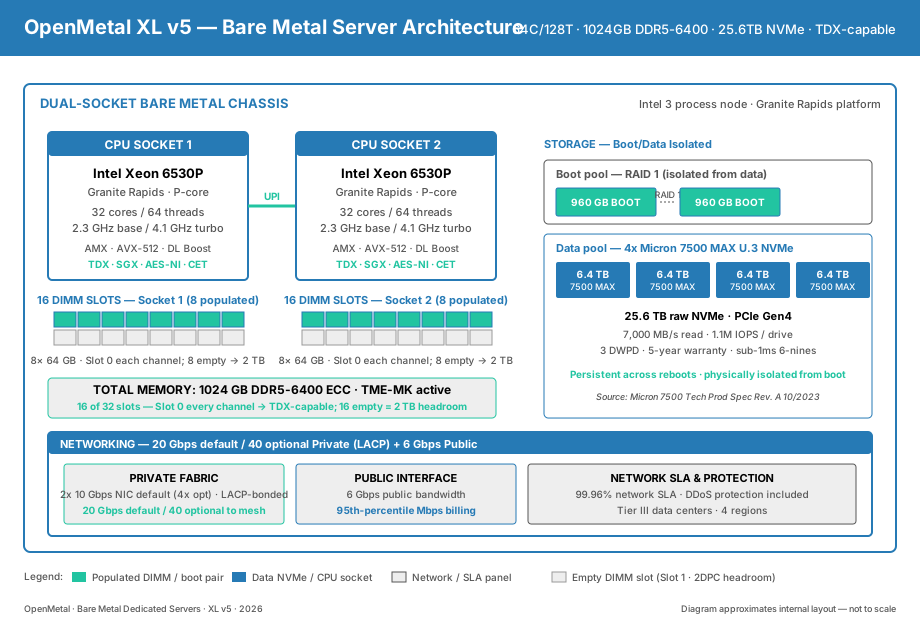
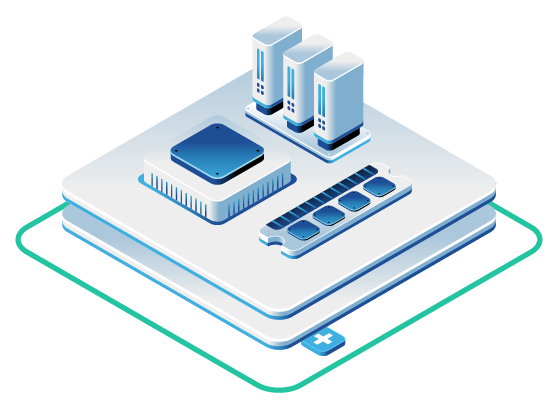
Component architecture diagram for the XL v5.
Ready to Deploy a XL v5?
Tell us about your workload and we’ll help you configure the right deployment — bare metal or Hosted Private Cloud, in any of our four data center regions.
Processor
The XL v5 uses two Intel Xeon 6530P processors from the Granite Rapids P-core family, fabricated on Intel 3. Each socket delivers 32 P-cores at a 2.3 GHz base clock with 4.1 GHz max turbo — 64 physical cores and 128 hyperthreads per server. Granite Rapids moves to a chiplet design with significantly more memory bandwidth than the Emerald Rapids 6530 in the XL v4, which translates directly into faster in-memory database scans, faster Spark shuffles, and lower tail latency at high QPS on PostgreSQL or MySQL.
OpenMetal exposes the BIOS and full root access on every XL v5 — you can pin cores, disable hyperthreading, enable Speed Select profiles, or configure NUMA balancing without filing a ticket. The P-core ISA includes AMX, AVX-512, AES-NI, and DL Boost, which matters for vectorized math, in-CPU TLS termination at line rate, and INT8 inference workloads that would otherwise need a GPU. PCIe 5.0 lanes feed both the NVMe data drives and the network NICs (two 10 Gbps by default, four when upgraded to 40 Gbps), so storage and network bandwidth don’t compete on the same PCIe budget.
Memory
The XL v5 ships with 1024 GB of DDR5-6400 ECC memory, populated across 16 of its 32 DIMM slots (8 channels per socket, 1 DIMM per channel). DDR5-6400 is a meaningful step over the XL v4’s DDR5-4800 — the additional bandwidth is what makes 64 cores actually usable on bandwidth-bound workloads like in-memory analytics, large KVM tenancy with many active VMs, or graph databases that thrash L3.
The XL v5 ships at 1 TB by design – it is the threshold that makes the server TDX-capable at its base configuration (you enable TDX in the server BIOS). RAM is expandable, not fixed. Populating the second DIMM per channel (all 32 slots with stocked 64 GB RDIMMs) reaches 2 TB. The maximum is 4 TB, which uses special-order 128 GB RDIMMs and carries a longer lead time. One trade-off is worth planning around: filling the second DIMM per channel puts the platform at 2 DPC, where memory negotiates down to DDR5-5200 from the DDR5-6400 of the 1 TB base configuration, so the maximum-capacity build is not the maximum-bandwidth build. Memory pricing and lead time move with the memory market and are quoted at the time of order. ECC is on by default and is mandatory for production VM density, OLTP durability, and any regulated workload where a single-bit error must be corrected and logged rather than silently propagated. TME-MK is active across all installed DIMMs, providing AES-XTS encryption of memory contents at the hardware level — independent of TDX trust domains.
Storage
Boot and data isolation
Micron 7500 MAX data drives
OpenMetal physically separates boot drives from data drives on every server — the XL v5 is no exception. Two 960 GB NVMe drives are configured in a RAID 1 mirror for the operating system, fully isolated from the data drive pool. This means a kernel panic, a botched grub update, or a forced re-image of the OS does not touch your data; conversely, a data drive failure does not stall the OS. Most commodity hosting providers and many cloud “metal” instances do not provide this separation.
The data tier is four Micron 7500 MAX U.3 NVMe SSDs at 6.4 TB each, for 25.6 TB raw. The 7500 MAX is built on Micron’s 232-layer 3D TLC NAND with a 6-plane independent wordline read architecture, rated Mixed-Use at 3 DWPD over a 5-year warranty.
| Metric | 6.4 TB Model |
|---|---|
| Sequential Read | 7,000 MB/s |
| Sequential Write | 5,900 MB/s |
| Random Read (4K) | 1,100,000 IOPS |
| Random Write (4K) | 400,000 IOPS |
| Mixed 70/30 (4K) | 650,000 IOPS |
| Read Latency (typ) | 70 μs |
| Write Latency (typ) | 15 μs |
| Endurance | 35,040 TBW (3 DWPD) |
| QoS | sub-1ms @ 99.9999% (6-nines) up to QD128 |
| Source | Micron 7500 Tech Prod Spec Rev. A 10/2023 |
Per-server raw NVMe IOPS at the rated mix reaches roughly 4.4 million 4K random reads, or about 2.6 million IOPS at the rated 70/30 mix — the kind of headroom that makes per-tenant noisy-neighbor problems disappear on Ceph OSD, ClickHouse, or PostgreSQL OLTP workloads.
Networking
The XL v5 connects to OpenMetal’s private fabric via two 10 Gbps NICs bonded with LACP for 20 Gbps of east-west bandwidth by default between every server in the region, upgradeable to four NICs for 40 Gbps (an option available on all v2+ hardware). Private VLAN traffic between your own servers and any Hosted Private Cloud cluster you own does not count toward billable egress — useful when running a database tier on bare metal and an application tier on Hosted Private Cloud in the same region. LACP also gives you link-level redundancy: a switch-side port failure does not drop the server.
Public-facing bandwidth is 6 Gbps, served from the same physical NICs with QoS. Every server includes the OpenMetal 99.96% network SLA and DDoS protection as part of the monthly rate, not as a paid add-on.
Egress pricing: 95th-percentile billing, not per-GB transfer.
Security and Confidential Computing
Intel TDX is capable at base on the XL v5. Because the server ships with 1 TB of DDR5 (16 of 32 slots populated), it meets Intel’s RAM threshold for trust domain allocation at its base configuration — no RAM upgrade or reconfiguration required, and you enable TDX in the server BIOS following OpenMetal’s Enabling Intel TDX on Bare Metal documentation. Trust domains run inside hardware-isolated, AES-encrypted memory regions with attestation, so the host hypervisor, host OS, and OpenMetal personnel cannot read trust-domain memory. Intel SGX is available at the base memory configuration for narrower enclave use cases such as key management, code-signing services, and small-attestation workloads where TDX’s whole-VM model is overkill. TME-MK provides multi-key hardware memory encryption across the rest of system memory regardless of whether a workload is running inside a trust domain.
Additional hardware-rooted security features active on the XL v5:
- AES-NI for in-CPU symmetric crypto acceleration (TLS, disk encryption, IPsec)
- Intel Boot Guard for measured boot and signed firmware verification
- Control-Flow Enforcement Technology (CET) for ROP / JOP mitigation in production workloads
- VT-x, VT-d, RDT, MBEC for hypervisor isolation, IOMMU passthrough, cache/memory bandwidth partitioning, and mode-based execution control
Recommended Workloads on the XL v5
Large PostgreSQL, MySQL, or SQL Server primaries
DDR5-6400 gives the XL v5 ~33% more memory bandwidth than the XL v4, which is exactly where large relational primaries bottleneck once the working set lives in RAM. The 25.6 TB of persistent Micron 7500 MAX NVMe sits on the same chassis as the database engine — no EBS round-trip, no per-IOPS metering, and 1.1M random read IOPS per drive at sub-1 ms QoS. Dedicated single-tenant hardware means no CPU steal and no noisy-neighbor variance during checkpoint flushes, vacuum, or replication catch-up.
Dense Proxmox, KVM, or OpenStack virtualization hosts
64 physical cores / 128 threads with ECC DDR5-6400 and full VT-x, VT-d, RDT, and MBEC support make the XL v5 a strong host for high-density KVM, Proxmox, or OpenStack compute nodes. Root + BIOS access lets you pin cores, disable hyperthreading per workload, configure NUMA balancing, or enable Speed Select profiles without filing a ticket. The private fabric (20 Gbps default, upgradeable to 40 Gbps) carries east-west VM traffic between hosts and any Hosted Private Cloud cluster you own in the same region — no per-GB egress billing on internal traffic.
Regulated and sovereign workloads on Intel TDX
Because the XL v5 ships with one 64 GB DIMM on every memory channel — Slot 0 populated across all 8 channels per socket, symmetric across both sockets, totalling 1 TB — it satisfies both of the conditions TDX depends on: the hardware baseline (full-channel population, ≥8 identical DIMMs per socket) and OpenMetal’s 1 TB production floor. No memory upgrade is therefore required — a single BIOS toggle (TDX + SGX) activates it, rather than the RAM upgrade the Medium and Large tiers need. The 16 unpopulated slots are the board’s second DIMM-per-channel — the platform is 2DPC-capable but runs at 1DPC to sustain DDR5-6400 — so they are capacity headroom toward 2 TB, or 4 TB with special-order 128 GB RDIMMs, not a confidential-computing prerequisite. Trust domains run inside hardware-isolated, AES-encrypted memory regions with attestation, so the host hypervisor, host OS, and OpenMetal personnel cannot read trust-domain memory. Intel SGX is available at the base memory configuration for narrower enclave use cases like HSM-style key management. Combined with OpenMetal’s org-level HIPAA + BAA across all four regions, the XL v5 is a fit for regulated financial, healthcare, and sovereign workloads.
Blockchain validators, archive nodes, and RPC endpoints
Validators and archive nodes need fast local NVMe for state, predictable monthly cost, and headroom for signature verification under load. The XL v5 delivers 25.6 TB of persistent NVMe on-chassis, AES-NI and SHA-NI acceleration for signature and hash workloads, and 95th-percentile egress billing instead of the per-GB metering that makes hot RPC endpoints expensive on public cloud. Fixed monthly pricing with multi year price locks gives validator operators a stable cost model for staking economics.
Kubernetes worker pools (Talos, Flatcar, K3s, Rancher)
64 cores and 1 TB of RAM per node is a comfortable footprint for high-density Kubernetes worker pools running stateful workloads, large JVM tenancy, or in-cluster CI runners. Full IPMI and BIOS access supports immutable OS distributions like Talos and Flatcar that PXE-boot from a signed image. Boot and data drive isolation means kernel updates and OS rebuilds never put persistent volumes at risk, and the private fabric (20 Gbps default, upgradeable to 40 Gbps) is sufficient headroom for Ceph RBD, Longhorn, or Rook backed by the on-chassis NVMe pool.
ML inference and AI-adjacent CPU workloads
Granite Rapids P-cores include Intel AMX, AVX-512, and DL Boost — meaningful acceleration for INT8 inference, vectorized retrieval, embedding pipelines, and small-model serving that would otherwise require a GPU. 1 TB of DDR5-6400 is enough RAM to hold large model weights in memory and feed many concurrent inference sessions, and the on-chassis NVMe gives low-latency access to vector indexes and feature stores. For workloads that need GPU acceleration, the XL v5 pairs cleanly with OpenMetal GPU Servers over the same private fabric (20 Gbps default, upgradeable to 40 Gbps).
Ready to Deploy a XL v5?
Tell us about your workload and we’ll help you configure the right deployment — bare metal or Hosted Private Cloud, in any of our four data center regions.
How the XL v5 Compares to Public Cloud
The closest AWS equivalents to the XL v5 by spec profile are m7i.metal-48xl (96 vCPU / 384 GB RAM, bare metal, EBS-only) and r7i.metal-48xl (96 vCPU / 1536 GB RAM, bare metal, EBS-only) for memory-heavy workloads. A persistent-NVMe match is i4i.metal (128 vCPU / 1024 GB RAM / 30 TB instance NVMe), though instance storage on AWS is ephemeral.
| Dimension | OpenMetal XL v5 | AWS m7i.metal-48xl (us-east-1) |
|---|---|---|
| Tenancy | Dedicated single-tenant | Dedicated single-tenant (metal) |
| Pricing model | Fixed monthly | On-demand / 1-yr RI / 3-yr RI |
| Egress | 95th-percentile Mbps | Per-GB metered |
| Storage included | 25.6 TB NVMe + boot RAID 1 | None — EBS purchased separately |
| Storage persistence | Persistent across reboots | EBS persistent; instance store (where included on other families) is ephemeral |
| Remote management | Full IPMI / iDRAC-class access | SSM only; no out-of-band BMC |
| Confidential computing | Intel TDX + SGX capable | Nitro Enclaves (different threat model) |
| HIPAA | Org-level + BAA across all 4 regions | Per-service eligibility + BAA required |
| Commitment | None; price lock available up to 5 yr | RI commitment for best price |
OpenMetal’s notes that bare metal becomes structurally cheaper than equivalent AWS instances above the $10k-20k per month spend threshold when egress is non-trivial; XL v5 typically lands well above that threshold for any continuous-load deployment.
What Changed from XL v4 to XL v5
Full comparison: For the complete XL v5 vs XL v4 spec-by-spec breakdown and guidance on which generation to choose, see OpenMetal XL v5 vs XL v4.
| Component | XL v4 | XL v5 | Improvement |
|---|---|---|---|
| CPU | 2x Intel Xeon Gold 6530 (Emerald Rapids) | 2x Intel Xeon 6530P (Granite Rapids) | New architecture, chiplet design |
| Process Node | Intel 7 | Intel 3 | 1 full node shrink |
| Cores / Threads | 64C / 128T | 64C / 128T | Same count, higher IPC and bandwidth |
| Base Frequency | 2.1 GHz | 2.3 GHz | +200 MHz base |
| Max Turbo | 4.0 GHz | 4.1 GHz | +100 MHz turbo |
| L3 Cache | 160 MB / CPU | 144 MB / CPU | -16 MB/CPU (offset by DDR5-6400 bandwidth) |
| TDP | 270 W / CPU | 225 W / CPU | -45 W/CPU (more efficient) |
| Memory Speed | DDR5-4800 | DDR5-6400 | +33% memory bandwidth |
| Memory Capacity | 1024 GB (16 DIMM populated) | 1024 GB (16 of 32 slots; 2 TB stocked, 4 TB maximum via special order) | Same base, faster DIMMs, more headroom |
| PCIe | PCIe 5.0 (80 lanes / CPU) | PCIe 5.0 (88 lanes / CPU) | Same generation |
| Storage Drive | Micron 7500 MAX (PCIe Gen4) | Micron 7500 MAX (PCIe Gen4) | Same drive |
| TDX | Capable at base (enable in BIOS) | Capable at base (enable in BIOS) | Unchanged |
The headline upgrade from XL v4 to XL v5 is the Granite Rapids architecture on Intel 3 plus the move from DDR5-4800 to DDR5-6400 — a roughly 33% jump in raw memory bandwidth on the same core count, which is exactly where bandwidth-bound workloads (in-memory DB, KVM density, Spark / ClickHouse / Trino) were bottlenecked on XL v4.
XL v5 Deployment Options
Bare Metal Dedicated Server
→ View pricing: openmetal.io/bare-metal-pricing
Hosted Private Cloud (XL v5 Cloud Core)
The XL v5 is also available as the compute foundation for a Hosted Private Cloud cluster — three XL v5 servers pre-configured as an OpenStack + Ceph cluster, with Day 2 operations (OpenStack version upgrades, Ceph health, security patching, hardware replacement) handled by OpenMetal SRE. The cluster runs Nova, Cinder, Neutron, and Ceph on the same hardware described above; tenants get a full OpenStack API plus Horizon UI for self-service VM, volume, network, and object storage provisioning. Additional XL v5 nodes (or smaller Standard / Large nodes) can be added to scale compute or storage independently.
→ Cluster pricing: openmetal.io/hosted-private-cloud-pricing
All deployments: available across OpenMetal’s Tier III data center locations. Fixed monthly pricing applies regardless of utilization. No per-hour, per-query, or per-GB billing.
Get a XL v5 Quote
Tell us about your infrastructure needs and we’ll provide a custom quote for the XL v5 — as a standalone bare metal server or as part of a Hosted Private Cloud cluster.
- Bare metal: Single-server or multi-server deployments with full root access and IPMI
- Hosted Private Cloud: Three-node OpenStack + Ceph clusters with Day 2 operations included
- Custom configurations: RAM upgrades, additional NVMe drives, TDX enablement
Ramp pricing available for migrations. All deployments include fixed monthly pricing, 99.96%+ network SLA, and DDoS protection.
Product specifications, pricing, and availability may change due to market conditions and other factors. For the most current information, please contact the OpenMetal team directly.