




















The XL v5 TDX Edition is the same physical server as the standard XL v5 — two Intel Xeon 6530P processors on Granite Rapids, 1 TB of DDR5-6400, 25.6 TB of Micron 7500 MAX NVMe — configured and documented for Intel Trust Domain Extensions (TDX) as the primary value proposition rather than as a feature. TDX is ready to enable in BIOS because the 1 TB memory configuration meets Intel’s threshold for trust domain allocation; Intel SGX is also active in parallel. The page that follows is written for engineers and architects evaluating bare metal for regulated, sovereign, or multi-tenant-SaaS workloads where attestable hardware isolation is a hard requirement.
Key Takeaways
- TDX-capable at deploy time — no RAM upgrade and no migration; you enable TDX in the server BIOS. Launch your first trust domain after enabling TDX in the server BIOS, following the OpenMetal SGX/TDX enablement guide.
- 64 P-cores at 2.3/4.1 GHz with AES-NI, AMX, AVX-512, and DL Boost inside trust domains — confidential computing without the per-thread performance penalty that plagued first-generation TEE implementations.
- 1 TB DDR5-6400 ECC with TME-MK — multi-key memory encryption across the platform plus per-TD encryption keys inside trust domains, so even memory outside a TD is encrypted at the hardware level.
- Boot and data drive isolation via separate RAID 1 boot pair (960 GB x 2) and 25.6 TB Micron 7500 MAX data pool — the attestation chain starts from a signed-firmware measured boot, not from a shared cloud image.
- HIPAA-compliant facility (Ashburn) + OpenMetal org-level HIPAA + BAA available — the regulated healthcare and financial path is paved.
- Fixed monthly pricing with multi-year price-lock available — predictable TCO for compliance budgets. See openmetal.io/bare-metal-pricing.
Server Configuration at a Glance
| Component | Specification |
|---|---|
| Processor | 2x Intel Xeon 6530P (Granite Rapids, P-core) |
| Architecture | Granite Rapids, Intel 3 process node |
| Total Cores / Threads | 64 cores / 128 threads |
| Base / Max Turbo Frequency | 2.3 GHz / 4.1 GHz |
| Memory | 1024 GB DDR5-6400 (16 of 32 DIMM slots, 1 DPC); expandable to 2 TB |
| Boot Storage | 2x 960 GB NVMe RAID 1 (isolated from data drives) |
| Data Storage | 4x 6.4 TB Micron 7500 MAX U.3 NVMe (25.6 TB raw) |
| Private Bandwidth | 20 Gbps default (2x 10 Gbps LACP); 40 Gbps optional (4x 10 Gbps), a v2+ upgrade |
| Public Bandwidth | 6 Gbps |
| Intel TDX | Capable at base (enable in BIOS) — no upgrade required |
| Intel SGX | Available at base — concurrent with TDX |
| TME-MK | Multi-key memory encryption across the platform |
| Hardware Security | AES-NI, Boot Guard, CET, VT-x / VT-d, RDT, MBEC |
| Attestation | Intel TDX attestation flow supported via OpenMetal guide |
| Confidential Computing | Trust domain isolation from hypervisor, host OS, and OpenMetal personnel |
| Pricing | Fixed monthly — see openmetal.io/bare-metal-pricing |
Why Intel TDX on the XL v5
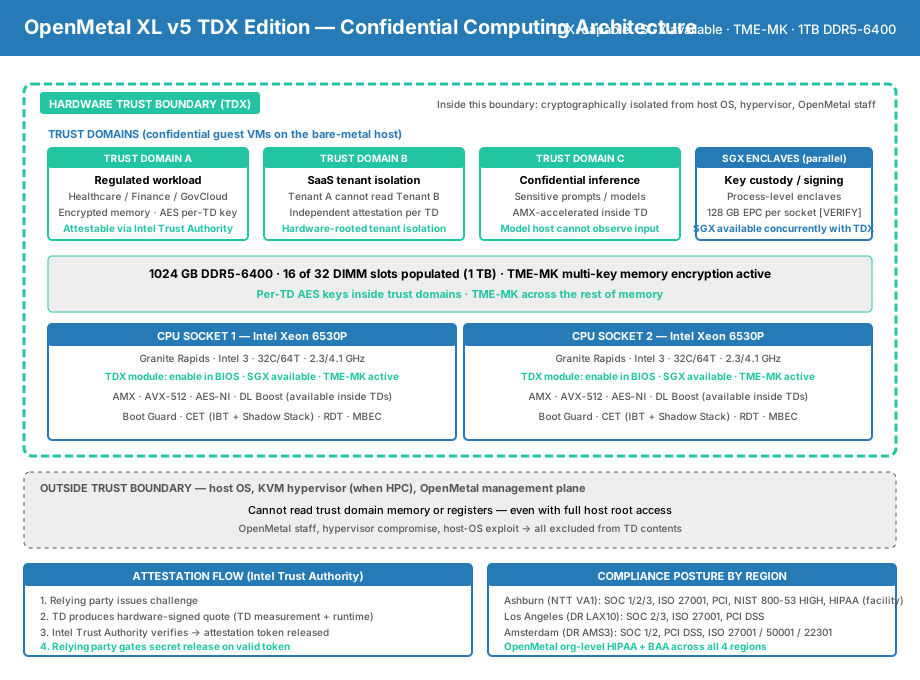
Trust Domain Extensions extend the Intel hardware security stack from process-level enclaves (SGX, capped at 128 GB EPC on this CPU) to whole-VM isolation. A trust domain runs an entire guest OS — Linux kernel, init, application stack — inside a memory region the host hypervisor and host OS cannot read or modify, with cryptographic attestation that the workload is running on genuine Intel hardware in a verified configuration.
The XL v5 is the OpenMetal SKU we expect TDX-driven engagements to land on for three reasons:
- TDX is active without a customer-side reconfiguration because the server ships at 1 TB (16 of its 32 DIMM slots populated) – the configuration Intel requires for trust domains. There is no RAM upgrade, no scheduled maintenance window, no second deploy.
- Granite Rapids on Intel 3 closes the historical performance gap between TEE-resident workloads and bare-metal workloads. AMX, AVX-512, AES-NI, and DL Boost are all available inside trust domains, so confidential inference, confidential analytics, and confidential database workloads run at competitive throughput.
- OpenMetal is a single-tenant dedicated host — the threat model TDX defends against on hyperscalers (a multi-tenant hypervisor running your workload alongside an attacker’s) is already mitigated at the tenancy layer, and TDX is the additional defense for workloads where even OpenMetal personnel must be cryptographically excluded.
The XL v5 also runs Intel SGX in parallel. SGX enclaves (up to 128 GB EPC per socket on the 6530P depending on Granite Rapids SPS configuration) are the right tool for narrow, high-value secrets — HSM-class key custody, code-signing services, license token verification, small attested microservices — while TDX handles whole-application confidentiality.
Processor
The XL v5 TDX Edition uses the same Intel Xeon 6530P (Granite Rapids) configuration as the standard XL v5 — 64 cores, 128 threads, AMX, AVX-512, AES-NI, and DL Boost. For the full processor deep-dive, see the standard XL v5 page.
Memory
The XL v5 TDX Edition ships with the same 1 TB of DDR5-6400 ECC as the standard XL v5 — 16 × 64 GB placing one DIMM on every memory channel (Slot 0 filled on all 8 channels per socket, symmetric across both sockets). That full-channel population — not the capacity figure on its own — is what satisfies TDX’s hardware baseline, and the 1 TB total clears OpenMetal’s production-performance spec, so it is TDX-capable with no memory upgrade required, and you enable TDX in the server BIOS (the TDX+SGX toggle). The remaining 16 slots are the board’s second DIMM-per-channel: the platform is 2DPC-capable but runs at 1DPC to hold full DDR5-6400, so those slots are capacity headroom toward 2 TB, not a TDX requirement. For the full memory deep-dive, see the standard XL v5 page.
Why 1 TB, not less: 1 TB matches the 2-socket / 16 × 64 GB platform Intel’s published TDX overhead figures are measured on, and leaves headroom for TDX metadata (PAMT, ~1/256 of RAM), NUMA-local memory, and running multiple Trust Domains — below it those overheads bite harder against a smaller usable envelope.
Storage
Boot and data isolation
Micron 7500 MAX data drives
The XL v5 TDX Edition uses the same boot and data drive layout as the standard XL v5 — 2x 960 GB NVMe in RAID 1 for boot, isolated from 4x 6.4 TB Micron 7500 MAX U.3 NVMe (25.6 TB raw) for data. The measured-boot chain that anchors TDX attestation starts on the boot RAID pair. For full Micron 7500 MAX performance specs, see the standard XL v5 page.
Networking
The XL v5 TDX Edition shares the same private fabric as the standard XL v5 (20 Gbps by default via 2x 10 Gbps LACP, upgradeable to 40 Gbps via 4x 10 Gbps) plus 6 Gbps public bandwidth as the standard XL v5, with 95th-percentile egress billing and 99.96% network SLA. For the full networking deep-dive, see the standard XL v5 page.
Egress pricing: 95th-percentile billing, not per-GB transfer.
Public-facing bandwidth is metered at the 95th-percentile rate, not by raw gigabytes transferred — a structurally cheaper model than per-GB hyperscaler egress for sustained workloads.
Security and Confidential Computing
The XL v5 TDX configuration has the full Granite Rapids hardware security stack active. Each layer addresses a different threat model:
| Layer | Hardware Feature | What it protects against |
|---|---|---|
| Firmware integrity | Intel Boot Guard (measured boot) | Tampered firmware, persistent rootkits |
| Memory confidentiality (platform) | TME-MK (multi-key AES-XTS) | Cold-boot attacks, DRAM physical extraction |
| VM-level confidentiality | Intel TDX (active) | Hypervisor compromise, host-OS compromise, OpenMetal operator access |
| Enclave-level confidentiality | Intel SGX (active) | Application-level secret extraction, root signing key exfiltration |
| Cryptographic acceleration | AES-NI | Side-channel cost of in-software crypto |
| Control-flow integrity | CET (IBT + Shadow Stack) | ROP / JOP exploit chains |
| Mode-based execution control | MBEC + VT-x / VT-d | Guest-to-host escapes, DMA attacks |
| Cache / memory partitioning | RDT | Cache-timing side-channels between tenants |
Configuration guidance, attestation flow, and verification commands are documented in the OpenMetal SGX/TDX enablement guide.
HIPAA and Regulatory Compliance
OpenMetal is HIPAA compliant at the organizational level. For workloads involving protected health information, OpenMetal may be able to sign a Business Associate Agreement (BAA) with covered entities; BAA availability is confirmed with the OpenMetal sales team. Trust domains do not change OpenMetal’s HIPAA posture; they strengthen the technical controls that support it. Facility-level certifications applicable to XL v5 TDX deployments:
- Ashburn, VA (NTT DATA VA1): SOC 1/2/3, ISO 27001, PCI DSS, NIST 800-53 HIGH, HIPAA (facility-level) — preferred site for federally regulated and HIPAA-covered TDX workloads.
- Los Angeles, CA (Digital Realty LAX10): SOC 2/3, ISO 27001, PCI DSS. HIPAA workloads here rely on OpenMetal’s org-level posture and the BAA.
- Amsterdam (Digital Realty AMS3): SOC 1/2, PCI DSS, ISO 27001 / 50001 / 22301 — appropriate for EU sovereign and GDPR-sensitive TDX workloads.
- Singapore (Digital Realty SIN10): BCA Green Mark Platinum — appropriate for APAC-localized TDX workloads.
For PCI DSS Level 1 merchants, any of the four sites supports the underlying facility cert; TDX adds an attestable application-layer protection on top.
Attestation and Operational Model
TDX is only as useful as its attestation flow. On the XL v5, the supported attestation path uses Intel Trust Authority (formerly Project Amber) as the verifier, with the OpenMetal-provisioned platform delivering quotes from the TDX module. The standard operational pattern looks like:
- A relying party (your application, an enterprise customer’s API gateway, a compliance auditor) issues a challenge.
- The trust domain on the XL v5 produces a quote that includes a measurement of the TD’s initial state, a measurement of the runtime memory, and a hardware-rooted signature.
- The relying party submits the quote to Intel Trust Authority, which returns a verifiable attestation token.
- The relying party gates the release of secrets, the routing of requests, or the unsealing of data on a valid attestation token.
OpenMetal does not gate access to attestation infrastructure or charge per-attestation — the SGX/TDX enablement guide provides the configuration for the Intel-provided flow, and customers can also integrate alternative verifiers (custom attestation services, Trustee, third-party RA-TLS implementations).
Recommended Workloads on the XL v5 TDX Edition
Regulated financial services
Confidential trading models, customer PII processing, KYC pipelines, and proprietary risk engines that cannot run on shared multi-tenant cloud infrastructure. Trust domain attestation gives compliance and risk teams a cryptographic answer to “prove this code ran on hardware you control” — something AWS Nitro Enclaves can answer in their own threat model, but with a different architecture and a different feature set. The XL v5’s NVMe persistence, fixed pricing, and 95th-percentile egress also make sustained data pipelines (market data fan-out, end-of-day batch) economically viable.
Healthcare PHI and protected research
HIPAA-eligible workloads benefit from the combination of OpenMetal’s org-level HIPAA and the Ashburn facility’s facility-level HIPAA certification. Trust domains give a third layer: even an OpenMetal operator with physical or hypervisor-level access cannot read PHI inside an active TD. For genomics pipelines and federated learning across hospital networks, the 64 cores + 1 TB RAM are enough to host substantial datasets in encrypted memory without spilling to disk.
Multi-tenant SaaS with cryptographic tenant isolation
SaaS providers selling into regulated industries (legal, financial, defense, healthcare) increasingly need to prove that tenant A’s data cannot be read by SaaS-vendor personnel — a security claim that requires hardware attestation, not just IAM and audit logs. Running each high-trust tenant inside its own trust domain on an XL v5 satisfies this claim. The 64-core / 128-thread count and 1 TB of RAM allow many trust domains per server, and Granite Rapids’ improved bandwidth keeps per-TD throughput acceptable even with high density.
Sovereign and government cloud
Sovereign clouds — national, regional, or sector-specific — need to demonstrate that workloads run on hardware physically present in a specific jurisdiction (Amsterdam for EU sovereignty, Singapore for APAC, Ashburn for US-based federal-adjacent) and that the host operator cannot read sovereign data. OpenMetal’s four data center regions plus active TDX on XL v5 is one of the more direct combinations of those requirements available outside the hyperscalers’ GovCloud SKUs.
Confidential key management and code-signing infrastructure
The combination of TDX + SGX on the same server lets you keep root signing keys in small SGX enclaves while running the broader key-management application (vault frontend, audit logging, request orchestration) inside a trust domain. This collapses what would otherwise be a multi-server architecture (HSM appliances + signing servers + KMS frontend) into a single bare-metal footprint with hardware-rooted attestation end-to-end.
Confidential AI inference
For inference workloads that handle sensitive prompts (legal contracts, medical notes, financial documents, customer support transcripts), running inference inside a trust domain prevents the model host from observing input data. Granite Rapids’ AMX makes INT8 transformer inference fast enough on CPU that a TDX-protected inference endpoint is a credible alternative to a GPU-backed endpoint that lacks comparable hardware confidentiality guarantees.
Ready to Deploy a XL v5 TDX Edition?
Tell us about your workload and we’ll help you configure the right deployment, in any of our four data center regions.
How the XL v5 TDX Edition Compares to Public Cloud
The closest hyperscaler equivalents for confidential computing are AWS Nitro Enclaves (process-level isolation, different architecture from TDX), Azure Confidential VMs on Intel TDX (the most direct equivalent), and Google Cloud Confidential VMs. The structural differences that matter on OpenMetal XL v5:
| Dimension | OpenMetal XL v5 TDX | Azure Confidential VM (TDX) |
|---|---|---|
| Tenancy | Dedicated single-tenant bare metal | Multi-tenant hypervisor with TDX guest isolation |
| Hardware control | Full BIOS + IPMI | None |
| Storage | 25.6 TB NVMe persistent, included | Managed Disk purchased separately |
| Pricing | Fixed monthly, price lock available | Per-hour / per-minute metered |
| Egress | 95th-percentile Mbps | Per-GB metered |
| Attestation flow | Intel Trust Authority via OpenMetal guide | Azure Attestation service |
| TDX cost premium | None (no confidential-VM SKU premium) | Confidential VM SKU price premium |
| HIPAA | Org-level + BAA across 4 regions | Per-service eligibility |
| Commitment | None or 5-year price lock at customer option | Reserved Instance for best pricing |
A more detailed AWS / Azure / GCP confidential-computing comparison is in the standard XL v5 cloud comparison page; the TDX-specific takeaway is that OpenMetal does not charge a premium for TDX because the server already meets the hardware threshold by default.
XL v5 TDX Edition Deployment Options
Single bare metal server (default)
A single XL v5 with TDX enabled, full IPMI, and root access. Appropriate for a confidential application that runs on one server, for a confidential development / staging environment, or for a tightly-scoped regulated workload (e.g., a single trading engine, a single signing service).
Multi-server confidential bare metal
Multiple XL v5 servers on the same private VLAN, with east-west traffic between trust domains protected by the LACP-bonded private mesh. Multi-server topology is appropriate for HA pairs, sharded confidential databases, and federated multi-party computation workloads.
Where to deploy
Deploy in Ashburn (preferred for HIPAA-covered TDX workloads), Los Angeles, Amsterdam (preferred for EU sovereign workloads), or Singapore (preferred for APAC localization). All sites can support TDX on XL v5 hardware. Proof of Concept clusters are available for testing TDX attestation flow before commitment.
→ View pricing: openmetal.io/bare-metal-pricing
Get a XL v5 TDX Edition Quote
Tell us about your infrastructure needs and we’ll provide a custom quote for the XL v5 TDX Edition — as a standalone bare metal server. Intel TDX is bare-metal-only; for general workloads, pair it with a Hosted Private Cloud cluster running SGX enclaves on each node.
- Bare metal: Single-server or multi-server deployments with full root access and IPMI
- Custom configurations: RAM upgrades, additional NVMe drives, TDX enablement
Ramp pricing available for migrations. All deployments include fixed monthly pricing, 99.96%+ network SLA, and DDoS protection.
Product specifications, pricing, and availability may change due to market conditions and other factors. For the most current information, please contact the OpenMetal team directly.