



















This configuration is no longer in the OpenMetal catalog. The XL v4 High Frequency was a high-clock variant we no longer stock or offer. The specifications below remain accurate for deployed units.
Sizing a new deployment? The Large v5 is the closest current equivalent: the same 32 cores / 64 threads at 3.2/4.2 GHz (versus 3.6/4.1 GHz on the retired part) with faster DDR5-6400 memory. If you need core count rather than per-core clock, see the XL v5 (64C/128T).
The XL v4 High Frequency is OpenMetal’s dedicated bare metal server for latency-sensitive workloads that need maximum clock speed over maximum thread count. Powered by dual 5th Gen Intel Xeon Gold 6544Y processors, it delivers a 3.6 GHz base clock and 4.1 GHz max turbo across 32 cores — at the same 1TB DDR5, 25.6TB NVMe configuration as the standard XL v4. Where the standard XL v4 (Gold 6530) is built for maximum parallelism at 64 cores and 2.1 GHz, the XL v4 High Frequency trades thread count for a 71% higher base clock, targeting workloads where per-thread execution speed determines outcome — not aggregate throughput.
Every XL v4 High Frequency server is TDX-capable at its base 1TB configuration (you enable TDX in the server BIOS following OpenMetal’s documentation), and Intel Speed Select Technology gives operators fine-grained control over active core count and power budget per deployment. OpenMetal provides dedicated tenancy with no resource sharing and fixed monthly pricing — no per-core licensing or burst fees.
Key Takeaways
- 3.6 GHz base clock, 4.1 GHz turbo: The Gold 6544Y sustains high single-thread frequency at full load — critical for tick processing, low-latency APIs, and real-time event streams where sub-millisecond response time matters.
- Intel Speed Select Technology: Three configurable profiles let operators reduce active core count and raise base frequency (up to 3.9 GHz at 8 cores per socket), dedicating compute resources to latency-critical threads without OS-level tuning.
- 4 high-priority cores per socket (3.7 GHz): Intel’s hardware-level core prioritization ensures designated threads receive preferential frequency allocation independent of system load.
- TDX-capable at base: Intel Trust Domain Extensions are available on all XL v4 High Frequency deployments at 1TB RAM; you enable TDX in the server BIOS to run hardware-isolated confidential computing.
- 25.6TB Micron 7500 MAX NVMe: Sub-millisecond storage latency (70 µs typ read, 15 µs typ write) aligns with the CPU’s latency profile — preventing storage from becoming the bottleneck in high-frequency workloads.
- Fixed monthly pricing, dedicated tenancy: No shared neighbors, no per-request billing surprises. See openmetal.io/bare-metal-pricing for current rates.
Server Configuration at a Glance
| Component | Specification |
|---|---|
| Processor | 2x Intel Xeon Gold 6544Y (Emerald Rapids, Intel 7) |
| Total Cores / Threads | 32C / 64T (16C/32T per socket) |
| Base / Max Turbo Frequency | 3.60 GHz / 4.1 GHz |
| High-Priority Cores | 4 per socket @ 3.7 GHz |
| L3 Cache | 45 MB per socket (90 MB total) |
| TDP | 270W per socket |
| Memory | 1TB (1024 GB) DDR5-5200 ECC, 16 DIMM slots |
| Boot Storage | 2x 960 GB SSD (RAID 1) |
| Data Storage | 4x 6.4 TB NVMe SSD (Micron 7500 MAX) = 25.6 TB |
| Max Drive Bays | 10 |
| Private Bandwidth | 20 Gbps (LACP bonded, 2x 10 Gbps) |
| Public Bandwidth | 6 Gbps |
| GPU | None |
| PCIe | PCIe 5.0, 80 lanes per processor |
| Confidential Computing | Intel TDX capable at base (enable in BIOS); Intel SGX available with Intel SPS |
| Pricing | Fixed monthly — see openmetal.io/bare-metal-pricing |
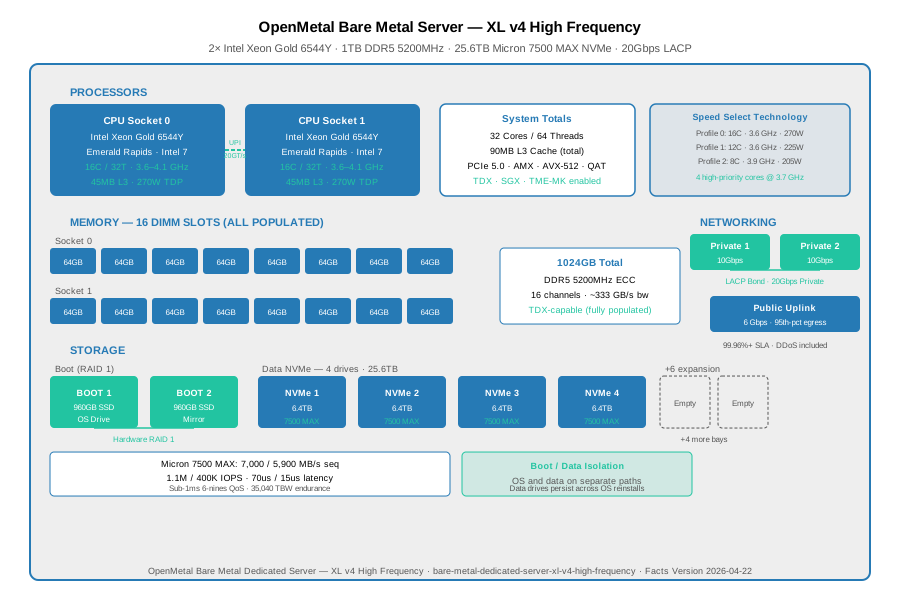
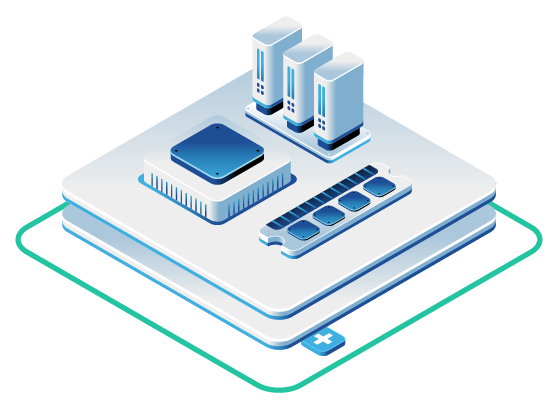
OpenMetal XL v4 High Frequency architecture: processor, memory, storage, and networking layers on dedicated bare metal.
Ready to Deploy a XL v4 High Frequency?
Tell us about your workload and we’ll help you configure the right deployment — bare metal or Hosted Private Cloud, in any of our five data center regions.
Processor: Intel Xeon Gold 6544Y, 32C, 3.6 GHz
The Gold 6544Y is a 5th Gen Intel Xeon Scalable processor (Emerald Rapids) built on Intel’s 7 process node, sharing the same FCLGA4677 socket and platform as the Gold 6530 used in the standard XL v4. The key architectural difference is the core-to-frequency trade-off: the 6544Y uses 16 cores per socket at 3.6 GHz base versus the 6530’s 32 cores at 2.1 GHz — a deliberate design for workloads where individual thread performance dominates.
Per socket, the 6544Y provides 45 MB of L3 cache, 80 PCIe 5.0 lanes, and three UPI links at 20 GT/s for socket-to-socket interconnect. Memory support runs to DDR5-5200 (versus DDR5-4800 on the 6530), a modest but measurable improvement for memory-bandwidth-constrained real-time applications.
Intel Speed Select Technology provides three factory-defined operating profiles:
| Profile | Active Cores (per socket) | Base Frequency | TDP |
|---|---|---|---|
| 6544Y (0) — Default | 16 | 3.6 GHz | 270W |
| 6544Y (1) | 12 | 3.6 GHz | 225W |
| 6544Y (2) | 8 | 3.9 GHz | 205W |
Profile 2 is particularly useful for trading systems and real-time DSP where a small number of threads must sustain the highest possible clock at reduced power draw. The 4 high-priority cores in each socket run at 3.7 GHz regardless of profile, providing hardware-enforced frequency guarantees for critical threads.
Additional ISA features enabled on the 6544Y include: Intel AMX (accelerator extensions for matrix workloads), AVX-512, Intel DL Boost, AES-NI hardware acceleration, Intel QuickAssist Technology, and TSX.
Memory: 1TB DDR5-5200 ECC
Each XL v4 High Frequency ships with 1TB (1024 GB) of DDR5-5200 ECC memory across 16 DIMM slots, populated at 8 slots per socket. DDR5-5200 provides a theoretical aggregate bandwidth of approximately 332.8 GB/s (8 channels × 8 bytes × 5200 MT/s × 2 sockets) — roughly 8% higher than the DDR5-4800 configuration of the standard XL v4 at the same capacity.
ECC support is standard at all DIMM configurations. For production workloads handling financial data, healthcare records, or persistent in-memory databases, ECC protects against single-bit memory errors without software overhead.
The 16 DIMM slots are fully populated at 1TB. The server is TDX-capable at this capacity; you enable TDX in the server BIOS for confidential computing deployments.
Storage: 25.6TB Micron 7500 MAX NVMe
Boot and data isolation
OpenMetal separates boot and data storage at the hardware level on every XL v4 High Frequency server. The two 960 GB boot SSDs run in RAID 1 for OS resilience, keeping operating system writes off the NVMe data tier. The four data NVMe drives are presented separately to the host for workload-exclusive I/O.
Micron 7500 MAX data drives
The data drives are Micron 7500 MAX 6400 GB U.3 NVMe SSDs (PCIe Gen4 x4, NVMe 2.0b), rated at mixed-use endurance (3 DWPD). Performance figures from the official Micron 7500 technical specification:
| Metric | 6.4 TB Model |
|---|---|
| Sequential read | 7,000 MB/s |
| Sequential write | 5,900 MB/s |
| Random read (4K) | 1,100,000 IOPS |
| Random write (4K) | 400,000 IOPS |
| Read latency (typical) | 70 µs |
| Write latency (typical) | 15 µs |
| Read latency (99th pct) | 80 µs |
| Write latency (99th pct) | 65 µs |
| Sub-1ms QoS | 99.9999% for 4KB random read at QD128 |
| Endurance | 35,040 TBW / 5-year warranty |
Storage latency at this tier is low enough to stay out of the critical path for most real-time data pipelines. For high-frequency trading systems writing order books to NVMe, the 15 µs typical write latency ensures persistent storage does not impose application-level latency above what the CPU and network introduce. The server supports up to 10 total drive bays for expansion.
Networking
The XL v4 High Frequency provides 20 Gbps of private bandwidth via two 10 Gbps ports bonded in LACP (Link Aggregation Control Protocol), and 6 Gbps of public bandwidth. Private bandwidth is dedicated to east-west traffic between servers — database replication, cluster synchronization, market data distribution — with no shared contention from other tenants.
LACP bonding provides both aggregate throughput and active-passive failover, giving production deployments link redundancy without additional configuration. For latency-sensitive workloads such as co-located matching engines or tick-to-trade pipelines, the private network carries time-critical inter-process messages while public bandwidth handles client-facing streams separately.
OpenMetal provides a network SLA of 99.96%+ uptime. All deployments include DDoS protection at the network layer.
Egress pricing: 95th-percentile billing, not per-GB transfer.
OpenMetal bills public egress on a 95th-percentile model rather than per-gigabyte transfer. The highest 5% of bandwidth samples are discarded before billing, so sustained burst traffic from market data feeds, API responses, or real-time streams does not spike the monthly egress bill. This contrasts with AWS and other public cloud providers that charge per GB transferred, which can make high-throughput, low-latency workloads cost-prohibitive at scale.
Security and Confidential Computing
The XL v4 High Frequency ships TDX-capable — you enable TDX in the server BIOS following OpenMetal’s Enabling Intel TDX on Bare Metal documentation. At 1TB DDR5, the full memory capacity is available for Trust Domain use, and Intel TDX allows operators to create hardware-isolated Trust Domains where virtual machine memory is encrypted and inaccessible to the hypervisor, other VMs, or the host OS. This is particularly relevant for financial institutions running proprietary algorithms or healthcare operators processing PHI in virtualized environments on shared infrastructure managed by a third party.
Intel SGX is also available on the 6544Y (with Intel SPS), supporting enclave-based confidential computing up to 128 GB EPC for applications requiring code and data confidentiality at a finer granularity than full-VM TDX. Intel TME-MK (Total Memory Encryption – Multi-Key) provides memory bus encryption for all DRAM, adding a hardware baseline protection layer independent of TDX or SGX activation.
Additional hardware security features:
- AES-NI hardware acceleration for cryptographic operations
- Intel Boot Guard for firmware integrity verification at boot
- Control-Flow Enforcement Technology (CET) for exploit mitigation
- Intel Resource Director Technology (RDT) for cache and memory bandwidth partitioning between tenants
- Intel Virtualization Technology (VT-x, VT-d) for hardware-enforced VM isolation
HIPAA and Regulatory Compliance
OpenMetal is HIPAA compliant at the organizational level. For workloads involving protected health information, OpenMetal may be able to sign a Business Associate Agreement (BAA) with covered entities; BAA availability is confirmed with the OpenMetal sales team. XL v4 High Frequency servers deployed in Ashburn are hosted in a HIPAA-certified facility (NTT DATA VA1); Los Angeles deployments are covered by OpenMetal’s organizational HIPAA compliance.
Facility certifications by location (attributed to facility operators, not OpenMetal):
| Location | Region | Facility Certifications |
|---|---|---|
| Ashburn, Virginia | US-East | SOC1 Type II, SOC2 Type II, ISO 27001, ISO 50001, PCI DSS, NIST 800-53 HIGH, HIPAA (NTT DATA) |
| Los Angeles, California | US-West | SOC2, SOC3, ISO 27001, PCI DSS (Digital Realty) |
| Amsterdam, Netherlands | EU-West | SOC1/SOC2, PCI-DSS, ISO 27001, ISO 50001, ISO 22301 (Digital Realty) |
| Singapore | Asia | BCA Green Mark Platinum (Digital Realty) |
Recommended Workloads on the XL v4 High Frequency
High-Frequency Trading and Financial Infrastructure
The Gold 6544Y’s 3.6 GHz base clock and Speed Select Technology make the XL v4 High Frequency a fit for co-located HFT systems where tick-to-trade latency is the primary constraint. Profile 2 (8 active cores, 3.9 GHz) reduces the active core footprint while pushing single-thread frequency higher — useful for matching engine threads that must process order book events in strict sequence. The 4 high-priority cores per socket provide hardware-guaranteed frequency headroom for critical threads without relying on OS scheduler hints.
For market data capture and time-series recording at high tick rates, the Micron 7500 MAX NVMe at 15 µs typical write latency and 400,000 random write IOPS provides persistent storage without introducing measurable pipeline stalls. Boot/data isolation keeps OS I/O completely separated from trade data writes. OpenMetal’s bare metal tenancy means no hypervisor overhead or noisy neighbors — the server runs your workload exclusively.
Real-Time Analytics and Low-Latency Query Engines
ClickHouse and Apache Druid deployments that serve sub-100ms analytical queries benefit from the XL v4 HF’s combination of high single-thread frequency and 25.6TB of local NVMe. Both engines are designed around vectorized execution with AVX-512 — the Gold 6544Y’s AVX-512 support and AMX extensions accelerate aggregations and matrix operations within each query thread.
For query-per-second workloads where concurrent queries are few but each query must complete quickly, the HF profile outperforms the standard XL v4’s higher core count. A single 3.9 GHz core completes more work per clock cycle than two 2.1 GHz cores when query execution is not parallelizable.
Time-Series Databases and IoT Event Processing
InfluxDB, TimescaleDB, and VictoriaMetrics deployments handling high-ingestion time-series data benefit from the XL v4 HF’s write performance. The Micron 7500 MAX’s 1.1M random read IOPS and 400K random write IOPS support high-cardinality time-series writes without batching delays, while the 3.6 GHz base clock sustains ingestion pipeline throughput under sustained load.
For IoT platforms processing sensor telemetry from thousands of devices with real-time alerting requirements, the XL v4 HF’s latency profile is preferable to the standard XL v4’s throughput profile. Alerting pipelines that evaluate trigger conditions on every ingested event benefit from high single-thread execution speed.
Low-Latency APIs and Application Servers
REST and gRPC APIs with strict p99 latency SLAs — fintech authorization services, payment processing backends, identity verification APIs — benefit from the XL v4 HF’s ability to sustain high per-thread frequency under concurrent load. Unlike public cloud burstable instances that throttle CPU credit under sustained load, the Gold 6544Y’s 3.6 GHz base is a guaranteed floor, not a burst ceiling.
Deploy latency-sensitive API tiers as bare metal to eliminate hypervisor jitter, then use the LACP-bonded 20 Gbps private network for fast inter-service communication to upstream databases and caches. For multi-server deployments, the XL v4 HF pairs well with the standard XL v4 (for batch processing) or a Hosted Private Cloud cluster (for OpenStack-managed compute).
Blockchain Validators and Node Infrastructure
Proof-of-stake validators (Ethereum, Solana, Cosmos) that participate in consensus rounds with strict timing windows benefit from predictable single-thread execution. Validator clients that fall behind on block processing due to CPU frequency throttling can miss attestation windows — the Gold 6544Y’s non-throttling base clock reduces this risk compared to burstable or shared cloud instances.
Archive nodes and RPC endpoints handling high request rates benefit from the NVMe storage tier: serving blockchain state from 7,000 MB/s sequential read and sub-80 µs latency NVMe eliminates the storage-side latency that dominates on HDD or cloud-backed block storage. Boot/data isolation allows the node operator to run the OS on mirrored boot SSDs while blockchain data lives entirely on the four dedicated NVMe drives.
CPU-Based ML Inference with Intel AMX
The Gold 6544Y includes Intel AMX (Advanced Matrix Extensions), which accelerates INT8 and BF16 matrix operations for deep learning inference without a GPU. For inference workloads where request latency matters more than batch throughput — real-time fraud detection, document classification, embedding generation — the XL v4 HF’s high single-core frequency reduces per-request inference time compared to higher-core-count processors running at lower clocks.
Intel DL Boost (VNNI) is also present, supporting INT8 inference for quantized models across all 32 cores. For training workloads requiring GPU acceleration, see OpenMetal GPU Servers.
Ready to Deploy a XL v4 High Frequency?
Tell us about your workload and we’ll help you configure the right deployment — bare metal or Hosted Private Cloud, in any of our five data center regions.
How the XL v4 High Frequency Compares to Public Cloud
For compute-intensive workloads requiring high frequency and large local NVMe, the closest AWS instance family is the z1d series (Intel Xeon Scalable, up to 4.0 GHz sustained all-core, local NVMe). The c7i and c6i families are also relevant comparisons for CPU-optimized workloads.
| Factor | AWS z1d.metal | OpenMetal XL v4 High Frequency |
|---|---|---|
| CPU | Intel Xeon Platinum 8151 @ up to 4.0 GHz | 2x Intel Xeon Gold 6544Y @ 3.6/4.1 GHz |
| Cores | 48 vCPUs | 32C/64T (dedicated, no sharing) |
| RAM | 384 GB | 1,024 GB DDR5-5200 |
| Local NVMe | 1.8 TB | 25.6 TB (4x 6.4 TB Micron 7500 MAX) |
| Tenancy | Shared (unless Dedicated Host) | Dedicated bare metal |
| Egress pricing | Per-GB transfer | 95th-percentile billing |
| Monthly cost | On-demand: ~$13,000+/month | Fixed monthly — see openmetal.io/bare-metal-pricing |
| Price lock | None (on-demand, spot, or 1-3yr Reserved) | Up to 5 years |
| TDX / confidential computing | Not available on z1d | Capable at base (enable in BIOS) |
| Management | Customer-managed with AWS tooling | Full root + IPMI, no vendor lock-in |
All AWS pricing and instance specifications can be checked at aws.amazon.com/ec2/pricing/on-demand/.
When public cloud is the better fit: If your HFT or latency workload requires elastic scaling (spinning up capacity on market open, releasing it at close), AWS Reserved Instances or Dedicated Hosts may be preferable to fixed monthly bare metal. AWS also offers deeper ecosystem integrations with managed services (ElastiCache, DynamoDB, Lambda) that bare metal requires self-managing. For event-driven or stateless workloads with unpredictable demand patterns, cloud elasticity is a genuine advantage.
XL v4 High Frequency Deployment Options
Bare Metal Dedicated Server
Deploy the XL v4 High Frequency as a standalone server with full root access, IPMI console, and dedicated hardware. No hypervisor layer, no shared tenancy. OpenMetal provisions pre-built OS images (Ubuntu, Rocky Linux, Debian) for immediate use; IPMI provides out-of-band access for bare OS installs or recovery operations.
Pricing is fixed monthly with no per-core licensing. Price locks are available for up to 5 years, and ramp pricing is available for migrations from AWS, Equinix Metal, or other providers — allowing the monthly cost to ramp up as workloads migrate rather than paying full price before migration completes.
→ View pricing: openmetal.io/bare-metal-pricing
Hosted Private Cloud
The XL v4 High Frequency is also available as a three-node OpenStack + Ceph cluster (Hosted Private Cloud). In this configuration, each node is an XL v4 High Frequency server, giving the cluster 96 physical cores, 3TB DDR5-5200, and 76.8TB NVMe. OpenMetal handles all Day 2 operations — patching, upgrades, monitoring — so your team focuses on workloads rather than infrastructure. Cluster deployment completes in under 45 seconds. No VMware licensing, no OpenStack licensing costs.
Deploy in Ashburn, Los Angeles, Amsterdam, Singapore, or the OpenMetal primary data center (Pod-0).
| Location | Region | Certifications | Location Page |
|---|---|---|---|
| Ashburn, Virginia | US-East | SOC1/2, ISO 27001, PCI DSS, NIST 800-53, HIPAA | Ashburn facility |
| Los Angeles, California | US-West | SOC2/3, ISO 27001, PCI DSS | Los Angeles facility |
| Amsterdam, Netherlands | EU-West | SOC1/2, ISO 27001, ISO 50001, PCI-DSS | Amsterdam facility |
| Singapore | Asia | BCA Green Mark Platinum | Singapore facility |
→ View pricing and configuration: openmetal.io/cloud-deployment-calculator
Both deployment paths: available across OpenMetal’s Tier III data center locations. Fixed monthly pricing applies regardless of utilization. No per-hour, per-query, or per-GB billing.
Get a XL v4 High Frequency Quote
Tell us about your infrastructure needs and we’ll provide a custom quote — as a standalone bare metal server or as part of a Hosted Private Cloud cluster.
- Bare metal: Single-server or multi-server deployments with full root access and IPMI
- Hosted Private Cloud: Three-node OpenStack + Ceph clusters with Day 2 operations included
- Custom configurations: Additional NVMe drives, TDX enablement verification, Speed Select profile configuration guidance
Ramp pricing available for migrations. All deployments include fixed monthly pricing, 99.96%+ network SLA, and DDoS protection.
Specifications, pricing, and availability are subject to change without notice. The information on this page is provided for general guidance and does not constitute a contractual commitment. Contact OpenMetal for current configuration details and pricing. AWS specifications and pricing are sourced from publicly available documentation and may not reflect current rates or configurations.