
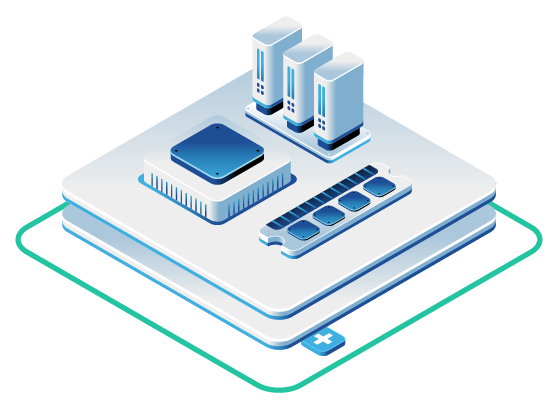



















The OpenMetal Medium v5 is the entry server in the v5 Granite Rapids lineup, built on dual Intel Xeon 6505P processors (Granite Rapids, Intel 3 process). It is the next version above the Medium v4 (Sapphire Rapids) with more than 2× the L3 cache per socket, 45% faster DDR5-6400 memory, and the Micron 7500 MAX NVMe generation. Every Medium v5 is deployed on hardware dedicated entirely to your workload: no shared tenancy, no noisy neighbors, full root access and IPMI.
Key Takeaways
- 24 dedicated cores / 48 threads across dual Xeon 6505P sockets with 96 MB total L3 cache – suited for containerized databases, mid-scale Kubernetes, and multi-threaded analytics that benefit from large per-core cache.
- Micron 7500 MAX 6.4 TB NVMe delivers 7,000 MB/s sequential read and 1.1M random read IOPS; expand to six drives (38.4 TB total) while boot/data isolation is maintained throughout.
- Boot and data drive isolation – two 960 GB NVMe boot drives in RAID 1 run the OS independently from data storage; a failed OS volume never touches workload data.
- 20 Gbps private bandwidth by default (2x 10 Gbps LACP), upgradeable to 40 Gbps (4x 10 Gbps) – east-west traffic between OpenMetal servers on the same customer VLAN is included and never metered.
- Intel TDX upgrade path – populate all 16 DIMM slots with 64 GB modules to reach 1 TB and activate TDX confidential computing; SGX with 128 GB EPC is available at the base memory configuration.
- Fixed monthly pricing, lockable up to 5 years – see openmetal.io/bare-metal-pricing.
Server Configuration at a Glance
| Component | Specification |
|---|---|
| Processor | 2x Intel Xeon 6505P (Granite Rapids, Intel 3) |
| Total Cores / Threads | 24 cores / 48 threads |
| Base / Max Turbo Frequency | 2.2 GHz base / 4.1 GHz max turbo |
| L3 Cache | 48 MB per socket (96 MB total) |
| TDP | 150 W per socket |
| Memory | 256 GB DDR5-6400 · 8 of 16 DIMM slots populated · upgradeable to 1 TB (stocked max; up to 4 TB special-order) |
| Boot Storage | 2x 960 GB NVMe (RAID 1) |
| Data Storage | 1x 6.4 TB Micron 7500 MAX NVMe |
| Max Drive Bays | 6 data drives (up to 38.4 TB) |
| Private Bandwidth | 20 Gbps default (2x 10 Gbps LACP); 40 Gbps optional (4x 10 Gbps), a v2+ upgrade |
| Public Bandwidth | 2 Gbps included |
| PCIe | Gen 5.0 · 88 lanes per processor |
| Confidential Computing | Intel TDX (via RAM upgrade to 1 TB) · Intel SGX (available at base memory config, 128 GB EPC) |
| Pricing | Fixed monthly – see openmetal.io/bare-metal-pricing |
Ready to Deploy a Medium v5?
Tell us about your workload and we’ll help you configure the right deployment — bare metal or Hosted Private Cloud, in any of our four data center regions.
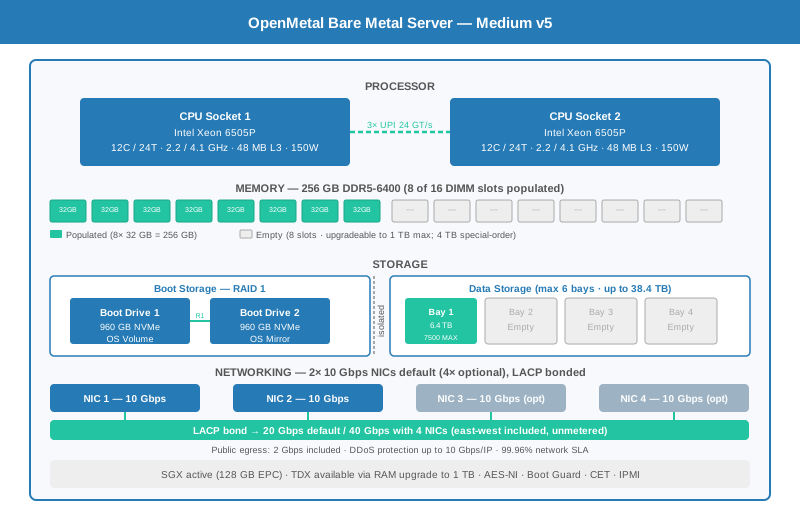
Hardware architecture overview for the Bare Metal Dedicated Server Medium V5
Processor
The Intel Xeon 6505P is part of Intel’s sixth-generation Xeon family (Xeon 6, Granite Rapids-AP), built on the Intel 3 process node. Each socket delivers 12 performance cores and 24 threads at 2.2 GHz base and 4.1 GHz max turbo, with 48 MB of L3 cache – more than twice the per-socket cache of the Xeon Silver 4510 used in the Medium v4.
PCIe 5.0 at 88 lanes per processor and 3 UPI links at 24 GT/s provide high-bandwidth connectivity across both sockets. The 6505P includes Intel AMX (Advanced Matrix Extensions) for matrix math acceleration in CPU-based ML inference, AVX-512 for vectorized compute workloads, and Intel DL Boost (VNNI) for INT8 inferencing without a GPU.
Memory
The Medium v5 ships with 256 GB of DDR5-6400 ECC RDIMM across eight memory channels per socket, with 8 of 16 DIMM slots populated using 32 GB modules. At 6,400 MT/s across 8 channels, peak per-socket memory bandwidth is approximately 409 GB/s – a 45% increase over the DDR5-4400 in the Medium v4. This is relevant for in-memory databases (Redis, Valkey, MySQL InnoDB buffer pool), workloads with many co-located memory-intensive containers, and vectorized compute pipelines that stream data through registers at high rates.
ECC provides single-bit error correction and double-bit error detection, a baseline requirement for production database and compliance workloads.
Eight DIMM slots remain open, providing upgrade paths to 512 GB (16× 32 GB), 1 TB (16× 64 GB) as the stocked maximum; up to 4 TB is possible with special-order 256 GB RDIMMs. The 1 TB level is the minimum required to activate Intel TDX confidential computing – see the Security section for details. RAM upgrades on deployed servers are available by contacting the OpenMetal team.
Storage
Boot and data isolation
OpenMetal separates boot and data storage at the hardware level on the Medium v5. The two 960 GB NVMe boot drives run in RAID 1, providing redundant OS storage that operates independently from the data bays. A failed boot drive does not interrupt running workloads or touch data volumes. See OpenMetal Boot Storage RAID 1 for configuration details.
Micron 7500 MAX data drives
The Medium v5 ships with one 6.4 TB Micron 7500 MAX in the first data bay. Up to five additional drives can be added for 38.4 TB raw NVMe capacity.
| Metric | 6.4 TB Model |
|---|---|
| Interface | PCIe Gen4, NVMe v2.0b |
| NAND | 232-layer 3D TLC (6-plane architecture with iWL) |
| Sequential Read | 7,000 MB/s |
| Sequential Write | 5,900 MB/s |
| Random Read (4 KB) | 1,100,000 IOPS |
| Random Write (4 KB) | 400,000 IOPS |
| Mixed 70/30 IOPS | 650,000 IOPS |
| Read Latency (typical) | 70 µs |
| Write Latency (typical) | 15 µs |
| Read Latency (99th pct) | 80 µs |
| Write Latency (99th pct) | 65 µs |
| QoS | Sub-1 ms at 99.9999% (6-nines) for 4 KB random read |
| Endurance | 35,040 TBW / 3 DWPD |
| MTTF | 2,000,000 hours (0–55 °C) |
| Warranty | 5 years |
Source: Micron 7500 NVMe SSD Tech Product Spec Rev. A 10/2023.
Networking
The Medium v5 ships with 20 Gbps of private bandwidth by default (two 10 Gbps NICs bonded via LACP) and can be upgraded to 40 Gbps (four 10 Gbps NICs), an option available across all v2+ OpenMetal hardware. Public bandwidth is 2 Gbps included, billed at the 95th percentile on egress. All private VLAN traffic between OpenMetal servers on the same customer network is included; there are no cross-node transfer charges for east-west traffic.
LACP bonding provides both throughput aggregation and link-level redundancy: if one NIC or uplink path fails, traffic continues uninterrupted on the remaining path with no manual intervention. See OpenMetal LACP networking for configuration details.
DDoS protection is included for up to 10 Gbps per IP. Network uptime SLA is 99.96%, with measured performance exceeding 99.99% from 2022 through Q1 2026. OpenMetal IPs are included; customers can also bring their own /24 or larger block and connect directly to the public internet for maximum throughput.
Egress pricing: 95th-percentile billing, not per-GB transfer.
Public egress is included with each server at no additional cost up to the base allotment. Additional capacity can be purchased in advance at $375/month per 1 Gbps, or billed in arrears at the 95th percentile – meaning your five busiest hours each week are discarded before calculating the billing rate. Workloads that are bursty but mostly idle pay for their sustained rate, not their peak. This contrasts directly with per-GB cloud egress billing, where every transferred gigabyte counts regardless of traffic pattern.
Security and Confidential Computing
The Intel Xeon 6505P includes hardware support for both Intel TDX (Trust Domain Extensions) and Intel SGX (Software Guard Extensions). SGX is available at the base memory configuration on all Medium v5 deployments, with 128 GB of Enclave Page Cache (EPC) available to enclave workloads. TDX requires a customer-initiated RAM upgrade. Beyond raw capacity, TDX has a hardware baseline: at least 8 identical DIMMs per socket, every memory-controller channel populated (Slot 0 on each channel), and symmetric population across both sockets. On the Medium v5 — a single-DIMM-per-channel platform — that means filling all 16 DIMM slots with 64 GB modules in one step, which simultaneously satisfies the channel/symmetry rule and reaches the 1 TB total OpenMetal enforces for production Trust Domains. BIOS must then be configured to activate TDX. This is a deliberate configuration step, not a default state, and should be planned as part of a TDX deployment.
When activated, TDX creates hardware-isolated Trust Domains that prevent access to protected memory contents from the hypervisor, firmware, or other VMs. Combined with remote attestation and measured boot, TDX is suited for multi-tenant workload isolation in regulated environments, healthcare PHI processing, key management services requiring hardware-level auditability, and sovereign cloud deployments. Intel TME-MK (Total Memory Encryption – Multi-Key) is also supported, with up to 1,024 encryption keys available for memory compartmentalization across concurrent workloads.
- AES-NI – hardware-accelerated AES encryption/decryption for at-rest and in-transit encryption without CPU overhead penalties
- Intel Boot Guard – verified measured boot chain from firmware through OS loader, protecting against pre-OS rootkits
- Control-Flow Enforcement Technology (CET) – hardware enforcement against return-oriented programming (ROP) and jump-oriented programming (JOP) attacks
HIPAA and Regulatory Compliance
OpenMetal is HIPAA compliant at the organizational level. For workloads involving protected health information, OpenMetal may be able to sign a Business Associate Agreement (BAA) with covered entities; BAA availability is confirmed with the OpenMetal sales team. Medium v5 servers deployed in Ashburn are hosted at the NTT DATA VA1 facility, which holds HIPAA as a facility-operator certification alongside SOC 1/2 Type II, ISO 27001, ISO 50001, PCI DSS, and NIST 800-53 HIGH. Servers deployed in Los Angeles are hosted at Digital Realty LAX10, which holds SOC 2, SOC 3, ISO 27001, and PCI DSS at the facility level – HIPAA coverage at that location is OpenMetal’s organizational-level compliance, not a LAX10 facility certification. Amsterdam (Digital Realty AMS3) holds SOC 1/2, PCI-DSS, ISO 27001, ISO 50001, and ISO 22301. Singapore (Digital Realty SIN10) holds BCA Green Mark Platinum; additional compliance certifications are not confirmed in the official facility data sheet.
All locations provide 24×7 trained security personnel, multi-layer physical access controls, and Tier III equivalent redundancy. OpenMetal can provide BAAs for HIPAA-covered workloads regardless of deployment region.
Recommended Workloads on the Medium v5
PostgreSQL and Mid-Scale Relational Databases
The Medium v5 is well-matched for PostgreSQL and MySQL deployments serving hundreds to a few thousand concurrent connections. The 1.1M random read IOPS and 70 µs typical read latency from the Micron 7500 MAX support OLTP workloads without a caching tier in front of the database. Boot/data isolation ensures the OS volume is never on the same physical device as database files. For PostgreSQL HA, deploy two or three Medium v5 nodes with streaming replication over the included private VLAN (20 Gbps default, upgradeable to 40 Gbps) – inter-node replication traffic is never metered.
Kubernetes and Container Orchestration
24 dedicated cores and 256 GB of DDR5-6400 support mid-scale Kubernetes clusters running 100 – 300 pods across one to three nodes. The Micron 7500 MAX’s sub-1 ms 6-nines latency suits persistent volume claims backed by local NVMe. The LACP-bonded private network (20 Gbps default, upgradeable to 40 Gbps) handles high-throughput pod-to-pod communication without per-GB billing. Deploy K3s, Talos, or Flatcar-based clusters with IPMI access for node reset and bare-metal OS reinstalls without a support ticket. Scale horizontally by adding Medium v5 or Large v5 nodes to the same private VLAN.
Blockchain Validator and RPC Infrastructure
Blockchain validator nodes and RPC endpoints require consistent low-latency responses, high uptime, and storage that sustains high random read rates for state access. The Micron 7500 MAX’s 650,000 mixed IOPS and 70 µs typical latency match Ethereum and Solana validator requirements without storage tuning. Fixed monthly pricing removes the cost unpredictability of validator rewards against variable per-hour cloud bills. For archive nodes exceeding 6.4 TB, add drives to the remaining five data bays (up to 38.4 TB) or co-deploy with a storage server as an archival backend.
Proxmox and KVM Virtualization
The Medium v5 is compatible with the Level1Techs Proxmox reference architecture published by OpenMetal. A three-node cluster with VLAN segmentation (corosync, storage, VM, management networks) and ZFS storage pools supports HA VM failover across nodes. At 24 cores and 256 GB RAM per node, a three-node cluster supports 90 – 150 VMs depending on per-VM allocation. Ceph is also supported as an alternative to ZFS for hyper-converged configurations. See OpenMetal Proxmox on bare metal for the full architecture, video walkthrough, and deployment guides.
Multi-Tenant VPS and VDS Hosting
Service providers building VPS or VDS products can use Medium v5 as a compute host with VLAN isolation enforcing per-tenant network boundaries. SGX enables per-VM memory isolation for privacy-sensitive tenants. The RamNode case study documents a 16× VM density increase after migrating from aging hardware to OpenMetal v4 bare metal with zero changes to existing cloud orchestration APIs and automation. Ramp pricing is available for migrations from existing hosting environments to avoid paying for two infrastructure layers simultaneously.
CPU-Based ML Inference
The Xeon 6505P includes Intel AMX and AVX-512, enabling CPU-based inference for transformer models (BERT, Llama variants, Whisper) using ONNX Runtime, TensorFlow Serving, or OpenVINO without GPU infrastructure. AMX accelerates INT8 and BF16 matrix operations central to modern inference pipelines; DL Boost handles VNNI-based INT8 ops. For model sizes that fit within 256 GB RAM, the Medium v5 handles continuous inference traffic at fixed monthly cost. For training or large-model serving, OpenMetal GPU servers (NVIDIA H200 or NVIDIA RTX PRO 6000) can be added to the same private VLAN.
Ready to Deploy a Medium v5?
Tell us about your workload and we’ll help you configure the right deployment — bare metal or Hosted Private Cloud, in any of our four data center regions.
How the Medium v5 Compares to Public Cloud
The closest AWS general-purpose match to the Medium v5 by RAM and storage profile is the i4i.8xlarge (32 vCPU, 256 GB RAM, 7.5 TB NVMe instance storage). The structural differences between the two platforms extend beyond the spec comparison.
AWS i4i instances allocate shared vCPUs on multi-tenant hardware. The Medium v5 provides 24 dedicated physical cores with full BIOS access – no CPU steal, no memory contention from neighboring tenant VMs. AWS i4i instance storage is ephemeral: data is lost on instance stop or termination unless separately migrated to EBS, which adds latency and cost. The Micron 7500 MAX in the Medium v5 persists across all reboots, power cycles, and OS reinstalls.
On egress: AWS charges per GB transferred out of a region, currently around $0.09/GB for US-East. A workload transferring 50 TB/month would incur approximately $4,500/month in egress costs at that rate. On OpenMetal, the same volume is metered at the 95th percentile against your committed baseline – workloads that burst occasionally pay for their sustained rate, not their peak.
When public cloud is the better fit: AWS and other public cloud providers are the right choice for workloads with highly variable demand (scale-to-zero, event-driven), workloads that depend on managed services tightly integrated with the cloud ecosystem (RDS, SQS, Lambda), global multi-region deployment with sub-50ms edge requirements, or total infrastructure spend below $10k/month where the operational simplicity of shared cloud outweighs the cost of dedicated hardware.
For a full side-by-side comparison with pricing tables and TCO models, see the companion page: OpenMetal Medium v5 vs AWS i4i.
What Changed from Medium v4 to Medium v5
| Component | Medium v4 | Medium v5 | Improvement |
|---|---|---|---|
| CPU | 2× Xeon Silver 4510 | 2× Xeon 6505P | – |
| Architecture | Sapphire Rapids | Granite Rapids | Intel 7 to Intel 3 process |
| Base / Max Turbo | 2.4 / 4.1 GHz | 2.2 / 4.1 GHz | Same max turbo |
| L3 Cache / Socket | 22.5 MB | 48 MB | +113% per socket |
| Memory Speed | DDR5-4400 | DDR5-6400 | +45% bandwidth |
| Memory Channels | 8 per socket | 8 per socket | Unchanged |
| PCIe Generation | Gen 5.0 | Gen 5.0 | Unchanged |
| PCIe Lanes / Socket | 64 | 88 | +37.5% per socket |
| UPI Speed | 16 GT/s | 24 GT/s | +50% inter-socket |
| Storage Drive | Micron 7450 MAX | Micron 7500 MAX | Newer 232-layer NAND |
| Max Data Drives | 6 | 6 | Unchanged |
| Boot Drives | 2× 960 GB RAID 1 | 2× 960 GB RAID 1 | Unchanged |
| Private Network | 2× 10 Gbps | 4× 10 Gbps | unchanged (v2+ upgrade) |
The headline improvement from v4 to v5 is per-socket L3 cache (+113%) and memory bandwidth (+45% via DDR5-6400), which directly benefit cache-sensitive workloads – large working sets in relational databases, containerized services with heavy inter-process communication, and inference pipelines streaming model weights from RAM. Drive capacity is unchanged at six data bays, so a Medium v4 storage layout ports to the Medium v5 without re-planning capacity.
Medium v5 Deployment Options
Bare Metal Dedicated Server
A standalone Medium v5 provides full root access and IPMI remote management from day one. Pre-built images for Big Data, Virtualization, and High Performance Computing reduce time-to-running. IPMI enables power control, BIOS access, and OS reinstall without a support ticket. Pricing is fixed monthly with optional price locks up to 5 years. Ramp pricing is available for migrations from other providers, so you avoid paying for two environments simultaneously during cutover. Proof of Concept clusters are available for testing replication, Datacenter Manager integration, and environment fit before committing.
→ View pricing: openmetal.io/bare-metal-pricing
Hosted Private Cloud
A three-node Medium v5 Hosted Private Cloud cluster runs OpenStack and Ceph with Day 2 operations handled by the OpenMetal team. The cluster provides a multi-tenant OpenStack API, Horizon dashboard access, and a distributed Ceph storage pool across the three nodes – deploying in under 45 seconds from the control plane perspective. No VMware licensing, no vSphere fees, and no hypervisor licensing costs.
Deploy a Medium v5 bare metal server in Ashburn (Virginia), Los Angeles (California), Amsterdam (Netherlands), or Singapore. All four regions support v5-generation hardware.
| Location | Region | Facility Certifications | Location Page |
|---|---|---|---|
| Ashburn, VA | US-East | SOC1/2 Type II, ISO 27001, ISO 50001, PCI DSS, NIST 800-53 HIGH, HIPAA (facility) | Ashburn |
| Los Angeles, CA | US-West | SOC2, SOC3, ISO 27001, PCI DSS | Los Angeles |
| Amsterdam, NL | EU-West | SOC1/2, PCI-DSS, ISO 27001, ISO 50001, ISO 22301 | Amsterdam |
| Singapore | Asia | BCA Green Mark Platinum | Singapore |
→ View pricing and configuration: openmetal.io/cloud-deployment-calculator
Both deployment paths: available across OpenMetal’s Tier III data center locations. Fixed monthly pricing applies regardless of utilization. No per-hour, per-query, or per-GB billing.
Get a Medium v5 Quote
Tell us about your infrastructure needs and we’ll provide a custom quote for the Medium v5 — as a standalone bare metal server or as part of a Hosted Private Cloud cluster.
- Bare metal: Single-server or multi-server deployments with full root access and IPMI
- Hosted Private Cloud: Three-node OpenStack + Ceph clusters with Day 2 operations included
- Custom configurations: RAM upgrades, additional NVMe drives, TDX enablement
Ramp pricing available for migrations. All deployments include fixed monthly pricing, 99.96%+ network SLA, and DDoS protection.
Specifications, pricing, and availability are subject to change without notice. The information on this page is provided for general guidance and does not constitute a contractual commitment. Contact OpenMetal for current configuration details and pricing. AWS specifications and pricing are sourced from publicly available documentation and may not reflect current rates or configurations.