
























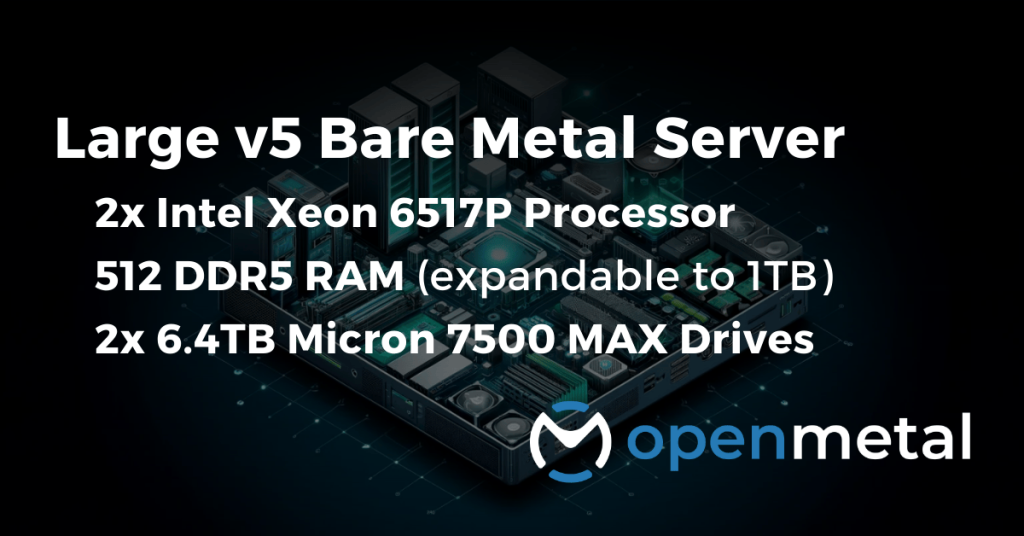
The Large v5 is the newest addition to OpenMetal’s Bare Metal Dedicated Server lineup, built on Intel’s Granite Rapids architecture. It pairs dual Intel Xeon 6517P processors with 512GB of DDR5-6400 memory and Micron 7500 MAX NVMe storage — delivering higher clock speeds, nearly double the L3 cache, and 23% faster memory bandwidth compared to the Large v4 it replaces. Whether you’re running distributed databases, blockchain validator nodes, AI inference pipelines, or virtualized environments, the Large v5 gives you dedicated access to current-generation hardware with fixed-cost pricing and no shared tenancy.
Key Takeaways
The Large v5 brings Granite Rapids performance to OpenMetal’s bare metal lineup — more cache, faster memory, better storage, and lower power draw than the Large v4. Here’s what matters most:
- Generational hardware upgrade: Dual Xeon 6517P processors on Intel 3 deliver 14% higher base clocks, 92% more L3 cache, and 35W lower TDP per socket compared to the v4’s Emerald Rapids CPUs.
- 23% faster memory bandwidth: DDR5-6400 at ~819 GB/s aggregate benefits memory-bound workloads like in-memory databases, state trie operations, and vectorized compute.
- Storage isolation by design: Dedicated boot drives keep OS I/O off the Micron 7500 MAX data drives, eliminating contention for workloads that depend on sustained NVMe throughput.
- Blockchain-ready configuration: 12.8TB NVMe with 1.1M read IOPS, 20 Gbps private bandwidth, and Intel TDX support (with RAM upgrade) map directly to validator, archive node, and RPC endpoint requirements.
- Fixed-cost, no shared tenancy: Both standalone Bare Metal Dedicated Server and Hosted Private Cloud deployments run on predictable monthly pricing with no per-hour or per-GB billing.
If you’re building infrastructure that needs dedicated, predictable hardware — whether that’s blockchain nodes, analytical databases, or production clusters — we’d like to walk you through the configuration.
Server Configuration at a Glance
| Component | Specification |
|---|---|
| Processor | 2x Intel Xeon 6517P (Granite Rapids, P-core) |
| Total Cores / Threads | 32 cores / 64 threads |
| Base / Max Turbo Frequency | 3.2 GHz / 4.2 GHz |
| L3 Cache | 72 MB per processor (144 MB total) |
| TDP (Thermal Design Power) | 190W per processor |
| Memory | 512GB DDR5-6400 ECC (16 DIMM slots, 8 populated) |
| Boot Storage | 2x 960GB SSD |
| Data Storage | 2x 6.4TB Micron 7500 MAX NVMe (12.8TB total) |
| Max Drive Bays | Up to 10 drives |
| Private Bandwidth | 20 Gbps |
| Public Bandwidth | 6 Gbps |
| PCIe | PCIe 5.0, 88 lanes per processor |
| Confidential Computing | Intel TDX (supported with 1TB RAM upgrade) |
Processor: Intel Xeon 6517P (Granite Rapids)
The Large v5 runs dual Intel Xeon 6517P processors in a two-socket configuration, delivering 32 physical cores and 64 threads across the system. Each processor clocks at 3.2 GHz base with a 4.2 GHz max turbo (4.0 GHz all-core turbo), paired with 72 MB of L3 cache — nearly double the 37.5 MB cache on the previous-generation Xeon Gold 6526Y.
The Xeon 6517P is built on Intel’s 3 process node, a significant shrink from the Intel 7 process used in the v4’s Emerald Rapids processors. The practical result: 190W TDP versus 225W on the v4, delivering more compute per watt while running at higher frequencies.
Each processor provides 88 PCIe 5.0 lanes, supporting high-bandwidth connections to NVMe storage, GPUs, network adapters, and accelerators. Inter-socket communication runs over three UPI (Ultra Path Interconnect) links at 24 GT/s, keeping cross-socket data transfer fast for NUMA-aware (Non-Uniform Memory Access) workloads.
For compute-specific features, the Xeon 6517P includes Intel AMX (Advanced Matrix Extensions) for AI and machine learning matrix operations, AVX-512 with two FMA (Fused Multiply-Add) units for vectorized floating-point compute, and full Hyper-Threading support. These instruction set extensions directly benefit workloads like ML inference, scientific computing, and vectorized database query execution.
Memory: 512GB DDR5-6400
The Large v5 ships with 512GB of DDR5-6400 ECC registered memory across 8 populated DIMM slots out of 16 total. This leaves a clear upgrade path to 1TB or more without replacing existing modules.
DDR5-6400 operates at 6,400 MT/s, delivering 51.2 GB/s of bandwidth per channel. With 8 memory channels per processor and two processors in the system, the Large v5 provides approximately 819 GB/s of aggregate memory bandwidth — a 23% increase over the Large v4’s DDR5-5200 configuration.
That bandwidth difference shows up in workloads that are memory-throughput bound: in-memory databases scanning large datasets, virtual machines competing for memory bus access, and vectorized compute operations that process data in large batches. Higher bandwidth per channel means each core spends less time waiting for data and more time processing it.
ECC (Error Correcting Code) support is standard, catching and correcting single-bit memory errors before they affect running workloads — a requirement for production database, financial, and compliance-sensitive deployments.
Storage: Micron 7500 MAX NVMe
The Large v5 separates boot and data storage into dedicated drive pools:
- Boot: 2x 960GB SSDs for the operating system and system services
- Data: 2x 6.4TB Micron 7500 MAX NVMe drives (12.8TB total usable data storage)
This separation keeps OS-level I/O — logging, package management, system monitoring — off the data drives entirely. For workloads that depend on sustained NVMe throughput (blockchain chain sync, database WAL (Write-Ahead Log) writes, analytics scans), boot drive isolation eliminates a source of I/O contention that shared-boot configurations introduce.
The Micron 7500 MAX is built on 232-layer 3D TLC (Triple-Level Cell) NAND with a 6-plane design and independent wordline read capability. The result is up to 50% faster random read performance compared to the previous-generation Micron 7450 MAX used in the Large v4.
Performance specifications (6.4TB model):
| Metric | Performance |
|---|---|
| Sequential Read | 7,000 MB/s |
| Sequential Write | 5,900 MB/s |
| Random Read IOPS (Input/Output Operations Per Second) | 1,100,000 |
| Random Write IOPS | 410,000 |
| Endurance | 3 DWPD (Drive Writes Per Day) |
| Read Latency | Sub-1ms at 99.9999% (6-nines) |
The 3 DWPD endurance rating means each 6.4TB drive can sustain 19.2TB of writes per day over its warranty life — making it suitable for mixed-use workloads that combine heavy reads with sustained write pressure. For a deeper analysis of the Micron 7500 MAX architecture and benchmarks, see our Micron MAX 7500 NVMe enterprise storage details.
The Large v5 server chassis supports up to 10 drives total, providing room to expand storage capacity as your data grows.
Networking
The Large v5 provides 20 Gbps private bandwidth for east-west traffic between servers within OpenMetal’s network and 6 Gbps public bandwidth for internet-facing connections.
The 20 Gbps private link matters most for distributed workloads: database replication, cluster communication, storage traffic between nodes, and data shuffles during distributed query execution. For teams running multi-node clusters — whether it’s a distributed database, a Kubernetes cluster, or a set of blockchain nodes syncing state — private bandwidth is the ceiling for inter-node performance.
OpenMetal uses 95th-percentile bandwidth billing instead of per-GB egress fees, aligning costs with sustained throughput rather than total data transferred. This eliminates unpredictable outbound data charges and provides a fixed, budgetable model for high-egress workloads such as backups, replication, analytics, and content delivery.
Security and Confidential Computing
The Xeon 6517P includes Intel’s current generation of hardware security technologies:
- Intel TDX (Trust Domain Extensions): Hardware-isolated trust domains for confidential computing. Workloads run in encrypted memory regions that the host OS, hypervisor, and other tenants cannot access. Requires 1TB RAM upgrade to activate.
- Intel SGX (Software Guard Extensions): Secure enclaves with up to 512GB of encrypted enclave page cache (EPC) for protecting sensitive data and code in memory.
- TME-MK (Total Memory Encryption – Multi-Key): Full memory encryption with support for multiple encryption keys, enabling per-VM or per-container memory isolation.
- AES-NI: Hardware-accelerated AES encryption for storage, network, and application-level encryption with minimal CPU overhead.
- Boot Guard and Control-Flow Enforcement: Hardware root-of-trust boot chain and runtime control-flow integrity to protect against firmware-level and code-reuse attacks.
For regulated industries, multi-tenant deployments, and workloads handling sensitive data (financial transactions, healthcare records, cryptographic key material), these features provide hardware-enforced isolation beyond what software-only security can deliver.
What Changed from Large v4 to Large v5
| Component | Large v4 | Large v5 | Improvement |
|---|---|---|---|
| CPU | Dual Xeon Gold 6526Y (Emerald Rapids) | Dual Xeon 6517P (Granite Rapids) | Newer architecture, Intel 3 process |
| Base / Turbo | 2.8 / 3.9 GHz | 3.2 / 4.2 GHz | +14% base, +8% turbo |
| L3 Cache | 37.5 MB per CPU | 72 MB per CPU | +92% cache per processor |
| TDP | 225W per CPU | 190W per CPU | 35W lower per socket |
| Process Node | Intel 7 | Intel 3 | Smaller transistors, better efficiency |
| Memory | DDR5-5200 | DDR5-6400 | +23% bandwidth |
| Storage | Micron 7450 MAX | Micron 7500 MAX | 232-layer NAND, higher IOPS, better latency |
| Boot Drives | Shared with data | Dedicated 2x 960GB | Isolated OS I/O |
The headline improvements: higher clocks and nearly double the cache on a more power-efficient process node, paired with faster memory and storage. The v5 delivers more throughput per watt than the v4 across every component.
Large v5 Deployment Options
The Large v5 is available in two deployment models:
- Bare Metal Server: Standalone dedicated server with full root access. You manage the OS, software stack, and configuration. Ideal for teams that want complete control over their infrastruecture.
- Hosted Private Cloud: Three Large v5 nodes deployed as a hyper-converged cluster running OpenStack with Ceph-backed storage. OpenMetal handles Day 2 operations — monitoring, patching, and infrastructure management — while you manage your workloads through the OpenStack API.
Both options are available on OpenMetal’s Tier III data center locations. Fixed monthly pricing applies regardless of utilization — no per-hour, per-query, or per-GB billing surprises.