

























In this article
We break down what the EU Cyber Resilience Act’s vulnerability reporting obligations actually require starting September 2026, why the tight reporting clock is fundamentally an infrastructure visibility problem, and where dedicated infrastructure and controlled build pipelines make that clock achievable.
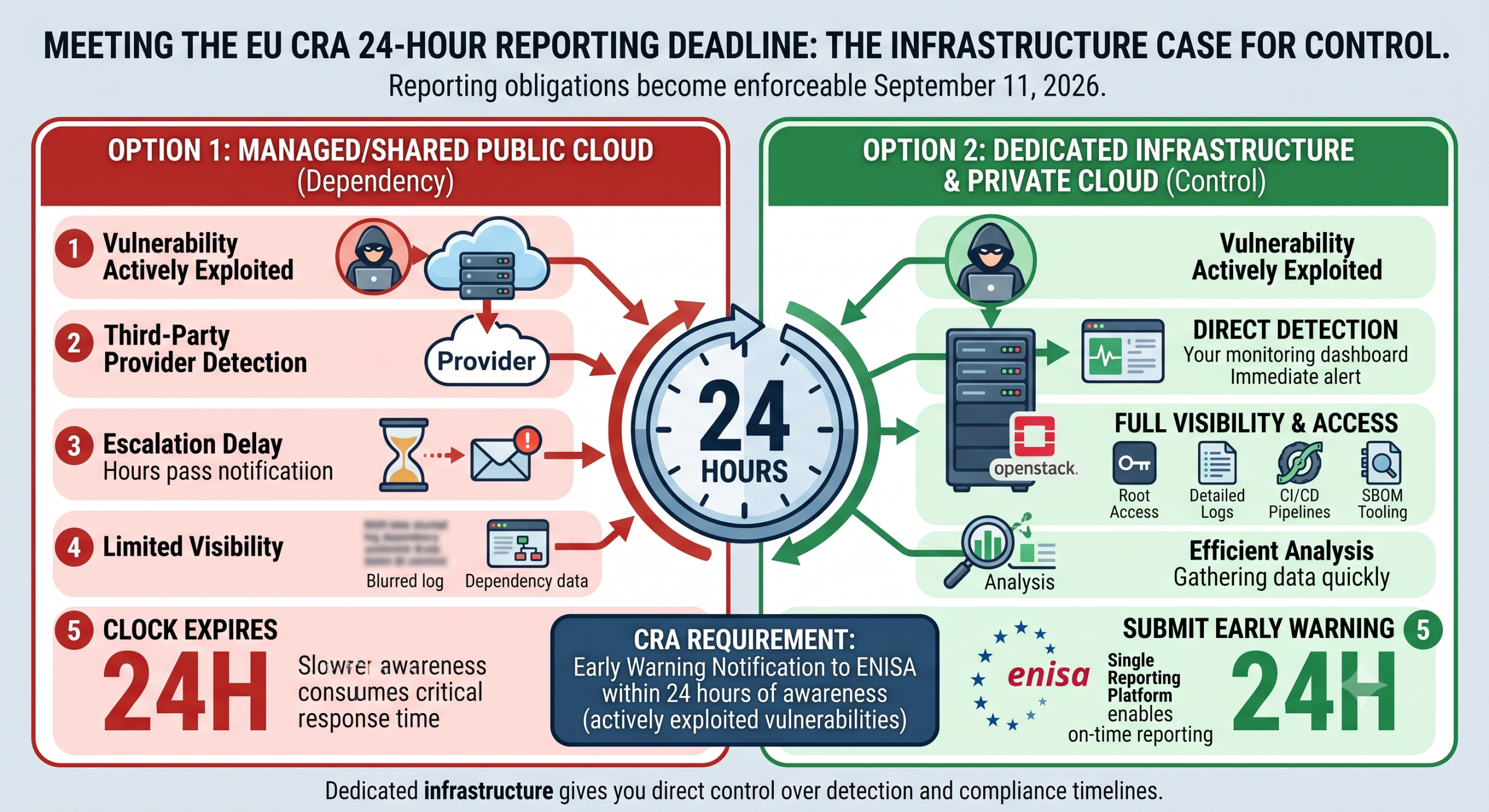
If your software reaches the EU market, a new regulatory clock starts running this September, and it’s a fast one. You’ll have 24 hours from discovering an actively exploited vulnerability to file an early warning, not 24 hours to fix it.
That distinction matters. The obligation isn’t about how quickly you can patch. It’s about how quickly you can even know something is wrong, with enough technical detail to file a real report, across your own stack.
What The Cyber Resilience Act Actually Requires
The EU Cyber Resilience Act, Regulation (EU) 2024/2847, entered into force in December 2024, with its vulnerability reporting obligations under Article 14 becoming enforceable on September 11, 2026, well ahead of the broader product conformity requirements that follow in December 2027. The reporting obligations apply to manufacturers of “products with digital elements,” a category that explicitly includes software and remote data processing solutions, not just physical connected hardware, and covers products already on the EU market, not only new releases.
The timeline itself is specific and short. Manufacturers must submit an early warning notification within 24 hours of becoming aware of an actively exploited vulnerability, a more detailed vulnerability notification within 72 hours, and a final report no later than 14 days after a corrective measure becomes available. Reports route through ENISA’s Single Reporting Platform, which is being stood up through 2026 specifically to receive them. None of this is triggered by every disclosed CVE. It applies specifically to vulnerabilities being actively exploited in the wild, which is a narrower and more urgent category than routine patch management.
Why This Is An Infrastructure Problem Before It’s A Legal One
Most current coverage of the CRA comes from compliance platforms, law firms, and open-source policy groups, focused on scope, liability, and SBOM documentation requirements. That’s necessary groundwork, but it understates a harder operational question: a 24-hour clock only means something if you actually find out about the exploitation within a window that leaves you time to act on it.
That detection speed depends entirely on how much visibility you have into your own stack. If your build pipeline, artifact repository, and monitoring tooling run inside a fully managed platform you don’t operate directly, your ability to detect active exploitation is bounded by that platform’s own monitoring, alerting, and support response times, not yours.
A delay in a third party noticing and escalating an issue eats directly into a clock you don’t control the start of. Teams running their own CI/CD and monitoring stack on infrastructure they operate directly, as covered in more depth in our piece on optimizing CI/CD pipelines with OpenStack-powered private cloud, have direct access to logs, build artifacts, and dependency data the moment something looks wrong, rather than waiting on a vendor’s own detection and disclosure process.
Full root access matters here specifically. Dedicated bare metal and hosted private cloud with direct API and CLI access lets engineering teams integrate vulnerability scanning and SBOM tooling directly into their own build and deployment pipeline, rather than depending on a managed provider to expose the right hooks or surface the right data on their own schedule.
The SBOM and Audit Trail Requirement
Filing an accurate vulnerability notification requires knowing exactly what’s in your product in the first place. A software bill of materials, cataloging every component, library, and dependency with version numbers, is the practical prerequisite most CRA guidance points to well ahead of the September deadline, since you can’t report on exposure you haven’t mapped. That inventory, along with the reporting history itself (early warnings filed, notifications sent, corrective measures documented), becomes an ongoing compliance record that needs to be retrievable and auditable, not just generated once and forgotten.
That’s the same storage pattern other compliance-driven infrastructure content on this topic addresses: records that accumulate steadily, need to be pulled reliably under time pressure, and are rarely deleted. A large-scale Ceph storage cluster handles SBOM history and incident documentation the same way it handles other audit-trail workloads, without per-retrieval fees complicating access during exactly the moment you need the records fastest.
What This Doesn’t Solve
Infrastructure control doesn’t write your SBOM, staff your vulnerability triage process, or draft your regulatory filings. The CRA’s obligations are organizational and procedural first, requiring a documented, tested process for detecting, assessing, and reporting vulnerabilities, the kind of “fire drill” preparation most CRA compliance guidance recommends running before September rather than after.
What infrastructure you control does is remove one variable from that timeline: the time it takes to actually see what’s happening in your own stack. Whether your specific product and organization fall under CRA’s scope, and what your documented process needs to include, are questions for your legal and compliance team.
Getting Started
Dedicated bare metal servers and hosted private cloud give development and security teams direct access to the build, deployment, and monitoring stack a fast-detection process depends on. Current configurations are on our bare metal pricing page.
FAQ
When do EU Cyber Resilience Act reporting obligations start?
September 11, 2026, for vulnerability and incident reporting under Article 14. The broader product conformity requirements of the CRA apply from December 11, 2027.
Does the CRA apply to software, or only physical hardware?
It applies to both. The regulation covers “products with digital elements”, which explicitly includes software and remote data processing solutions, not just physical connected devices.
How fast do companies need to report a vulnerability under the CRA?
An early warning notification is due within 24 hours of becoming aware of an actively exploited vulnerability, a full notification within 72 hours, and a final report within 14 days of a corrective measure becoming available.
Does every disclosed vulnerability trigger CRA reporting?
No. The reporting obligation applies specifically to vulnerabilities that are being actively exploited, not every CVE or disclosed weakness. Routine vulnerability management and patching are separate from this specific reporting trigger.
Why would infrastructure control matter for a compliance deadline like this?
The reporting clock starts when you become aware of active exploitation. Teams with direct, full access to their own build pipeline, monitoring, and logs can detect and confirm that awareness faster than teams depending on a managed platform’s own detection and escalation process, which shortens the effective time available to act within the CRA’s fixed deadlines.
Schedule a Consultation
Get a deeper assessment and discuss your unique requirements.
Read More on the OpenMetal Blog