
























In this article
This guide compares Singapore, Tokyo, and Sydney for APAC infrastructure deployment, covering geographic advantages, cost analysis with OpenMetal pricing, regulatory frameworks, network connectivity, and detailed use cases including gaming, fintech, e-commerce, live streaming, and SaaS platforms.
Companies expanding into Asia-Pacific face a critical infrastructure decision: Tokyo, Sydney, or Singapore. Each location has its strengths, but when you look at costs, network performance, regulations, and geographic coverage, Singapore comes out ahead for most APAC deployments.
This analysis breaks down why Singapore beats Tokyo and Sydney across key factors, with focus on bare metal infrastructure and hosted private cloud deployments that give you dedicated hardware without hyperscaler price tags.
Geographic Coverage: Singapore’s Central Position
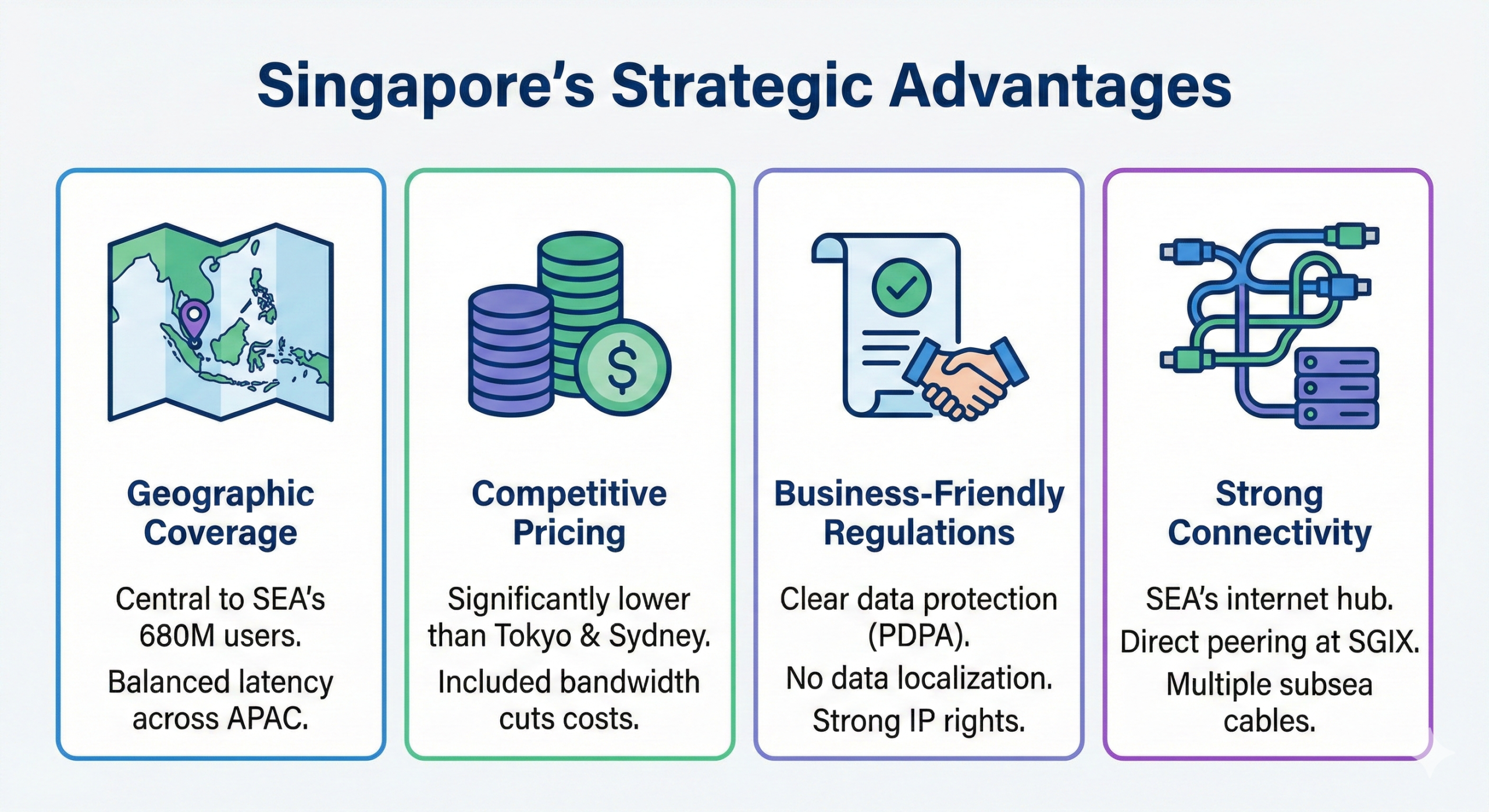
Singapore sits at the southern tip of the Malay Peninsula, right in the geographic center of Southeast Asia. This puts it within easy reach of major population centers across the region – and more importantly, it’s roughly equidistant from the massive populations of Indonesia, Thailand, Vietnam, the Philippines, and Malaysia.
This geographic advantage isn’t just about being in Southeast Asia. Singapore also maintains reasonable connectivity to broader Asia-Pacific markets including India, Australia, Hong Kong, and Japan. While it’s not the closest location to any single market (Tokyo is closer to Japan, Sydney is closer to Australia), Singapore provides the best average performance across the entire region.
Network Latency Comparison
From Singapore: Jakarta: 15-20ms | Bangkok: 25-30ms | Manila: 25-30ms | Mumbai: 50-60ms | Hong Kong: 35-40ms | Sydney: 95-110ms | Tokyo: 70-80ms
From Tokyo: Singapore: 70-80ms | Jakarta: 90-110ms | Bangkok: 100-120ms | Mumbai: 120-140ms | Sydney: 110-130ms
From Sydney: Singapore: 95-110ms | Jakarta: 80-100ms | Bangkok: 110-130ms | Mumbai: 140-160ms | Tokyo: 110-130ms
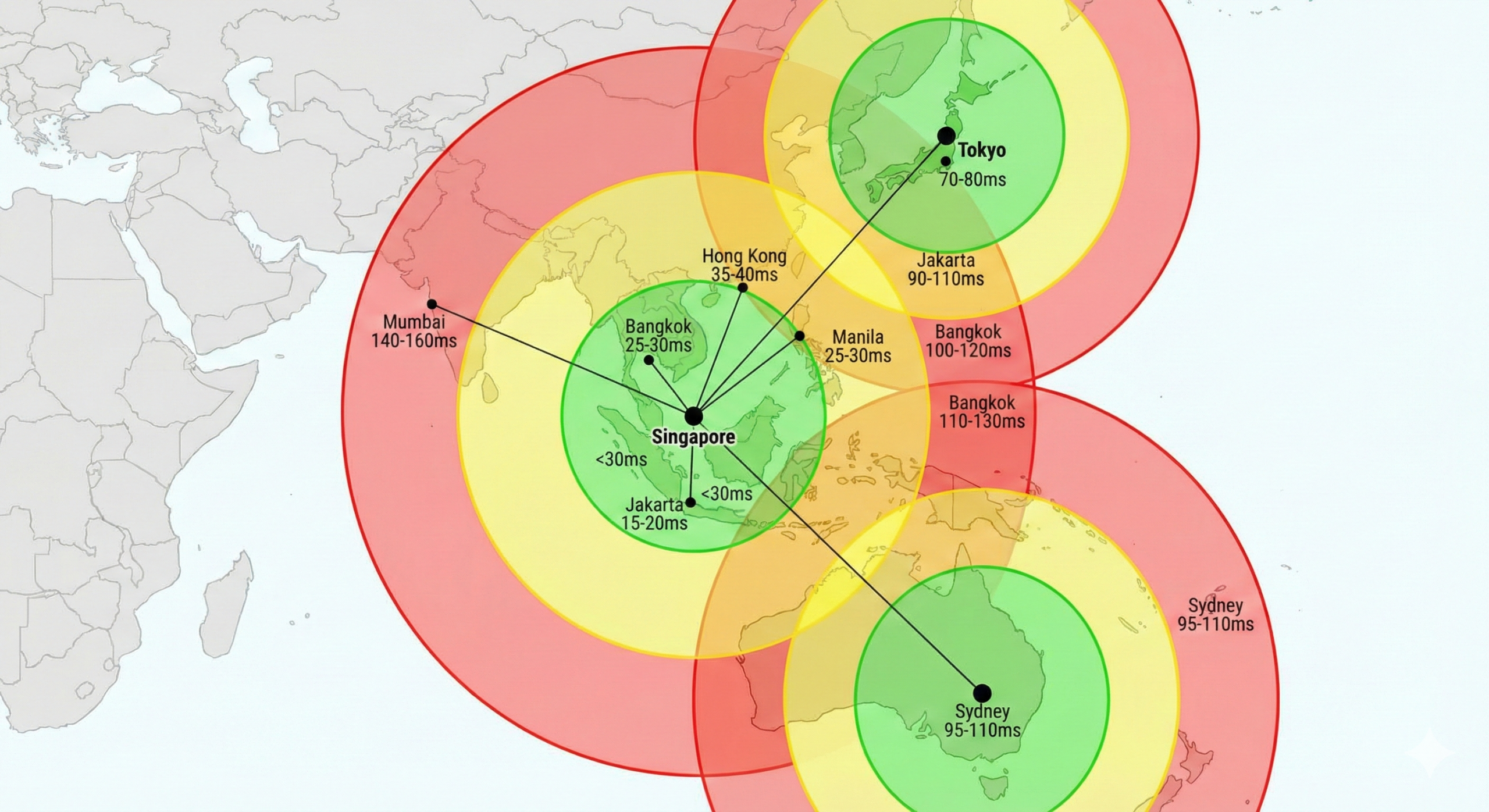
Singapore gives you much better latency to Southeast Asia’s 680 million internet users across high-growth markets. If you’re serving users in multiple APAC countries, Singapore’s central spot keeps your worst-case latency low. A user in Jakarta gets 15-20ms response time from Singapore but 90-110ms from Tokyo – that’s a 5-6x difference that users absolutely notice.
The Southeast Asia Opportunity
Southeast Asia represents one of the fastest-growing digital markets globally. The region’s internet economy reached $218 billion in 2023 and exceeded $360 billion in 2025, with projections showing continued double-digit growth through 2026 and beyond. To put this in perspective, that’s faster growth than any other region globally, with mobile-first consumers who are comfortable buying everything from groceries to cars on their smartphones.
Indonesia alone has 204 million internet users – more than Japan, South Korea, and Australia combined. The Philippines adds another 85 million internet users, Vietnam contributes 77 million, Thailand has 57 million, and Malaysia adds 30 million. These aren’t small markets – together they represent over 450 million internet users, and they’re younger and growing faster than mature markets.
If you’re targeting this growth, you need infrastructure positioned to actually serve these markets well. Tokyo infrastructure adds 90-120ms latency to Jakarta and Bangkok, which hurts user experience for any interactive application. Sydney is closer to Indonesia but still sits at 80-100ms latency and gets worse as you move north through Southeast Asia.
Singapore keeps latency to 15-30ms across the region’s major cities. This makes real-time applications possible, keeps web applications feeling snappy, and creates a user experience that can compete with local providers who also operate from Singapore.
Multi-Market Strategy
Most companies expanding into APAC aren’t targeting just one country. You’re building products for users across Indonesia, Thailand, Vietnam, the Philippines, and beyond. Singapore infrastructure lets you serve all these markets well from a single deployment.
The alternative – deploying separate infrastructure in each country – creates operational complexity and multiplies costs. Data residency requirements in some countries may require local infrastructure, but for companies that can legally serve the region from Singapore, it’s the most efficient choice.
Even companies with data residency requirements often use Singapore as their primary hub, with minimal infrastructure in countries requiring local data storage. Singapore handles the compute-intensive work and real-time processing, while country-specific infrastructure handles only the data that legally must remain local.
Cost Comparison: Infrastructure Economics
Infrastructure costs across APAC vary wildly by location. Tokyo is one of the most expensive cities in the world for data center operations, running 50-70% higher than Singapore for the same hardware. High real estate costs, expensive electricity, and premium enterprise services all add up.
Sydney lands between Tokyo and Singapore, typically 20-30% higher than Singapore for the same infrastructure. Geographic isolation and a smaller market contribute to the price difference.
Singapore keeps infrastructure pricing competitive despite being a major financial hub. The government wants Singapore to be Asia’s data center hub, so they’ve created favorable conditions including tax breaks, streamlined regulations, and power infrastructure investments.
OpenMetal Singapore Pricing
OpenMetal offers both individual bare metal servers and hosted private cloud deployments using Cloud Core bundles (3 servers configured as a production-ready cloud).
Bare Metal Server Pricing (per server, monthly):
Large V4 Server:
- Monthly cost: $1,504.80 per server
- Hardware: 2× Intel Xeon Gold 6526Y (32C/64T, 2.8/3.9Ghz), 512GB DDR5, 2× 6.4TB NVMe
- Public bandwidth: 4Gbps per server
- Private bandwidth: 20Gbps between servers
For Hosted Private Cloud (3-server Cloud Core bundle):
- Large V4 Cloud Core: $4,514.40/month (3 servers)
- Combined capacity: 1,296 vCPUs (192 physical threads), ~142 VMs
- Combined egress: 3,797TB monthly (12Gbps total: 4Gbps × 3 servers)
- Storage: NVMe-based Ceph cluster across 3 servers
- Deployment: 45 seconds to production-ready OpenStack cloud
Longer-term commitments offer substantial savings. With a 5-year agreement, monthly costs drop significantly:
- Medium V4: $522.72/month (34% savings vs monthly)
- Large V4: $993.17/month (34% savings vs monthly)
- XL V4: $1,677.46/month (34% savings vs monthly)
- XXL V4: $2,347.49/month (34% savings vs monthly)
This same Large V4 configuration would cost 50-70% more in Tokyo through comparable providers. The included 3,797TB bandwidth (for a 3-server Cloud Core) would cost you $228,000-$342,000 monthly in AWS egress fees at typical $0.06-$0.09/GB rates.
If you’re running bandwidth-heavy applications like video streaming, content delivery, gaming, or API platforms, this bandwidth advantage alone makes Singapore worth it over Tokyo or Sydney.
Regulatory Environment and Business Climate
Singapore has one of the most business-friendly regulatory setups in the world. The government actively wants technology companies and data centers here.
Key advantages:
- Clear data protection: Personal Data Protection Act (PDPA) protects privacy without GDPR-level complexity
- No data localization: Unlike Indonesia, Vietnam, and India, Singapore doesn’t force you to keep data in-country
- Strong IP protection: Your software and trade secrets get solid legal protection
- Political stability: Consistent government policy means less regulatory risk
- English as official language: No translation needed for contracts and regulations
Japan’s Act on the Protection of Personal Information (APPI) creates more compliance work, while the regulatory setup tends to favor established companies over foreign newcomers. Australia’s Privacy Act has sector-specific rules, but Sydney’s distance from other APAC markets makes it tough to use as a regional hub.
Connectivity and Network Infrastructure
Singapore works as Southeast Asia’s main internet hub. Multiple submarine cable systems meet here, giving you redundant high-capacity links to every major APAC market: Southeast Asia-Japan Cable, Asia-America Gateway, SEA-ME-WE 5, Asia-Pacific Gateway, and others.
Singapore Internet Exchange (SGIX) is one of the world’s largest internet exchange points with over 200 networks peering locally. Direct peering means traffic flows right here in Singapore instead of bouncing through expensive international links, cutting latency and eliminating transit costs.
Nearly every major telecom carrier operates in Singapore. This gives infrastructure operators multiple options and keeps bandwidth pricing competitive. OpenMetal’s Singapore data center uses this carrier diversity to get you redundant connectivity and better bandwidth pricing.
Use Case Analysis: Which Applications Benefit Most
Gaming and Esports Infrastructure
Asia-Pacific dominates global gaming, with countries like South Korea, China, Indonesia, and the Philippines leading in player counts and esports viewership. Gaming servers serving Southeast Asian players absolutely need Singapore’s 15-30ms latency advantage.
Tokyo adds 90-120ms latency to Jakarta, Bangkok, and Manila, which makes competitive gaming basically unplayable. Fighting games like Mortal Kombat, first-person shooters like Valorant and PUBG, and MOBAs like League of Legends require sub-50ms latency for responsive gameplay where milliseconds determine wins and losses.
Indonesia alone has over 100 million gamers, with mobile gaming particularly dominant. Thailand and Vietnam each contribute tens of millions more players. A game server in Singapore can serve this entire market with consistent low latency, while Tokyo or Sydney force you to choose between serving Japan/Australia well or Southeast Asia well…you can’t do both.
OpenMetal’s bare metal servers give gaming companies dedicated hardware without the performance inconsistency of shared cloud infrastructure. When player counts spike during tournaments or new releases, you get consistent performance instead of slowdowns from noisy neighbors.
Mobile-First Applications and Super Apps
Southeast Asia has leapfrogged desktop computing entirely. Mobile internet penetration exceeds 70% across major markets, with users accessing services primarily through smartphones. Super apps like Grab, Gojek, and WeChat combine ride-hailing, food delivery, payments, and social features in single platforms serving tens of millions of daily users.
These applications need infrastructure that can handle:
- Real-time location tracking for millions of drivers and customers
- Payment processing across multiple countries and currencies
- Chat and social features with instant message delivery
- Live order tracking and notifications
- Map rendering and routing calculations
Singapore’s central location keeps API response times low for users across the region. A ride-hailing request from Manila to Singapore and back happens in 50-60ms round trip. The same request to Tokyo takes 140-180ms, creating noticeable lag in the user experience.
Mobile applications are also bandwidth-intensive. App updates, image-heavy social feeds, and video content consume substantial bandwidth. OpenMetal’s generous egress allocations mean you’re not nickel-and-dimed for every GB users download.
Digital Payments and Financial Technology
Southeast Asia’s digital payments market is exploding. The region processed over $1 trillion in digital payments in 2023, with mobile wallets and QR code payments replacing cash across Indonesia, Thailand, Vietnam, and the Philippines.
Payment processing infrastructure needs:
- Ultra-low latency for real-time transaction authorization
- High availability and redundancy for financial operations
- Compliance with local financial regulations
- Secure infrastructure for sensitive financial data
Singapore’s role as ASEAN’s financial hub makes it the natural choice for fintech infrastructure. The Monetary Authority of Singapore provides clear regulatory frameworks for digital payments, making compliance straightforward compared to navigating regulations across multiple countries.
Transaction processing can’t tolerate the latency Tokyo adds. A payment authorization that takes 200ms feels instant to users. One that takes 400ms feels slow and creates doubt about whether the transaction succeeded. Singapore keeps payment flows fast across the entire region.
Dedicated hardware also matters for financial workloads. PCI compliance and data security requirements make shared infrastructure risky. Dedicated servers give you the isolation financial regulators expect.
E-Commerce and Cross-Border Retail
Southeast Asian e-commerce reached $145 billion in 2024 and continues rapid expansion, with projections showing the market more than doubling to $410 billion by 2030. Shopee, Lazada, and Tokopedia compete for market share across multiple countries, while cross-border sellers from China serve the region through platforms like AliExpress and TikTok Shop.
E-commerce platforms serving multiple APAC countries face challenges:
- Product catalog and image serving to millions of daily visitors
- Real-time inventory management across warehouses in different countries
- Shopping cart and checkout flows that need to be fast and reliable
- Payment processing integrations with local payment methods
- Order tracking and logistics coordination
Singapore infrastructure positions you optimally for serving customers across Indonesia (275 million people), the Philippines (115 million), Vietnam (100 million), Thailand (70 million), and Malaysia (35 million). These markets together exceed the US population and are growing faster.
The bandwidth advantage really shows up in e-commerce. Product images, video content, and high-resolution photos consume bandwidth. A Large V4 Cloud Core’s 3,797TB monthly bandwidth supports massive product catalogs and high-traffic shopping events without extra charges.
Live Streaming and Social Commerce
Live streaming commerce combines entertainment and shopping, with hosts demonstrating products while viewers purchase in real-time. This format dominates in China and is rapidly expanding across Southeast Asia, with platforms like TikTok Shop, Shopee Live, and Lazada Live driving billions in sales.
Live streaming infrastructure requirements include:
- Real-time video encoding and distribution to thousands of concurrent viewers
- Chat and interaction features for viewer engagement
- Real-time inventory updates as products sell out
- Payment processing integrated into the viewing experience
- Content delivery with minimal buffering and lag
Video streaming is bandwidth-intensive. A single popular live stream with 10,000 concurrent viewers at 1080p consumes roughly 40Gbps of bandwidth. Content delivery networks running from Singapore can serve these streams across Southeast Asia with low latency and included bandwidth that makes the economics work.
Tokyo’s distance from Southeast Asian viewers creates buffering and lag that kills the live shopping experience. When a host asks “who wants this product?” and there’s a five second delay before responses appear, the energy and immediacy that makes live commerce work disappears.
Online Education and EdTech
The pandemic accelerated online education adoption across Asia-Pacific, and growth continues as platforms serve K-12 students, university learners, and professional upskilling. Companies like Ruangguru (Indonesia), BYJU’S (India), and regional platforms serve millions of students.
EdTech platforms need infrastructure supporting:
- Video-based lessons and recorded lectures
- Live virtual classrooms with real-time interaction
- Interactive exercises and assessments
- Progress tracking and analytics
- Mobile-first delivery for students on smartphones
Educational video content creates substantial bandwidth requirements. A platform serving 100,000 students who each watch 2 hours of video daily consumes enormous bandwidth. Singapore’s included egress makes this economically viable without per-GB charges that would make the business model unsustainable.
Latency matters for live virtual classrooms. When a teacher asks a question and students experience 200ms+ delay before they can respond, classroom dynamics suffer. Singapore keeps latency low enough for natural interaction across the region.
API Platforms and Developer Tools
Software developers across Asia-Pacific consume APIs for payments, maps, authentication, messaging, and countless other services. API platforms need global reach but particularly strong APAC performance.
Companies running API platforms serving mobile applications across Asia-Pacific need infrastructure that keeps latency low for users everywhere. Kubernetes workloads work well with dedicated resources and consistent performance for hitting your SLAs.
API platforms also generate substantial bandwidth from millions of small requests that add up. A mapping API serving mobile apps across Southeast Asia might handle millions of tile requests daily. While each request is small, the aggregate bandwidth becomes substantial. Public cloud per-GB egress pricing makes this expensive. Singapore’s included bandwidth solves this.
Developer tools and CI/CD platforms also benefit from Singapore deployment. Development teams distributed across Asia, Australia, and the US need infrastructure positioned to serve all regions reasonably well. Singapore provides better average latency to this distribution than Tokyo (too far from SEA) or Sydney (too far from Asia).
Content Management and Media Production
Media companies, news organizations, and content creators across Asia-Pacific need infrastructure for storing, processing, and distributing video content. Video file sizes make bandwidth costs a major concern.
A media production company uploading raw 4K footage from field offices across Southeast Asia to central storage benefits from Singapore’s connectivity. Low latency to source locations speeds uploads, while generous bandwidth allocations eliminate cost anxiety about large file transfers.
Content distribution to audiences across the region also favors Singapore. News organizations serving readers in multiple countries need fast content delivery everywhere. Tokyo infrastructure serves Japan well but creates higher latency to Indonesia, Thailand, and the Philippines. Singapore provides more balanced coverage.
SaaS Platforms and Business Software
Business software companies expanding into Asia-Pacific face infrastructure decisions. Your product might work great for US and European customers, but serving Asian customers well requires APAC infrastructure.
SaaS providers deploying in Singapore can serve customers across Southeast Asia, Australia, India, and Japan reasonably well from a single location. This multi-region coverage from one deployment point reduces operational complexity compared to maintaining separate infrastructure in Tokyo, Sydney, and Singapore.
CRM systems, project management tools, accounting software, and other business applications benefit from low latency for responsiveness. Users typing in a web interface expect instant feedback. 200ms+ latency creates noticeable lag that frustrates users and makes your product feel slow.
Data Analytics and Business Intelligence
Organizations running big data infrastructure for analytics across Asian markets benefit from Singapore’s connectivity to data sources throughout the region.
Analytics platforms pulling data from operations in Indonesia, Thailand, Vietnam, and the Philippines need infrastructure positioned to minimize data transfer time. Lower latency to source systems reduces data pipeline lag and improves real-time analytics responsiveness.
Machine learning training workloads processing data from multiple countries also benefit from Singapore’s network connectivity. Faster data transfer from source systems to training infrastructure reduces overall processing time. The substantial local storage in OpenMetal servers (up to 6× 6.4TB NVMe drives in XXL configurations) supports data-intensive analytics without relying on slow network-attached storage.
Migration Considerations
If you’re thinking about moving to Singapore, plan it out:
Network Architecture: Most migrations work better in phases. Keep your existing infrastructure while you deploy new services in Singapore to test performance, or set up multi-region architecture with your main services in Singapore and regional DR elsewhere.
Data Transfer: Set up direct connections between data centers to skip the public internet and cut transfer costs. Move data bit by bit and run systems in both locations during the switch.
Testing: Check that applications perform correctly, failover works right, and load capacity holds up before you go live. OpenMetal offers free 30-day trials so you can test with real workloads.
OpenMetal Singapore Infrastructure
OpenMetal’s Singapore data center gives you enterprise-grade infrastructure with OpenStack for full API compatibility with standard cloud management tools.
Hardware Configurations
OpenMetal offers flexible deployment options from individual bare metal servers to fully managed hosted private cloud using 3-server Cloud Core bundles.
Bare Metal Servers (per server, monthly):
Medium V4: $792/month – 24C/48T CPU, 256GB RAM, 6.4TB NVMe, 2Gbps public bandwidth
Large V4: $1,504.80/month – 32C/64T CPU, 512GB RAM, 2× 6.4TB NVMe, 4Gbps public bandwidth
XL V4: $2,541.60/month – 64C/128T CPU, 1024GB RAM, 4× 6.4TB NVMe, 6Gbps public bandwidth
XXL V4: $3,556.80/month – 64C/128T CPU, 2048GB RAM, 6× 6.4TB NVMe, 10Gbps public bandwidth
Hosted Private Cloud (3-server Cloud Cores, monthly):
Medium V4 Cloud Core: $2,376/month – 1,008 vCPUs, ~66 VMs, 1,898TB egress (6Gbps total)
Large V4 Cloud Core: $4,298.40/month – 1,296 vCPUs, ~142 VMs, 3,797TB egress (12Gbps total)
XL V4 Cloud Core: $7,149.60/month – 2,736 vCPUs, ~293 VMs, 5,695TB egress (18Gbps total)
XXL V4 Cloud Core: $10,238.40/month – 2,784 vCPUs, ~557 VMs, 9,491TB egress (30Gbps total)
All servers use 5th gen Intel Xeon processors and Micron 7450 MAX NVMe drives. Cloud Cores deploy in 45 seconds as fully configured OpenStack environments with complete root access.
5-year commitment pricing available: Save up to 34% with longer-term agreements. For example, Large V4 drops to $993.17/month per server on a 5-year term.
Key Features
- Ceph storage: Distributed storage with adjustable redundancy
- 95th percentile billing: Usage beyond included amounts costs 60-80% less than per-GB charging
- Private networking: 20Gbps between servers for high-performance clusters
- Network uptime: >99.99% track record (2022-2025)
- 30-day money-back guarantee: Test it risk-free
Cost Comparison: Singapore vs Tokyo vs Sydney
Real numbers using a medium-scale deployment serving 100,000 users across Southeast Asia with 500TB monthly bandwidth. This comparison uses OpenMetal’s Large V4 Cloud Core (3-server hosted private cloud bundle).
Singapore (OpenMetal Large V4 Cloud Core):
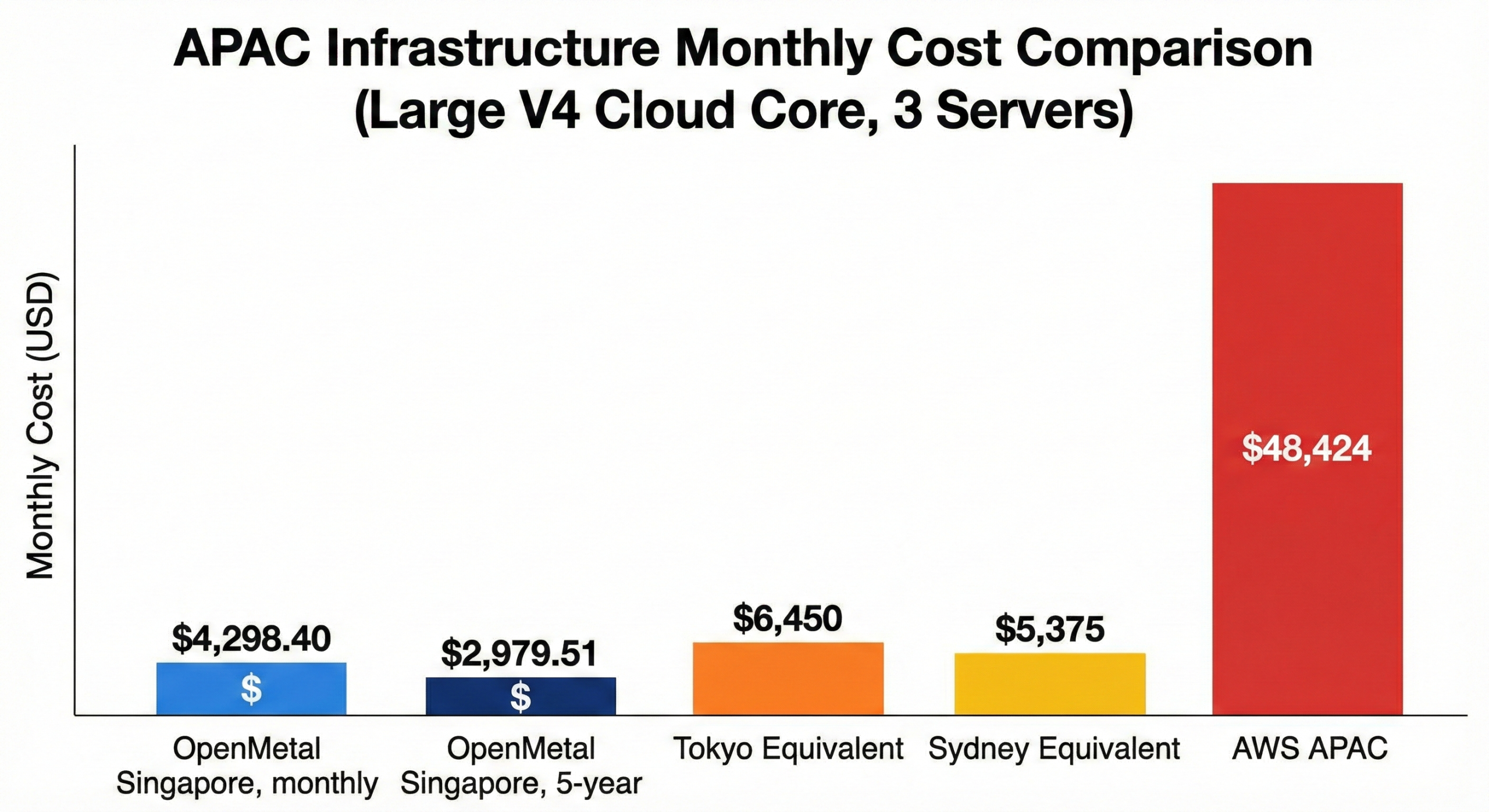
- Monthly: $4,298.40 (bandwidth included)
- Annual: $51,580.80
- With 5-year commitment: $2,979.51/month ($35,754.12/year)
Tokyo (Equivalent 3-Server Setup):
- Monthly: ~$6,450 (50% more expensive)
- Annual: $77,400
- You pay $25,819.20/year extra vs Singapore monthly pricing
- You pay $41,645.88/year extra vs Singapore 5-year pricing
Sydney (Equivalent 3-Server Setup):
- Monthly: ~$5,375 (25% more expensive)
- Annual: $64,500
- You pay $12,919.20/year extra vs Singapore monthly pricing
- You pay $28,745.88/year extra vs Singapore 5-year pricing
Public Cloud Comparison
AWS in any APAC region for the same workload:
- Compute: ~$2,400/month
- Storage: $1,024/month
- Egress (500TB @ $0.09/GB): $45,000/month
- Total: $48,424/month ($581,088/year)
OpenMetal Singapore saves you:
- $529,507 annually vs AWS (using monthly pricing)
- $545,334 annually vs AWS (using 5-year pricing)
All while giving you dedicated hardware, consistent performance, and no noisy neighbor issues.
Wrapping Up: Singapore’s Comprehensive Advantage
Singapore wins for APAC infrastructure through a combination of geography, cost, regulations, and connectivity. The central location gives you 15-30ms latency to 680 million Southeast Asian users while keeping decent performance to Australia, India, and Northeast Asia. Infrastructure costs run 25-50% below Tokyo while delivering the same or better performance.
OpenMetal’s Singapore deployment takes these location advantages and adds infrastructure economics that seriously undercut both competitors and hyperscale providers. Included bandwidth wipes out egress cost worries. Dedicated hardware gives you consistent performance. OpenStack compatibility means you’re not locked in.
Whether you’re a US company expanding into Asian markets, an Australian business growing across Southeast Asia, or a regional startup scaling up, Singapore infrastructure gives you the right foundation for APAC growth.
Ready to deploy in Singapore? Check out OpenMetal’s cloud deployment calculator or talk to the team about your APAC expansion.
Schedule a Consultation
Get a deeper assessment and discuss your unique requirements.
Read More on the OpenMetal Blog