



















In this article
If you’re a MENA-based tech company planning European expansion, here’s why Amsterdam should be at the top of your list, and how OpenMetal’s infrastructure can get you there without the typical data center headaches.
The Middle East and North Africa tech sector is booming. From Dubai’s AI initiatives to Saudi Arabia’s Vision 2030 digital transformation, MENA companies are scaling rapidly. But when it’s time to expand into Europe, the question isn’t if you need European infrastructure. It’s where.
Amsterdam has become the clear choice for MENA tech companies entering the European market. The city offers something competitors like Frankfurt, Paris, or London can’t match: exceptional connectivity to MENA markets combined with comprehensive access to European customers, all wrapped in a business-friendly regulatory environment.
The Connectivity Advantage: 111ms to Dubai
Latency matters. When your engineering team is in Dubai and your European customers are in Amsterdam, you need infrastructure that serves both markets efficiently.
Amsterdam delivers outstanding connectivity to MENA markets. Current network measurements show approximately 111-117ms round-trip latency between Dubai and Amsterdam. That’s fast enough to support real-time applications, API-driven services, and collaborative workflows across both regions.
Amsterdam sits at the intersection of multiple high-capacity submarine cable systems connecting Europe to the Middle East.
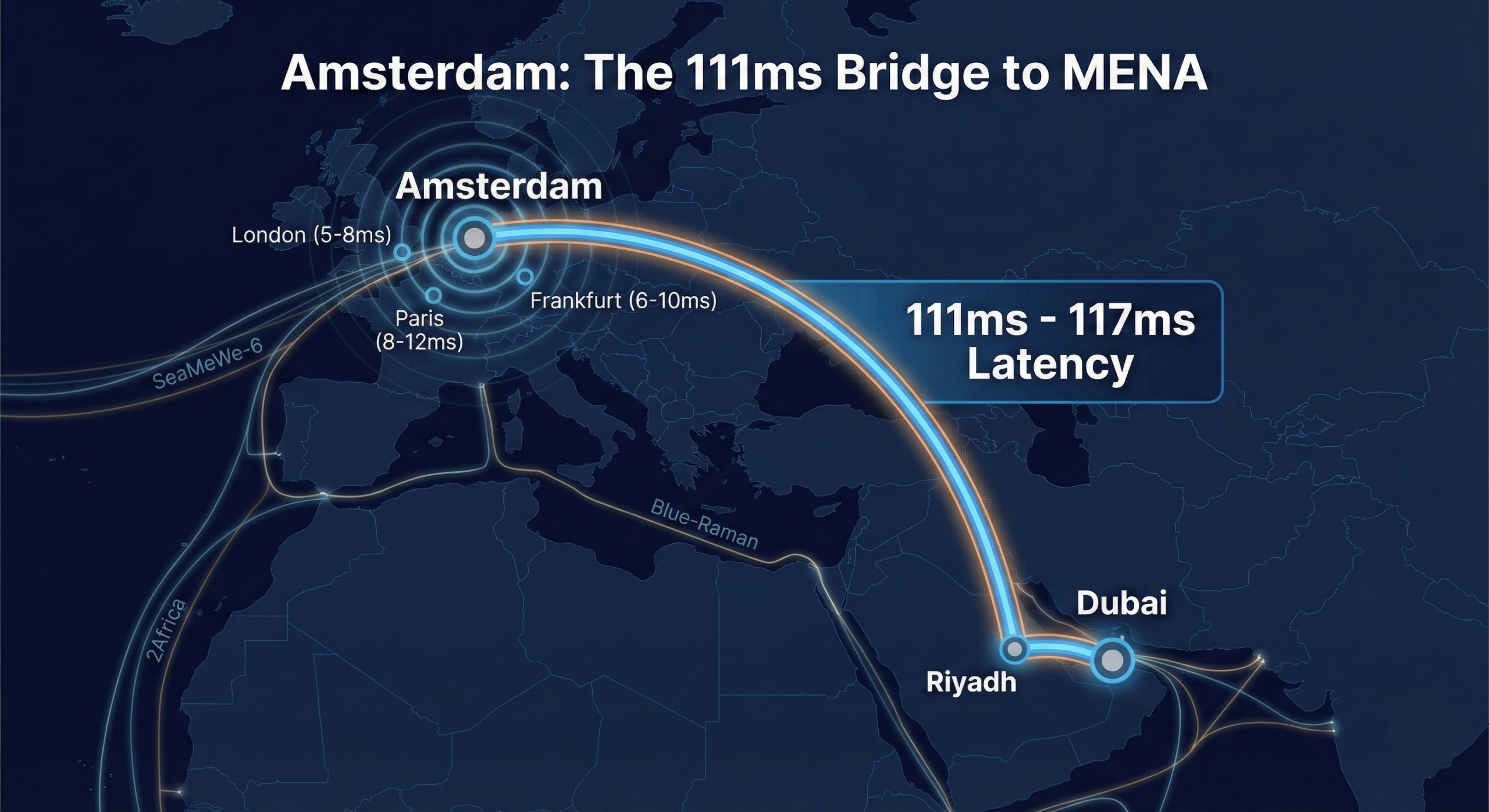
Major Cable Systems Serving MENA-Europe Routes
- SeaMeWe-6: Connects Singapore to Marseille via UAE, Qatar, Bahrain, Saudi Arabia, and Oman with 126 Tbps capacity
- 2Africa: The world’s longest cable (45,000km) with landings in Jeddah, Yanbu, Duba, and Al Khobar
- Blue-Raman: Google-backed system connecting Italy to India via Saudi Arabia, Jordan, and Israel
- AAE-1: Links Hong Kong to Marseille through UAE, Oman, and multiple Middle Eastern markets
Amsterdam’s AMS-IX (Amsterdam Internet Exchange) is one of the world’s largest internet exchanges, providing direct peering with over 210 carriers, ISPs, and CDNs. For MENA companies, this means you can serve European customers with single-digit millisecond latency while maintaining excellent connectivity back to your home market.
What This Means for Your Business
If you’re running a SaaS platform from Dubai serving European customers, Amsterdam infrastructure lets you deliver European-quality performance without abandoning your MENA operations. Your development team in Riyadh can push code updates. Your DevOps engineers in Dubai can troubleshoot production issues. Your European customers get the low-latency experience they expect.
Compare this to deploying solely in Frankfurt or London, where latency to MENA markets increases significantly, or deploying only in Dubai, where European customers experience slower response times that hurt conversion rates.
GDPR Compliance Made Simple
Here’s the reality of selling to European customers: GDPR compliance isn’t optional. If you’re offering goods or services to EU residents or monitoring their behavior, you must comply regardless of where your company is headquartered.
GDPR Requirements for MENA Companies
When you process personal data of EU residents, GDPR mandates:
- Data protection by design: Privacy must be built into your systems from the start
- Lawful basis for processing: You need clear legal grounds (usually consent or contract performance)
- Individual rights: EU residents can request access, correction, or deletion of their data
- Data breach notification: You must report breaches to regulators within 72 hours
- Potential fines: Up to €20 million or 4% of global annual turnover, whichever is higher
The good news: GDPR doesn’t require that data physically reside in the EU. However, if you transfer EU customer data outside the European Economic Area (EEA), you must ensure “adequate” data protection through mechanisms like Standard Contractual Clauses.
The Amsterdam Simplification
By hosting your European operations in Amsterdam, you avoid the complexity of cross-border data transfers entirely. Your EU customer data stays in the EU, protected by European data protection laws, with no need for transfer impact assessments or supplementary measures.
This matters when you’re:
- Responding to RFPs from European enterprise customers (many require EU data residency)
- Pursuing government or public sector contracts (strict data sovereignty requirements)
- Building trust with privacy-conscious European consumers
- Avoiding regulatory scrutiny from European data protection authorities
For a MENA fintech startup expanding to Europe, hosting transaction data in Amsterdam means you can confidently tell European banking partners that customer data never leaves EU jurisdiction. For a healthcare tech company, it means patient data stays compliant with both GDPR and sector-specific regulations.
Strategic Location at Europe’s Digital Crossroads
Amsterdam is more than simply well-connected to MENA. It’s Europe’s digital gateway.
Geographic Coverage from Amsterdam
From Amsterdam, you can reach:
- London: 5-8ms latency (major financial hub)
- Paris: 8-12ms latency (second-largest European economy)
- Frankfurt: 6-10ms latency (financial and enterprise center)
- Berlin: 15-20ms latency (growing tech ecosystem)
- Brussels: 10-15ms latency (EU regulatory center)
This positions Amsterdam as the optimal single European location for MENA companies. Rather than deploying infrastructure in multiple European cities, you can serve the entire European market from Amsterdam with acceptable latency for most applications.
Business Advantages
Amsterdam offers practical benefits beyond connectivity:
- English widely spoken: Easier for MENA teams to coordinate with local partners
- Business-friendly regulations: Straightforward company formation and operations
- Time zone alignment: CET is just 1-3 hours ahead of MENA time zones, enabling real-time collaboration
- Proximity to Schiphol Airport: 10 minutes from major data centers, enabling on-site visits from MENA headquarters
- Stable power grid: 100% renewable energy with N+1 redundancy
- Mature tech ecosystem: Access to European talent and partnerships
OpenMetal Infrastructure Options for MENA Companies
When you’re ready to deploy in Amsterdam, you need infrastructure that matches the scale and sophistication of your MENA operations. OpenMetal provides enterprise-grade bare metal servers and private cloud infrastructure in Amsterdam’s Digital Realty AMS3 facility.
Bare Metal Dedicated Servers
For MENA companies that need maximum performance and control, bare metal servers deliver dedicated hardware with no virtualization overhead.
Hardware Specifications:
Generation 3 & 4 (V3/V4) – High Performance:
- XXL V4: 2x Intel Xeon Gold 6530 (64C//128T, 2.1/4.0GHz), 2TB RAM, 6x 6.4TB Micron 7450 NVMe, 2x10Gbit network, 10Gbps egress – $2779.20/month (month to month agreement price)
- XL V4: 2x Intel Xeon Gold 6530 (32C/64T, 2.1/4.0GHz), 1TB RAM, 4x 6.4TB Micron 7450 MAX NVMe, 2x10Gbit network, 6Gbps egress – $1,987.20/month
- Large V4: 2x Intel Xeon Scalable 6526Y (16C/32T, 2.8/3.9GHz), 512GB RAM, 2x 6.4TB Micron 7450 MAX NVMe, 2x10Gbit network, 4Gbps egress – $1,173.60/month
- Medium V4: 2x Intel Xeon Scalable 4510 (12C/24T, 2.4/4.1GHz), 256GB RAM, 1x 6.4TB Micron 7450 MAX NVMe, 2x10Gbit network, 2Gbps egress – $619.20/month
Generation 2.1 (V2.1) – Balanced Performance:
- XL V2.1: 2x Intel Xeon Scalable 6338 (32C/64T, 2.0/3.2GHz), 1TB RAM, 4x 6.4TB Micron 7450 MAX NVMe, 2x10Gbit network, 6Gbps egress – $1,620/month
- Large V2.1: 2x Intel Xeon Scalable 4314 (16C/32T, 2.4/3.4GHz), 512GB RAM, 2x 6.4TB Micron 7450 MAX NVMe, 2x10Gbit network, 4Gbps egress – $986.40/month
Use Cases for Bare Metal:
- High-frequency trading platforms: Need microsecond-level latency without virtualization overhead
- Large-scale data processing: Batch processing, ETL pipelines, analytics workloads
- Dedicated database clusters: MongoDB, PostgreSQL, or Elasticsearch requiring maximum IOPS
- Compliance-sensitive workloads: Financial services or healthcare requiring dedicated hardware
- AI/ML training: GPU workloads requiring dedicated compute resources
Hosted Private Cloud (OpenStack + Ceph)
For MENA companies that want cloud flexibility with predictable costs, OpenMetal’s hosted private cloud delivers Day 2-ready infrastructure powered by OpenStack and Ceph.
Cloud Core Pricing Examples (80% capacity utilization):
XXL V4 Cloud Core ($10,303.20/month at 80% capacity):
- 557 running VMs
- 2,784 vCPUs, 2TB RAM
- $18.38 per VM per month
- Ideal for: Large-scale SaaS platforms, multi-tenant applications, microservices architectures
XL V4 Cloud Core ($7,214.40/month at 80% capacity):
- 293 running VMs
- 2,736 vCPUs, 1TB RAM
- $24.40 per VM per month
- Ideal for: Growing platforms, development/staging environments, distributed applications
Large V4 Cloud Core ($4,363.20/month at 80% capacity):
- 142 running VMs
- 1,296 vCPUs, 512GB RAM
- $30.27 per VM per month
- Ideal for: Mid-sized applications, regional deployments, testing environments
Medium V4 Cloud Core ($2,440.80/month at 80% capacity):
- 66 running VMs
- 1,008 vCPUs, 256GB RAM
- $36.00 per VM per month
- Ideal for: Startups, smaller workloads, proof-of-concept deployments
What You Get:
- Full OpenStack control plane (Horizon dashboard, CLI, API access)
- Ceph-based block storage with 3x replication
- Software-defined networking with floating IPs, load balancers, VPNs
- Self-service VM provisioning and management
- Built-in monitoring and alerting
- No hypervisor tax. You control the entire stack
Use Cases for Private Cloud:
- Multi-tenant SaaS platforms: Isolate customer environments while sharing infrastructure
- Microservices architectures: Deploy containerized workloads on Kubernetes
- DevOps environments: Rapid provisioning for CI/CD pipelines
- Hybrid cloud: Extend MENA infrastructure to Europe while maintaining consistent APIs
- Cost optimization: Fixed monthly costs instead of hyperscaler variable pricing
Choosing the Right Option
Start with Bare Metal if you:
- Run latency-sensitive applications requiring dedicated resources
- Need compliance isolation (dedicated hardware for regulated data)
- Have workloads with predictable, constant utilization
- Require maximum performance per dollar
Choose Private Cloud if you:
- Need rapid VM provisioning and scaling
- Run multiple applications requiring isolation
- Want cloud APIs (OpenStack) for automation
- Have variable workloads that benefit from elastic infrastructure
- Plan to deploy containerized applications
Consider Hybrid Deployments:
Many MENA companies use both:
- Bare metal for production databases and high-performance workloads
- Private cloud for application servers, microservices, and development environments
This gives you dedicated performance where it matters while maintaining cloud flexibility for everything else.
Note that all pricing is relative to change. Pricing above was compiled February 2026. View current bare metal pricing and hosted private cloud pricing.
Real-World Deployment Scenario: Dubai SaaS Company
Let’s walk through how a Dubai-based SaaS company might deploy in Amsterdam.
Company Profile:
- B2B SaaS platform with 500 European enterprise customers
- Engineering team in Dubai, sales team across Europe
- 200TB of customer data, GDPR compliance required
- Experiencing 20% monthly growth in European market
Infrastructure Strategy:
Phase 1: Initial European Deployment
- Deploy Large V4 Cloud Core in Amsterdam ($4,363.20/month)
- Host PostgreSQL primary database on Large V2.1 bare metal ($986.40/month)
- Total: ~$5,350/month for European presence
This setup provides:
- 142 VMs for application servers, caching layers, background workers
- Dedicated bare metal database with 512GB RAM, dual 6.4TB NVMe drives
- Low latency to European customers (5-20ms across major markets)
- GDPR-compliant infrastructure within EU jurisdiction
- 111ms latency back to Dubai headquarters for team collaboration
Phase 2: Growth and Scaling (6 months later)
- Upgrade to XL V4 Cloud Core ($7,214.40/month)
- Add XL V2.1 bare metal for read replicas ($1,620/month)
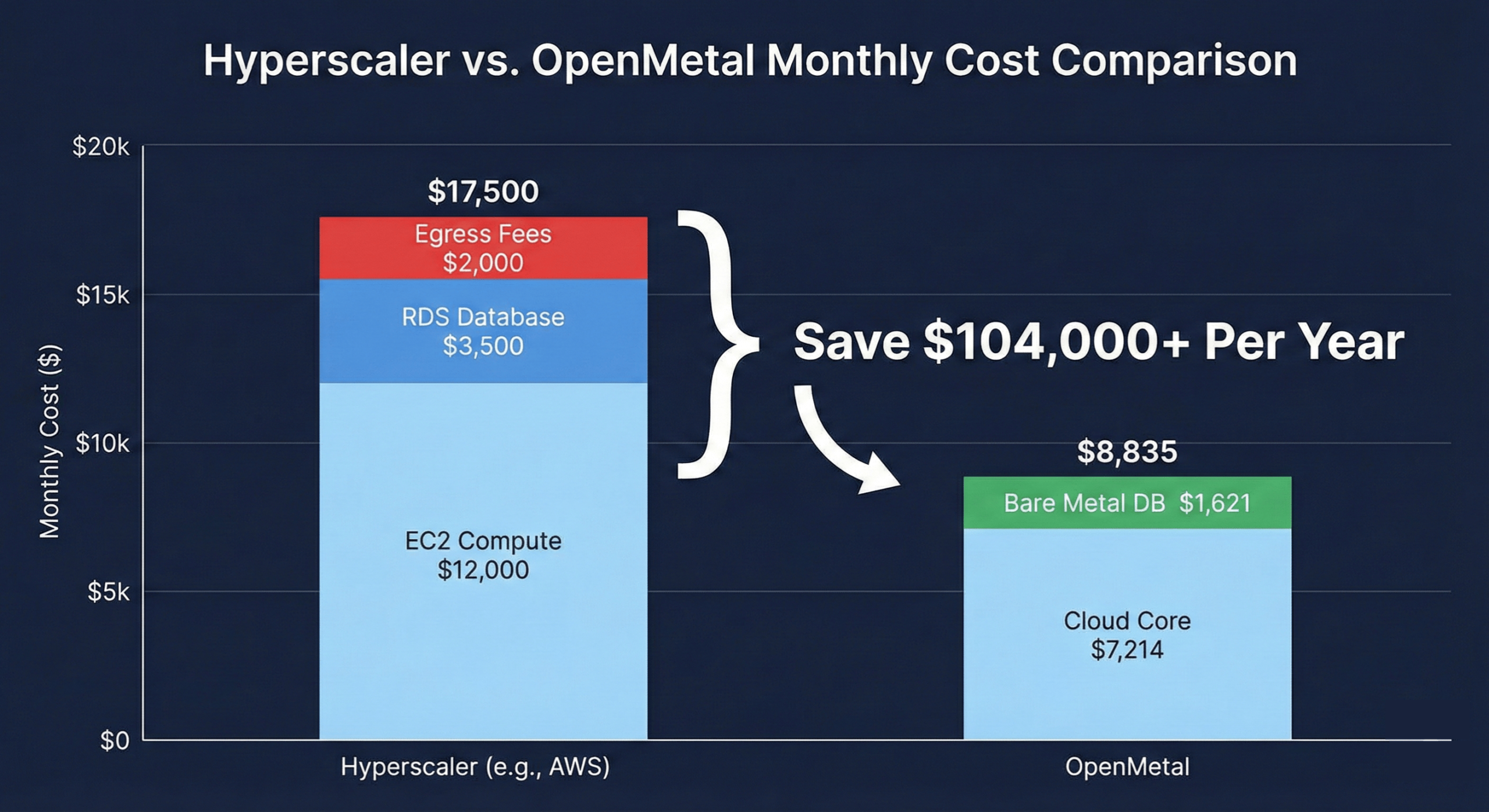
- Total: ~$8,835/month
Now supporting:
- 293 VMs for expanded workloads
- Primary + read replica databases for high availability
- Increased capacity for 1,000+ European customers
Cost Comparison:
Running equivalent workloads on AWS eu-central-1:
- EC2 instances: ~$12,000/month
- RDS for PostgreSQL: ~$3,500/month
- Data transfer: ~$2,000/month
- Total: ~$17,500/month
OpenMetal savings: ~$8,665/month or ~$104,000/year
The Amsterdam Data Center: Digital Realty AMS3
OpenMetal’s Amsterdam infrastructure is located in Digital Realty’s AMS3 facility, positioned just 10 minutes from Schiphol Airport.
Facility Specifications:
Power and Reliability:
- 2,300 kW utility power capacity
- N+1 UPS redundancy
- N+1 cooling redundancy
- 100% renewable, carbon-free energy
- Dual power feeds with independent UPS and generator backup
- 99.999% availability SLA
Security:
- 24×7 onsite security personnel
- Biometric and photo badge access control
- CCTV monitoring with 90-day backup
- Advanced alarm and monitoring systems
- Fire retardant walls with automatic gas suppression
Connectivity:
- Direct access to 4 internet exchanges
- AMS-IX certified
- 210+ carriers, ISPs, and CDNs
- Dual-entry fiber from separate carrier routes
- SLA-based cross-connect installation
Compliance:
- SOC Type 1 and Type 2
- PCI-DSS
- ISO 27001 (Information Security)
- ISO 50001 (Energy Management)
- ISO 22301 (Business Continuity)
For MENA companies accustomed to world-class facilities in Dubai or Riyadh, AMS3 delivers equivalent standards in the heart of Europe.
Getting Started: Timeline and Process
Week 1: Planning and Scoping
- Initial consultation with OpenMetal team
- Review infrastructure requirements
- Discuss compliance needs (GDPR, sector-specific regulations)
- Propose architecture (bare metal, private cloud, or hybrid)
Week 2-3: Provisioning
- Hardware allocation and configuration
- Network setup (IPs, VLANs, routing)
- Storage configuration
- Access credentials and initial setup
Week 4: Migration and Testing
- Data migration from MENA to Amsterdam
- Application deployment
- Performance testing
- Security audit and compliance verification
Week 5+: Production Launch
- Gradual traffic shift from MENA to Amsterdam for European customers
- Monitoring and optimization
- Team training on management tools
- Ongoing support
Most MENA companies are serving European customers from Amsterdam infrastructure within 4-6 weeks.
Common Questions from MENA Companies
Q: Can we keep some infrastructure in MENA and some in Amsterdam?
Yes. Many companies maintain dual-region deployments:
- User authentication and session management in Amsterdam (GDPR compliance)
- Application logic in both regions
- Customer data geographically distributed based on customer location
- Asynchronous replication between regions for disaster recovery
OpenMetal’s consistent infrastructure across regions makes hybrid deployments straightforward.
Q: What about data transfer costs between MENA and Amsterdam?
OpenMetal provides fair egress pricing without surprise bills. Typical scenarios:
- Replication traffic MENA→Amsterdam: Plan for actual usage
- European customer traffic: Served locally from Amsterdam (no cross-region transfer)
- Development team access Dubai→Amsterdam: Minimal impact
Contact OpenMetal for specific egress pricing based on your architecture.
Q: Can we visit the data center for audits?
Yes. Digital Realty AMS3 is 10 minutes from Schiphol Airport, making it accessible for MENA-based teams. Many companies schedule quarterly visits for compliance audits, hardware inspections, or on-site troubleshooting.
Q: What if we need to scale beyond one data center?
OpenMetal supports multi-region deployments. Common expansion paths:
- Start in Amsterdam for EU market
- Add US location for American customers
- Keep MENA infrastructure for regional customers
- Deploy consistent OpenStack-based private cloud across all regions
Q: How does support work across time zones?
OpenMetal provides 24×7 support. For MENA companies:
- Morning in Dubai (8 AM GST) = 6 AM CET (Amsterdam time)
- Support teams available across UAE, European, and US hours
- Ticket system for asynchronous communication
- Emergency escalation for critical issues
Why Not Just Use a Hyperscaler?
Many MENA companies start European expansion on AWS, Azure, or Google Cloud. Here’s why they migrate to OpenMetal:
Predictable Costs:
- Hyperscalers: Variable monthly bills, surprise egress charges, complex pricing
- OpenMetal: Fixed monthly costs, predictable scaling, transparent egress
Performance:
- Hyperscalers: Noisy neighbor problems, CPU throttling, variable I/O
- OpenMetal: Dedicated resources, consistent performance, bare metal option
Control:
- Hyperscalers: Abstracted infrastructure, limited access, vendor lock-in
- OpenMetal: Full root access, OpenStack APIs, no platform lock-in
Compliance:
- Hyperscalers: Shared responsibility model, complex compliance verification
- OpenMetal: Dedicated infrastructure, clear data residency, easier audits
Support:
- Hyperscalers: Tiered support, long response times, offshore teams
- OpenMetal: Direct engineering support, faster resolution, infrastructure expertise
For a growing MENA tech company, OpenMetal delivers hyperscaler-quality infrastructure without hyperscaler complexity and costs.
Take the Next Step
Amsterdam offers MENA tech companies the perfect entry point to the European market: outstanding connectivity to both MENA and European markets, straightforward GDPR compliance, and access to 450 million European consumers.
OpenMetal makes Amsterdam deployment simple with enterprise-grade bare metal servers and private cloud infrastructure, predictable pricing, and expert support for MENA companies navigating European expansion.
Ready to expand to Europe?
Schedule a consultation with OpenMetal’s team to discuss your Amsterdam infrastructure requirements. Whether you need bare metal for maximum performance, private cloud for flexibility, or hybrid infrastructure for complex architectures, we’ll help you deploy the right solution for your European expansion.
Learn More:
- Amsterdam Data Center Facility Specs
- Hosted Private Cloud Pricing Calculator
- Bare Metal Server Catalog
- Contact OpenMetal Sales
Schedule a Consultation
Get a deeper assessment and discuss your unique requirements.
Read More on the OpenMetal Blog