




















In this article
Amsterdam has emerged as the leading European base for crypto, blockchain, and Web3 infrastructure, combining EU regulatory clarity through MiCA with world-class connectivity at AMS-IX and bare metal hardware that supports the full range of demanding workloads.
For years, crypto and blockchain teams building in Europe faced a frustrating tradeoff: favorable regulatory environments came with mediocre infrastructure options, while world-class data centers were concentrated in jurisdictions that either restricted crypto workloads or buried teams in unpredictable billing. Amsterdam changes that equation.
The Netherlands is now one of the leading jurisdictions for MiCA (Markets in Crypto-Assets) licensing in the EU, home to some of the world’s most connected data center infrastructure, and increasingly the base of operations for serious crypto-native teams. If you’re building DeFi protocols, validator networks, confidential compute applications, or cross-chain tooling, the case for Amsterdam is worth understanding, not just from a legal standpoint, but from a performance one.
The Regulatory Shift That Changed Where Crypto Builds
MiCA fully came into force in December 2024, establishing a uniform EU-wide framework for crypto-asset service providers (CASPs). For the first time, companies operating in crypto, including exchanges, custody platforms, token issuers, DeFi tooling providers, and others, have a defined legal path to serve the entire EU market from a single authorization.
The Netherlands moved early. Authorities in the Netherlands issued the first MiCA licenses on December 30, 2024 itself, and the majority of CASP licenses issued so far across the EU have come out of the Netherlands. The Dutch Authority for the Financial Markets (AFM) began accepting advance MiCA authorization applications as early as April 2024, giving teams that moved quickly a head start on compliance and, more importantly, on passporting rights.
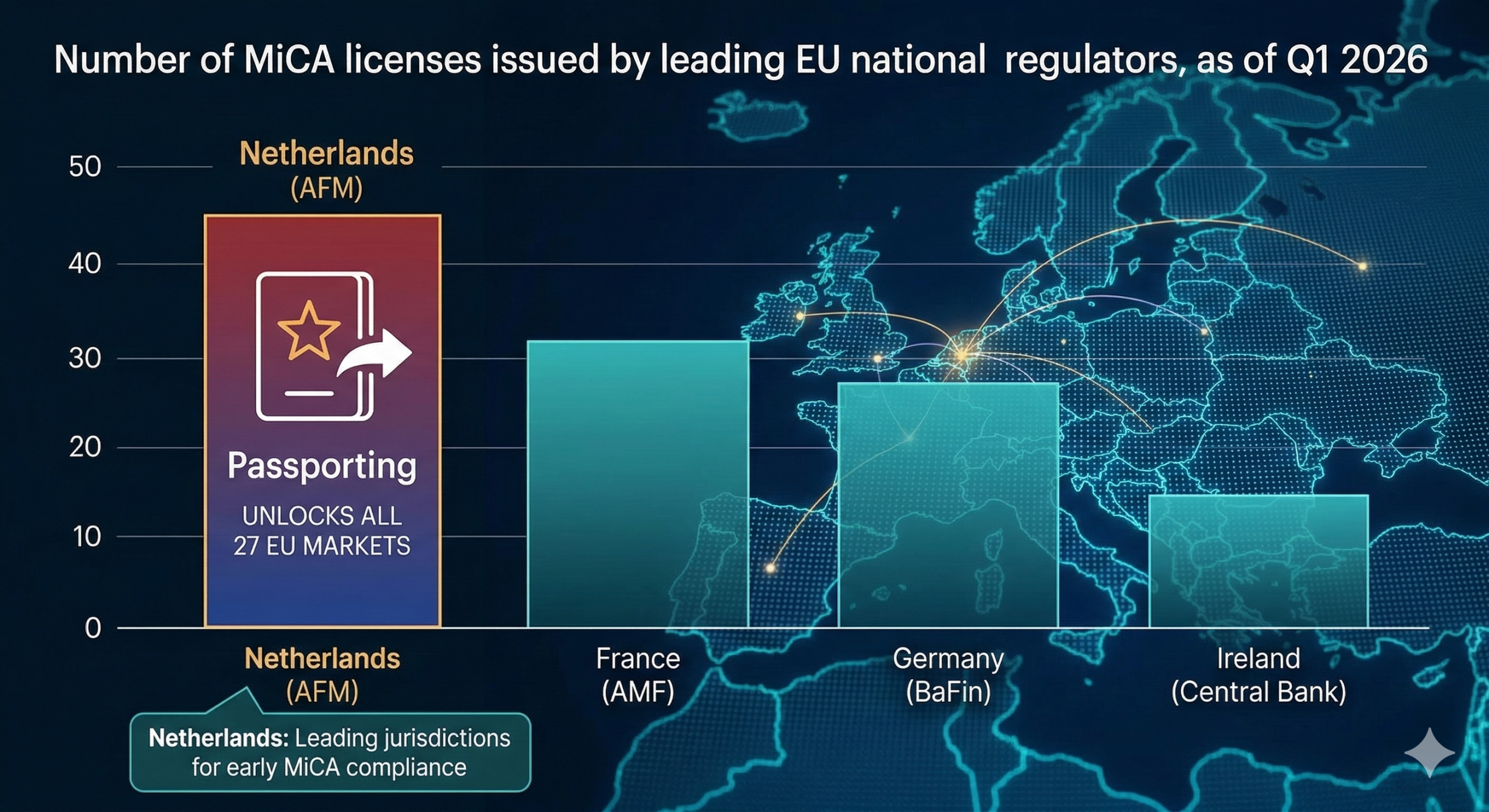
That passporting matters enormously. Once a CASP receives authorization in a single EU country, it can extend operations to other EU countries without obtaining additional licenses. That right only applies to fully MiCA-authorized entities, not those operating under transitional grandfathering periods. For a crypto startup or DeFi protocol trying to serve European users, that’s the difference between building a business and building a compliance obstacle course.
The contrast with the US regulatory environment has been stark. US-based crypto and blockchain teams have spent years operating under jurisdictional uncertainty, enforcement-by-litigation, and shifting agency guidance. Amsterdam has seen a surge in inbound interest from foreign firms seeking to establish their European base of operations as a direct result of MiCA providing a clear, consistent framework for crypto businesses.
Why Amsterdam, Specifically
The Netherlands has built the kind of infrastructure concentration that makes Amsterdam a natural anchor point for any latency-sensitive application, which is exactly what most blockchain workloads are.
The city sits at the crossroads of transatlantic and intra-European fiber routes. The Amsterdam Internet Exchange (AMS-IX) is one of the largest internet exchanges in the world, which means your application can reach peering partners, validators on other networks, oracles, and end users across Europe with low, predictable latency. For block propagation, transaction finality, MEV workflows, and real-time DeFi settlement, that connectivity profile is a technical advantage, not just a logistical convenience.
It’s also increasingly a community and talent hub. Amsterdam hosts regular blockchain and crypto events, including Dutch Blockchain Week, scheduled for June 2026 and drawing major institutional participants from Fireblocks, Kraken, OKX, Visa, and Mastercard, reflecting how the city has evolved from a grassroots crypto scene into a serious B2B infrastructure and finance hub.
What Crypto and Blockchain Teams Actually Need From Infrastructure
Before getting into specific use cases, it’s worth being direct about what actually makes infrastructure matter for crypto and blockchain workloads, because the failure modes are specific.
Public cloud restrictions are real. Some of the largest cloud providers have historically restricted or outright banned certain crypto-related workloads. Teams have woken up to suspended accounts, throttled capacity, or policy violations with little warning. If you’re running validator infrastructure, MEV-related tooling, or blockchain data pipelines at scale, you need a provider that explicitly supports these workloads, not one that tolerates them conditionally.
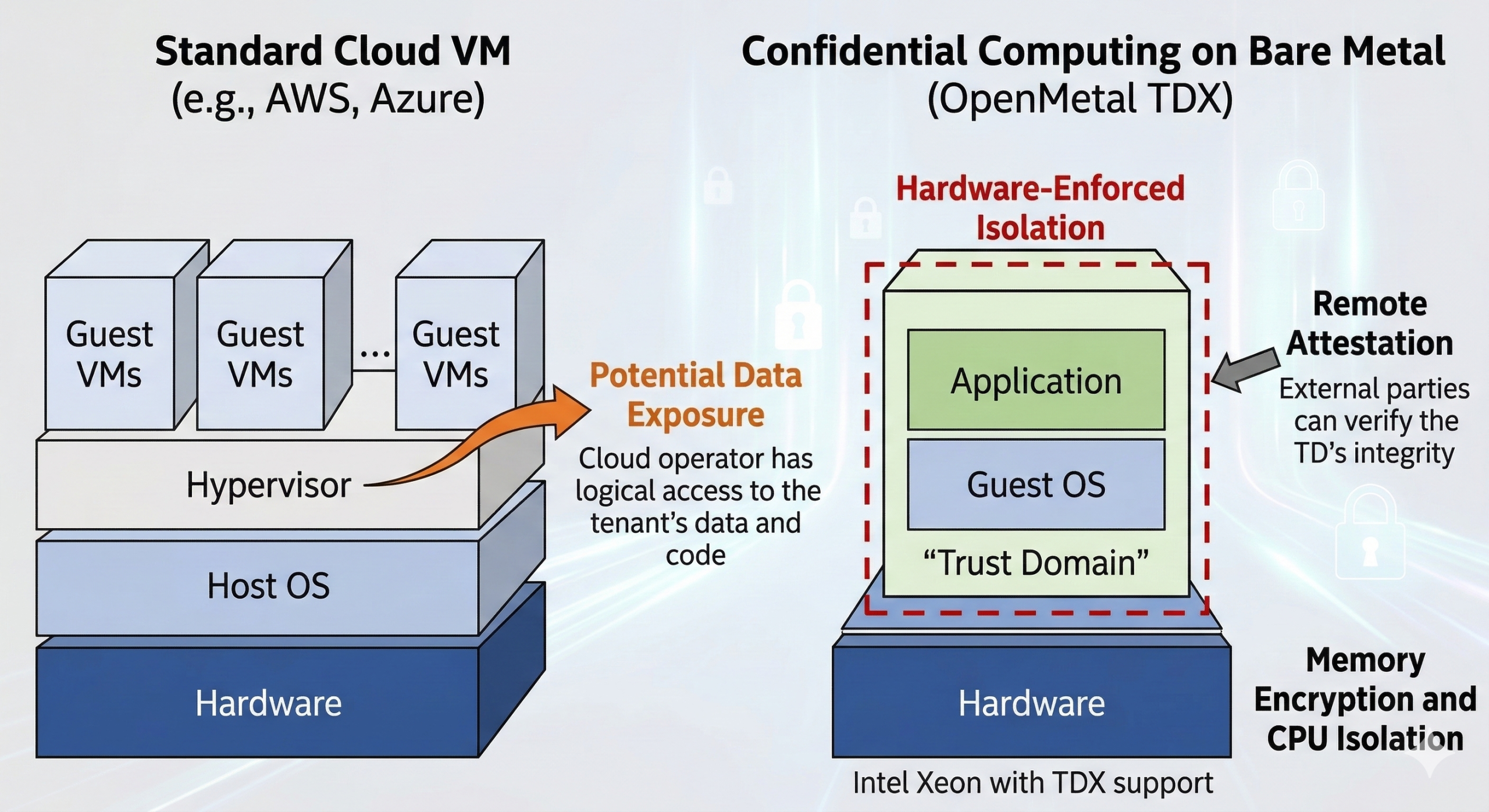
Virtualization is the enemy of some workloads. Blockchain nodes, validator infrastructure, and confidential computing applications frequently require bare metal access. Attestation-based protocols, especially anything using Intel TDX, depend on hardware-level verification that a hypervisor layer obscures or breaks entirely. Teams running DePIN networks, privacy-preserving smart contract environments, or MEV infrastructure built on TEEs cannot reliably run these workloads in shared cloud VMs.
Egress costs compound fast. Blockchain nodes, archive nodes, RPC endpoints, and data-heavy applications move enormous amounts of data. On AWS or GCP, that egress is metered and billed at rates that can turn a $10K/month infrastructure budget into a $40K/month surprise as traffic scales. Predictable egress pricing isn’t a nice-to-have for this category of workload. It’s a financial planning requirement.
Latency isn’t abstract. For validator nodes, block propagation timing directly affects rewards and slashing risk. For MEV workflows, the difference between winning and losing a transaction inclusion race can be measured in milliseconds. Infrastructure geography and network topology become performance variables.
OpenMetal’s bare metal servers and hosted private cloud are designed for exactly this profile: dedicated hardware, no crypto workload restrictions, fixed monthly pricing, and direct access to AMS-IX from the Amsterdam facility.
Use Case: Validator Nodes and RPC Endpoints
Running validator infrastructure is one of the most infrastructure-sensitive workloads in the blockchain space. Whether you’re operating Ethereum validators, Solana nodes, Cosmos validators, or building a network like Sui, which has reached out to bare metal providers specifically to support its growing node operator base, the underlying requirements are consistent: dedicated CPU resources, NVMe storage, high-bandwidth networking, and consistent sub-millisecond network responsiveness.
The problems with running validators on public cloud are well-documented:
- Noisy neighbors introduce CPU and I/O contention that breaks timing guarantees
- Shared networking causes latency spikes at exactly the wrong moments, during high-traffic periods when other validators are also competing for block slots
- Egress metering turns RPC endpoint traffic into a variable cost that scales with adoption in ways that are hard to predict
- Workload policy risk creates operational uncertainty that has no place in infrastructure you depend on for staking rewards
On OpenMetal bare metal in Amsterdam, your validator runs on hardware dedicated entirely to your workload. There are no VMs splitting CPU time, no shared network pipes, and no usage-based billing surprises. For teams running validator networks on behalf of delegators, that operational reliability has direct economic implications. Missed attestations and slashing events are costly in ways that make cheap shared cloud look expensive in retrospect.
The Amsterdam location specifically benefits teams serving European DeFi users and protocols. Proximity to AMS-IX means lower round-trip times to other European validators, oracle services, and L2 sequencers. For Ethereum validators, that proximity translates to faster block propagation and more competitive attestation inclusion.
OpenMetal recommends Medium V4 or Large V4 bare metal servers for most PoS validator workloads, with XL or XXL V4 configurations for memory-heavy networks like Solana. Teams running validators alongside sentry nodes and RPC endpoints can combine bare metal compute with Ceph-based block storage for state snapshots and historical data, keeping the full stack on dedicated infrastructure within the same Amsterdam facility.
Use Case: DeFi Protocols and Cross-Chain Applications
DeFi protocols occupy a specific category of blockchain infrastructure need: they require infrastructure that supports both the protocol’s own validators or sequencers and the surrounding tooling, including indexers, RPC endpoints, monitoring systems, and data pipelines, that makes the protocol usable.
Teams building cross-chain applications face an additional dimension. Protocols enabling private cross-chain transactions, cross-domain MEV internalization, or multi-chain settlement need infrastructure that can run multiple node types across different networks while maintaining data sovereignty and consistent performance.
Flashbots, the research and development organization focused on MEV transparency and democratization on Ethereum, is a direct example of the kind of infrastructure-intensive blockchain team that has chosen providers like OpenMetal. Their BuilderNet infrastructure runs on Trusted Execution Environments (TEEs) for verifiable block building, which represents exactly the kind of workload that requires bare metal with hardware attestation support. BuilderNet is a decentralized block building network for Ethereum that runs on TEEs and shares MEV with the community, and the attestation requirements that make it work are incompatible with virtualized cloud infrastructure.
For DeFi protocols operating under MiCA or building toward compliance, the Amsterdam data center also offers a regulatory positioning advantage. Operating infrastructure within an EU-licensed jurisdiction, from a facility with SOC 2, PCI-DSS, and ISO 27001 compliance, provides an audit trail and data residency story that regulators and institutional partners increasingly expect to see.
For DeFi teams evaluating infrastructure, the practical starting point is typically a combination of bare metal for compute-intensive node work and OpenMetal’s hosted private cloud for the surrounding orchestration layer, giving you OpenStack-based VM management, Ceph storage, and private networking within a single fixed-cost environment.
Use Case: Confidential Computing for Privacy-Preserving Blockchain Apps
One of the clearest signals from the crypto and blockchain infrastructure space is the growing appetite for confidential computing, specifically Intel TDX on bare metal. Teams building privacy-preserving DeFi, confidential smart contracts, secure oracle environments, and zero-knowledge-adjacent infrastructure are actively searching for providers that can deliver hardware-level isolation with attestation support.
The reason is architectural. Confidential smart contracts and privacy-preserving applications need to guarantee that computation happens in a tamper-proof environment, not just logically isolated in software, but physically isolated at the CPU level. Intel TDX (Trust Domain Extensions) provides that guarantee through hardware-enforced Trust Domains that protect code and data from the host OS, hypervisor, and other tenants. Remote attestation allows external parties to cryptographically verify that a workload is running in a genuine TDX environment before sharing sensitive inputs.
As computation moves across infrastructure boundaries, verifiable execution becomes a prerequisite for trust. Remote attestation and confidential computing provide a way to establish security guarantees without relying solely on infrastructure operators or centralized trust assumptions.
OpenMetal’s Intel TDX bare metal offering in Amsterdam is purpose-built for this category. The XL V4 configuration features 2x Intel Xeon with TDX support, 256GB DDR5 RAM, 6.4TB NVMe storage, and 20 Gbps networking, giving teams the memory capacity and compute headroom to run production confidential workloads alongside the storage needed for full state management.
Teams coming from providers like Azure who have evaluated OpenMetal’s TDX offering are often comparing on attestation reliability and memory flexibility. The ability to customize RAM configurations (384-512GB for teams that need it) and provision without delays is a practical operational advantage for research teams and production deployments alike. See Intel TDX performance benchmarks and the confidential computing blog series for technical depth on workload optimization.
Privacy-preserving applications running from Amsterdam can also lean on the Netherlands’ strong data protection framework and GDPR alignment, relevant for any protocol handling user transaction data, zero-knowledge proof generation, or private input pipelines where data residency and jurisdictional coverage matter.
Use Case: Blockchain Data Infrastructure and Analytics
Not every blockchain workload is a validator or a smart contract. A significant portion of the ecosystem is built on data: archive nodes, indexers, analytics platforms, and blockchain intelligence services that require enormous storage capacity and high-throughput query performance.
Teams building Solana and multi-chain data products, for example, need infrastructure capable of storing full historical ledger state across multiple chains while serving high-concurrency query loads. The storage requirements here are substantial. Deployments of 5PB and larger are not uncommon for teams building serious archive or analytics infrastructure, and the cost structure of hyperscaler object storage at that scale can become a primary financial concern.
OpenMetal’s Ceph storage clusters offer an attractive alternative for this category: distributed, high-performance object, block, and file storage with fixed monthly pricing and predictable egress costs. For data-heavy blockchain workloads, the ability to co-locate compute and storage within the same Amsterdam facility, connected over high-speed internal networking rather than metered cross-region transfers, materially changes the economics.
Teams can pair Ceph storage with dedicated bare metal compute to run indexers, archive nodes, or analytics workloads in a single-tenant environment, with full control over storage topology and access patterns. Use the egress pricing calculator to model how egress costs compare to your current provider at your data volumes.
Use Case: Layer 2 Sequencers and Rollup Infrastructure
Layer 2 networks and rollup architectures represent one of the fastest-growing categories of blockchain infrastructure demand. Sequencers, provers, DA layers, and rollup nodes each have distinct hardware requirements, and the teams running them are increasingly sophisticated about infrastructure choices.
Rollup sequencers in particular are latency-sensitive in ways that matter commercially. Near-instant confirmation times, like those Flashbots targets with Flashblocks, depend on sequencer infrastructure that can sustain high transaction throughput without queueing delays. That requires dedicated CPU resources, fast NVMe storage for transaction ordering, and consistent network responsiveness.
Rollup-Boost extends Flashbots’ products to Ethereum rollups with a lightweight sidecar designed to upgrade existing sequencers, delivering near-instant confirmations, transparent priority ordering, and robust MEV internalization. Infrastructure running this kind of sequencer software needs isolation from competing workloads and hardware that doesn’t throttle under sustained load, which is precisely what bare metal provides.
For teams building rollups on OP Stack or other modular frameworks, OpenMetal’s Amsterdam facility gives you the compute, storage, and networking profile to run sequencer and prover infrastructure close to European users and other Ethereum validators, without cloud provider restrictions on how you configure or use the hardware.
OpenMetal’s Amsterdam Data Center: What’s Under the Hood
OpenMetal operates in the Digital Realty AMS3 facility in Amsterdam, located 10 minutes from Schiphol Airport. The facility is built for the kind of uptime and connectivity that production blockchain infrastructure requires:
Power and redundancy: 2,300 kW utility capacity, N+1 UPS redundancy, N+1 cooling redundancy, and two separate power feeds with independent UPS and generator backup for each, rated for indefinite full-load running. The facility operates on 100% renewable energy.
Connectivity: Direct access to 4 Internet Exchange Points (IXPs), AMS-IX certified, with more than 210 fixed and mobile carriers, ISPs, and CDNs. Dual-entry fiber from two separate carrier routes ensures no single point of failure at the network layer.
Compliance: The facility holds SOC Type 1 and Type 2, PCI-DSS, ISO 27001, ISO 50001, and ISO 22301 certifications, relevant for teams operating under MiCA compliance requirements or serving institutional clients who conduct infrastructure due diligence.
Reliability SLA: 99.999% availability.
For teams that need to demonstrate infrastructure maturity to regulators, auditors, or institutional partners, the facility’s compliance posture is worth documenting in your own due diligence materials.
Fixed-Cost Infrastructure in a Variable-Cost World
One of the consistent themes from crypto and blockchain teams evaluating infrastructure is the tension between variable hyperscaler billing and the financial predictability that operational maturity requires. Teams currently spending $5,000-$10,000/month on AWS or GCP for blockchain workloads often find that costs scale non-linearly as traffic grows. RPC request volume, egress, and cross-region data transfer charges compound in ways that are hard to model in advance.
OpenMetal operates on a fixed monthly cost model. Whether it’s a bare metal server or a full hosted private cloud, you know the number before the month starts. That predictability matters in three concrete ways for blockchain infrastructure:
- Budget planning: Token treasury management, grant-funded projects, and investor-backed startups all benefit from infrastructure costs that don’t vary with protocol adoption curves.
- Scaling decisions: When you know exactly what the next increment of infrastructure costs, you can make rational provisioning decisions rather than under-provisioning to avoid bill surprises.
- Migration economics: Teams migrating from AWS or GCP can model the TCO comparison accurately. The savings from fixed pricing often cover the migration effort within the first quarter.
Getting Started
If you’re building validator infrastructure, DeFi tooling, confidential computing applications, or data-heavy blockchain services in Europe, the Amsterdam facility is worth a direct conversation.
Review bare metal pricing for dedicated server configurations, including TDX-enabled hardware. Use the egress calculator to model bandwidth costs against your current provider. Explore the broader blockchain infrastructure content library for technical depth on specific workload categories.
If you have a specific use case or want to run a proof of concept before committing, contact the OpenMetal team to discuss your architecture. Crypto and blockchain workloads are explicitly supported, with no restrictions on validator nodes, RPC endpoints, DeFi protocols, or confidential compute applications.
Schedule a Consultation
Get a deeper assessment and discuss your unique requirements.
Read More on the OpenMetal Blog