



















In this article
Hardware costs are up significantly in 2026 and the supply dynamics driving that aren’t short-term. Server DRAM prices surged nearly 95% in early 2026. AI infrastructure demand is consuming global supplies of high-performance components faster than manufacturers can respond. Everyone buying infrastructure right now is paying more. Your pricing model determines how much visibility you have into those costs before they show up in your budget.
If you’ve priced out server hardware recently and felt sticker shock, you’re not imagining it. CIOs and IT leaders across the industry are reporting the same thing. The structural shift happening in the hardware supply chain is real, it’s affecting every infrastructure provider including OpenMetal, and it has specific implications for how organizations should think about infrastructure procurement and budget planning.
What’s Actually Driving the Supply Crunch
The hardware cost increases of 2026 trace back to a single dominant force: the AI infrastructure buildout happening at hyperscaler scale.
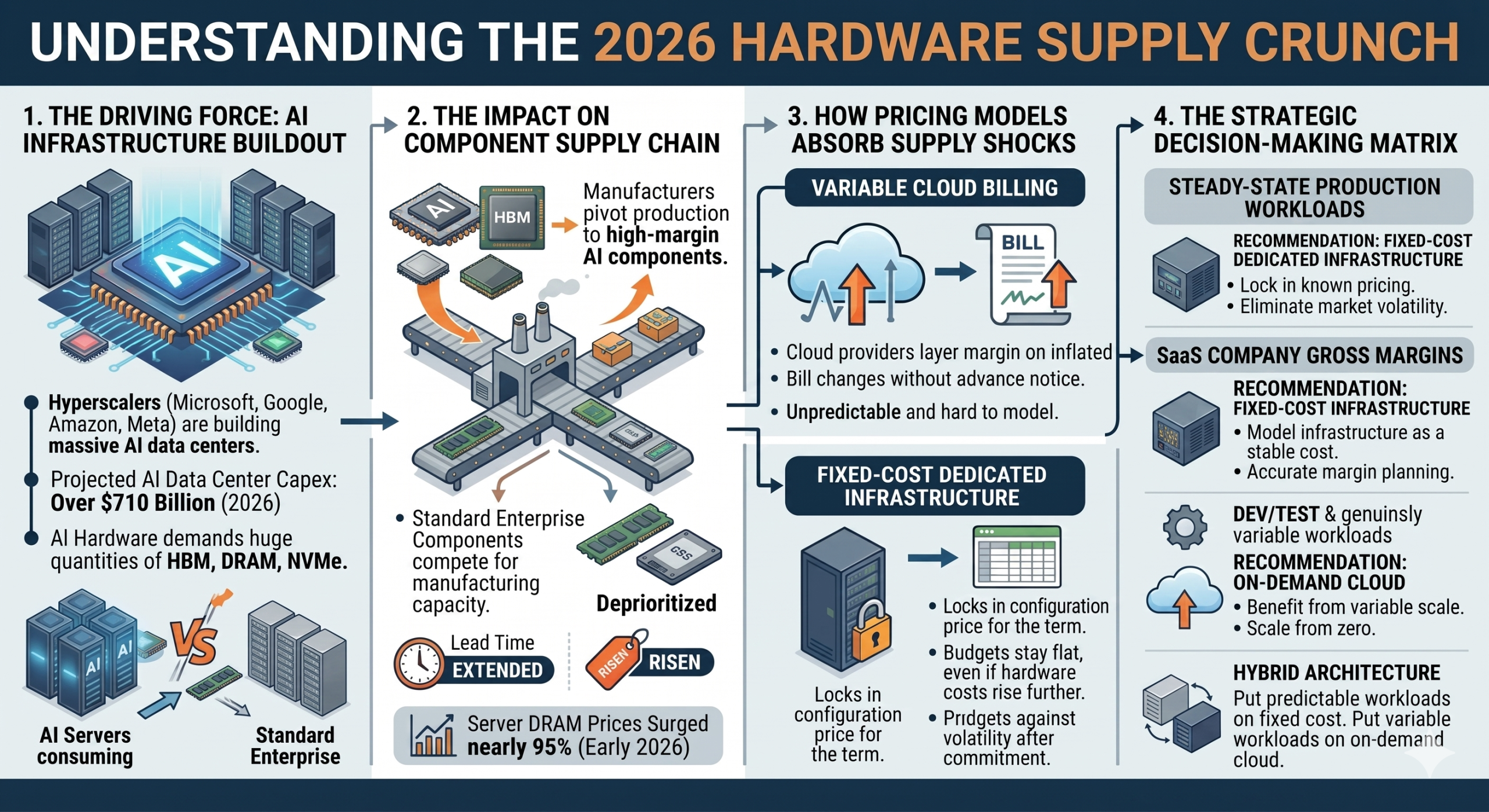
Microsoft, Google, Amazon, and Meta are collectively spending hundreds of billions of dollars building AI data centers. Combined capital spending among top cloud providers is forecast to exceed $710 billion in 2026. Those data centers require massive quantities of High Bandwidth Memory, high-performance DRAM, and NVMe storage, all of which are the same components that go into standard enterprise servers.
The result is a supply constraint that affects everyone downstream. Manufacturers have pivoted production toward the high-margin AI components that hyperscalers are buying in volume. Standard enterprise server components are competing for capacity with AI hardware at a scale that hasn’t been seen before. Lead times have extended. Prices have risen accordingly.
Server DRAM prices surged nearly 95% in early 2026, and the underlying supply dynamics don’t point toward a quick resolution. The AI buildout is a multi-year investment cycle. The component supply constraints are structural, not cyclical. Organizations planning their infrastructure budgets around 2024 hardware cost assumptions are working with numbers that no longer reflect reality.
This affects every infrastructure provider. OpenMetal’s new v5 hardware reflects current market pricing. Anyone telling you they’ve found a way around the supply crunch is worth scrutinizing carefully.
How Hyperscaler Pricing Absorbs and Amplifies Supply Shocks
Public cloud pricing and dedicated infrastructure pricing respond to supply shocks differently, and understanding that difference matters for budget planning.
Hyperscalers buy hardware at enormous scale, which gives them real negotiating leverage with manufacturers. That leverage means they absorb supply cost increases somewhat, but it doesn’t eliminate the pass-through to customers. On-demand cloud pricing is adjusted periodically to reflect underlying cost changes. Reserved instance pricing locks in today’s rates for a commitment period, which provides some protection, but the commitment itself creates flexibility constraints that have their own cost.
The more significant issue with hyperscaler pricing during a supply crunch is the compounding effect. Cloud providers layer margin on top of hardware costs, and that margin applies to the inflated hardware cost. A 95% increase in server DRAM costs doesn’t necessarily translate to a 95% increase in cloud compute prices, but it does translate to something, and customers often find out through bill changes rather than advance notice.
Variable cloud billing also makes supply-driven cost increases harder to see and plan for. When your infrastructure bill changes because you used more compute, that’s predictable from usage data. When it changes because the underlying hardware cost basis shifted, that’s harder to model in advance. For organizations with tight infrastructure budgets or board-level scrutiny on cloud spend, that unpredictability is a real planning problem.
The public cloud cost tipping point article covers the broader cost comparison between hyperscaler and private cloud pricing in more detail, including the scale thresholds where the economics shift.
What Fixed-Cost Infrastructure Actually Protects You From
This is worth being direct about, because the claim here is specific and not a broader claim that dedicated infrastructure is cheaper across the board.
Fixed-cost dedicated infrastructure doesn’t make hardware cheaper. OpenMetal’s v5 servers are priced to reflect current market conditions, which means current market hardware costs. The protection that fixed-cost pricing provides is against ongoing volatility once you’ve committed to a configuration.
When you agree to a monthly price for a dedicated server or private cloud configuration, that price is your price for the term of the agreement. If hardware costs go up further next quarter, your bill doesn’t move. If the supply crunch deepens and component prices climb another 30%, your infrastructure budget line stays where it was when you signed up. You can model your infrastructure costs accurately for a 12, 24, 36 month or more planning horizon without building in a volatility buffer.
That predictability has a real financial value that’s easy to underestimate when hardware costs are stable. When hardware costs are volatile, it becomes more concrete. Finance teams that have had to revise infrastructure budget projections upward mid-year because of unexpected cloud cost increases understand this directly.
The flip side is also true. If hardware costs come down significantly, you won’t benefit from that on a committed fixed-cost configuration. Fixed-cost pricing is a hedge against upside volatility, not a guarantee of the lowest possible price at any given moment. For organizations whose primary infrastructure concern is budget predictability rather than opportunistic cost optimization, it’s the right tradeoff.
The v5 Hardware Reality
OpenMetal’s v5 server generation reflects the current hardware market. Performance is substantially improved over previous generations, and pricing reflects both the performance improvement and the current cost of the components that deliver it.
The v5 lineup is built on Intel’s Granite Rapids architecture using the Intel 3 process node, a meaningful step up from the Intel 7 process used in v4’s Emerald Rapids processors. The practical results show up in every tier:
The Medium v5 runs dual Intel Xeon 6505P processors with 256GB DDR5-6400 memory and Micron 7500 MAX NVMe storage. Compared to the Medium v4, it delivers more than 2x the L3 cache per socket and 45% faster memory bandwidth. For containerized databases, mid-scale Kubernetes, and multi-threaded analytics workloads, that cache improvement is meaningful at the workload level.
The Large v5 pairs dual Intel Xeon 6517P processors with 512GB DDR5-6400 and Micron 7500 MAX storage. It delivers nearly double the L3 cache of the Large v4, 23% faster memory bandwidth, and runs at 190W TDP versus 225W on the v4. More performance per watt, which translates to better sustained throughput under sustained workloads.
The XL v5 brings dual Intel Xeon 6530P processors, 1TB DDR5-6400, and 25.6TB of Micron 7500 Max NVMe. Intel AMX provides hardware acceleration for AI inference workloads, and full TDX and SGX support is included for confidential computing deployments. For high-density virtualization, AI inference pipelines, and large-scale analytics, the XL v5 is substantially ahead of what the XL v4 delivered.
All v5 servers include the same 20 Gbps private networking, fixed monthly pricing, and no shared tenancy that the v4 generation established. The performance gains are real and the pricing reflects both those gains and what current-generation Granite Rapids components cost in the current market.
The v5 hardware preorder page has current availability and details across all configurations.
How to Think About Infrastructure Decisions Right Now
The supply crunch creates a specific set of considerations for infrastructure procurement that are worth working through systematically.
For steady-state production workloads, the case for fixed-cost dedicated infrastructure is stronger than it’s been in a while. If you’re running workloads that have predictable, consistent resource requirements, paying hyperscaler on-demand rates during a period of hardware cost inflation means absorbing both the underlying cost increase and the provider’s margin on top of it. Locking in dedicated infrastructure at a known price removes that exposure.
For compliance-sensitive environments, the supply crunch adds another argument to an already strong case for dedicated infrastructure. Private cloud with dedicated hardware gives you the compliance and auditability benefits of single-tenant infrastructure with a cost structure you can explain to auditors and finance teams without caveats about market-driven variability.
For SaaS companies with predictable growth curves, infrastructure cost predictability is a gross margin planning input. Variable cloud billing that moves based on supply chain dynamics rather than your actual usage makes gross margin forecasting harder. Fixed-cost infrastructure sized to your workload lets you model infrastructure as a stable cost rather than a variable one.
For development and testing environments and genuinely variable workloads, on-demand cloud still makes sense. The supply crunch doesn’t change the fundamental economics of workloads that need to scale from zero or that have highly unpredictable demand. The right answer for most organizations is a hybrid architecture that puts predictable workloads on fixed-cost infrastructure and variable workloads on on-demand cloud.
What the Supply Trajectory Suggests
The supply constraints driving 2026 hardware costs are not expected to resolve quickly. The AI infrastructure buildout is a multi-year capital deployment cycle. Major cloud providers have announced multi-year capex commitments that will continue competing for component supply. Analysts tracking the bare metal cloud market are projecting continued growth, with the global bare metal cloud market forecast to reach between $52 billion and $79 billion by 2033, reflecting sustained demand that will keep pressure on component supply.
This doesn’t mean hardware costs will continue rising at 2026’s pace. Supply chains do respond to demand signals over time, and some relief is likely as manufacturers expand capacity for high-performance components. But the structural shift toward AI-driven hardware demand is permanent, and the days of declining hardware costs that characterized the previous decade of cloud pricing are not coming back in any near-term planning horizon.
For organizations making infrastructure decisions with 18 to 36 month planning horizons, the practical implication is that locking in known pricing now is a more defensible position than deferring and buying at unknown future prices. That’s not a guarantee that costs will be higher later. It’s an observation that the supply dynamics currently in place don’t point toward significant cost relief in the near term.
The bare metal server configurations and private cloud options available today are priced at current market rates. The organizations that understand what they need and commit to it with a clear planning horizon are in a better position than those still treating infrastructure as a month-to-month decision.
Ready to model your infrastructure costs against current market pricing? Use the cloud deployment calculator to see itemized pricing across all configurations, or contact the team to discuss what the right configuration looks like for your workloads.
Schedule a Consultation
Get a deeper assessment and discuss your unique requirements.
Read More on the OpenMetal Blog