


















In this article
Most SaaS companies that have looked at private cloud and walked away did so based on assumptions that were either outdated or never accurate to begin with. Private cloud has a reputation problem that doesn’t match the current reality. This article addresses the misconceptions that most commonly derail evaluations before they get to the numbers.
Private cloud has been on the radar of most SaaS CTOs and founders at some point, usually when an AWS or Azure bill lands that’s hard to explain to the board, or when an enterprise prospect asks a compliance question that’s awkward to answer. What happens next is usually one of two things: the team digs into the evaluation and finds something that works, or they surface a handful of concerns, conclude it’s not the right time, and move on.
The concerns that end most evaluations early are remarkably consistent. They sound reasonable on the surface. Most of them are based on an outdated picture of what private cloud actually involves in 2026. Here’s what those misconceptions are and what the current reality looks like.
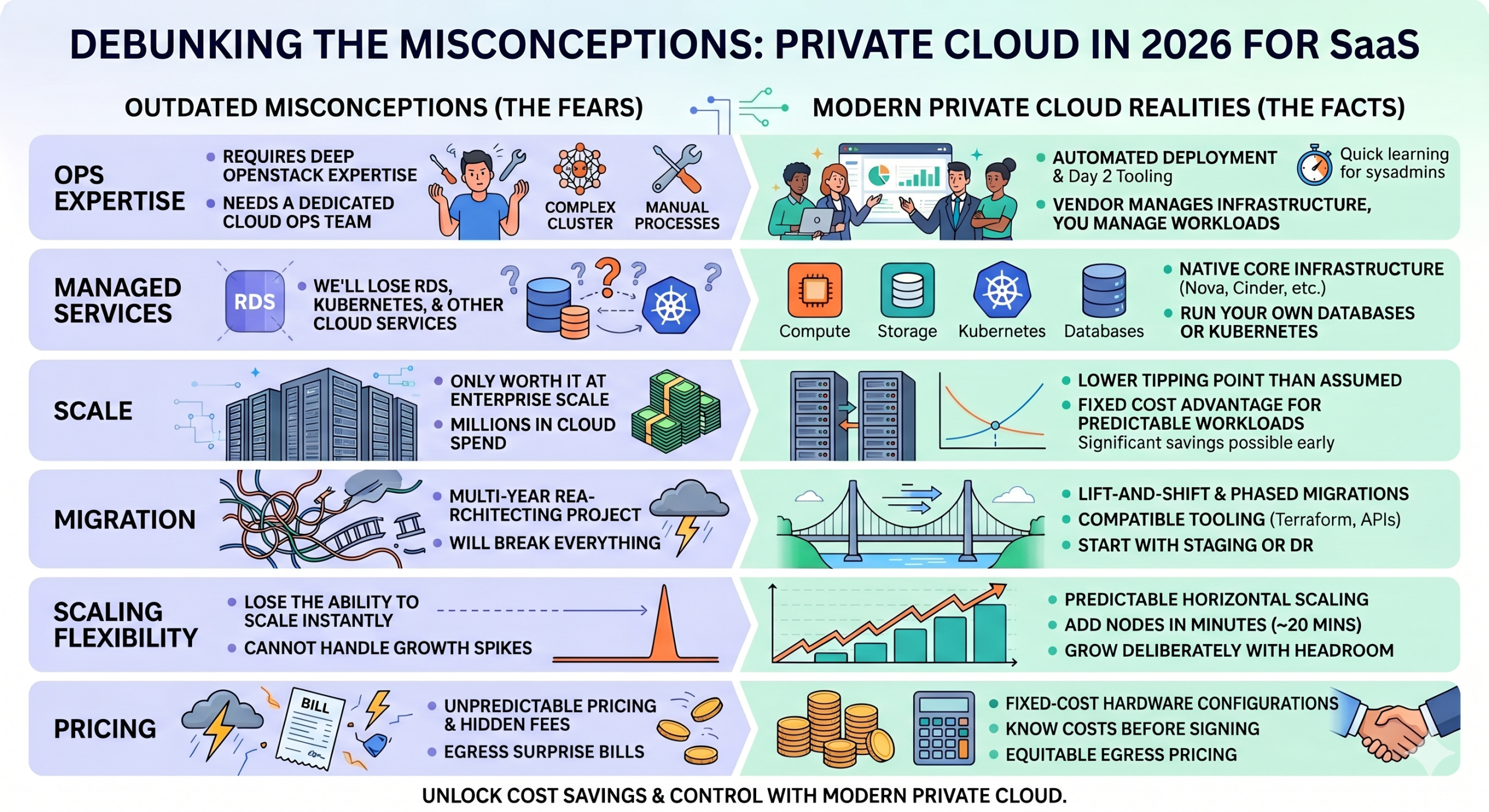
“We Don’t Have the Ops Expertise to Run It”
This is the most common reason SaaS companies give for walking away from private cloud evaluations, and it deserves the most direct response.
The concern is rooted in a real history. Self-managed OpenStack deployments from even five or six years ago were genuinely complex. Standing up an OpenStack cluster from scratch required deep expertise, significant configuration time, and ongoing operational investment that many teams couldn’t justify. That reputation has stuck around longer than the underlying reality warrants.
Hosted private cloud is a different proposition. OpenMetal deploys production-ready private clouds in approximately 45 seconds using proprietary automation. The infrastructure arrives preconfigured with tested, validated OpenStack and Ceph configurations, day 2 operational tooling including monitoring and logging, and a support model built around engineer-to-engineer communication through dedicated Slack channels rather than random ticket queues.
The operational model is straightforward: OpenMetal manages the infrastructure layer, your team manages the workloads running on top. For teams that want to go deeper into OpenStack operations over time, the platform supports that. For teams that want to stay focused on their product, the infrastructure complexity stays with OpenMetal.
As a reference point, skilled Linux sysadmins can learn to maintain an OpenMetal cloud in approximately 40 hours using available guides, and free test clouds are available for training before any production commitment. That’s a different picture than the “you need a dedicated cloud ops team” assumption that often ends evaluations prematurely.
“Private Cloud Means Giving Up Managed Services”
The second most common concern is that moving off AWS means losing the managed services that make hyperscaler infrastructure convenient: RDS, managed Kubernetes, elastic load balancers, CloudFront, and the dozens of other services that SaaS teams have built workflows around.
This one has more validity than the ops expertise concern, so it’s worth being specific about what you actually give up and what you don’t.
OpenStack provides natively: compute (Nova), block storage (Cinder), object storage (Swift), networking with virtual routers, security groups and firewall rules (Neutron), identity and access management (Keystone), and load balancing. These cover the core infrastructure layer that most SaaS applications actually depend on.
For databases, the honest answer is that you’re running your own. That means PostgreSQL, MySQL, or whatever you’re using, managed by your team rather than RDS. For teams already using containerized databases or running databases on EC2 rather than RDS, this isn’t a meaningful change. For teams heavily dependent on RDS-specific features, it’s a real consideration worth factoring into the evaluation.
For Kubernetes, OpenMetal supports Kubernetes workloads on both hosted private cloud and bare metal. If Kubernetes is central to how your SaaS platform operates, this is a workload that translates well.
The broader point is that most SaaS companies, when they audit which managed services they’re actually using versus which ones they’re paying for, find the list is shorter than expected. The evaluation question isn’t “can private cloud replace everything AWS offers”. It’s “can private cloud handle the services my application actually depends on”. For the majority of SaaS workloads, the answer is yes.
“It’s Only Worth It at Enterprise Scale”
The scale misconception is pervasive. Most SaaS founders assume private cloud only makes financial sense at hundreds of servers or millions of dollars in monthly cloud spend. The actual tipping point is lower than most assume.
Convesio, a WordPress hosting platform, cut infrastructure costs by over 50 percent after moving to OpenMetal. They weren’t running enterprise-scale infrastructure when they made that decision. The savings came from the fundamental difference between paying for capacity on dedicated hardware at a fixed monthly rate versus paying hyperscaler per-unit rates that include significant margin for elasticity you may not need.
The math is straightforward. Public cloud costs make sense when your workload is genuinely variable and you need to scale from zero to significant capacity on short notice. For SaaS companies with relatively predictable baseline compute and storage needs, paying for elastic capacity you use maybe 20 percent of the time is expensive. Fixed-cost infrastructure sized to your actual workload is cheaper at a lower scale than most people expect.
A useful starting point is the cloud deployment calculator, which gives itemized pricing across hardware configurations. Running your current AWS or Azure spend against a comparable private cloud configuration usually surfaces the tipping point faster than abstract analysis.
“Migration Will Break Everything”
The migration complexity assumption stops more evaluations than it should. The image most SaaS teams have of a private cloud migration is a multi-year rearchitecting project that requires rewriting application code, rebuilding CI/CD pipelines, and accepting months of parallel operations before anything moves.
That picture applies to migrations that involve significant architectural changes. It doesn’t apply to lift-and-shift migrations of existing workloads, which is how most SaaS companies actually start.
OpenStack’s compute APIs are compatible with standard cloud tooling. Terraform configurations that work on AWS or Azure can be adapted for OpenStack without rewriting application logic. Containerized workloads move cleanly. Virtual machines that run on EC2 can run on OpenStack VMs without modification.
The practical approach most teams take is phased migration rather than a cutover: start with a non-critical workload or a staging environment, validate that the platform works for your specific requirements, then expand from there. A disaster recovery environment is a particularly clean starting point because it runs in parallel with production without requiring any traffic to shift until you’re ready.
The migration fear is real, but it’s usually a fear of a worst-case scenario that doesn’t represent how migrations actually happen when they’re planned and executed incrementally.
“We’ll Lose the Flexibility to Scale”
The elasticity concern is the most technically grounded of the misconceptions, and it’s worth addressing precisely because it has a kernel of truth.
Public cloud’s on-demand scaling model is genuinely useful for workloads with unpredictable or highly variable demand. If your SaaS product can go from a hundred users to a hundred thousand users in a week with no warning, the ability to provision capacity in minutes has real value.
For most SaaS companies, the actual scaling reality is different. Growth is relatively predictable over a planning horizon. Traffic spikes are manageable with pre-provisioned headroom. The scenario where you need to triple your infrastructure capacity overnight is less common than the public cloud narrative suggests.
On OpenMetal, adding capacity to an existing cluster takes approximately 20 minutes. New nodes come online and integrate with the existing environment without downtime. Within your provisioned hardware, you can create as many VMs as the physical resources support, with no per-VM fees and no licensing costs for additional instances. The scaling model is horizontal and deliberate rather than elastic and automatic, which suits the growth patterns of most SaaS businesses better than the “scale to zero” model that public cloud optimizes for.
The honest answer is that if your workload genuinely requires hyperscaler-style elastic scaling, that’s a real constraint. For the majority of SaaS workloads, it isn’t.
“The Pricing Will Be Unpredictable”
The irony of this misconception is that it’s the exact opposite of reality. The unpredictable pricing problem belongs to public cloud, not private cloud.
SaaS founders and CTOs who have been burned by unexpected AWS bills, surprise egress charges, or data transfer costs that appeared out of nowhere have developed a generalized skepticism about infrastructure pricing. That skepticism is warranted when applied to public cloud. It doesn’t transfer to fixed-cost infrastructure.
OpenMetal’s pricing is based on dedicated hardware configurations at a fixed monthly rate. You know what it costs before you sign up. The cloud deployment calculator shows itemized pricing for every configuration without a sales call. There are no per-VM fees, no charges for VMs you create and delete within a billing period, and no licensing costs that accumulate with scale.
Egress is the one area worth understanding in detail. Each server includes a baseline egress allowance, and usage above that is billed using 95th percentile bandwidth measurement rather than per-gigabyte metering. The 95th percentile model means traffic spikes don’t automatically translate to bill spikes, and sustained bandwidth is priced more predictably than per-GB public cloud egress rates. For most SaaS workloads, egress costs on OpenMetal are significantly lower than equivalent hyperscaler costs.
The network architecture article goes into more detail on how egress pricing works for SaaS companies specifically, including the implications for video platforms and high-bandwidth applications.
What a First Evaluation Actually Looks Like
The fastest way to move past the misconceptions is to run a structured proof of concept rather than trying to resolve them through research alone.
OpenMetal offers a guided PoC program where you get hands-on access to the infrastructure with engineering support from the OpenMetal team. Rather than testing in a vacuum, you get help architecting the PoC to match your actual requirements, a transparent cost analysis mapping your current usage to the fixed-cost model, and a clear picture of what migration would look like for your specific workload.
For SaaS companies that haven’t looked seriously at private cloud in the last two or three years, the current reality is different enough from the assumptions that a structured evaluation is worth doing before concluding it’s not the right fit. The companies that have done that evaluation and made the move have generally found the transition smoother and the economics more compelling than they expected.
The SaaS providers use case page covers how OpenMetal specifically serves SaaS workloads, including the Convesio case study and details on how the platform handles the requirements SaaS companies care most about.
Ready to test the assumptions? Start a trial or guided proof of concept or use the cloud deployment calculator to compare your current infrastructure costs against a private cloud alternative.
Schedule a Consultation
Get a deeper assessment and discuss your unique requirements.
Read More on the OpenMetal Blog