













In this article
A layer-by-layer breakdown of responsibility on an OpenMetal hosted private cloud: what our team handles, what stays under your control, how Assisted Management changes the split, and how to pick the support level that fits your team.
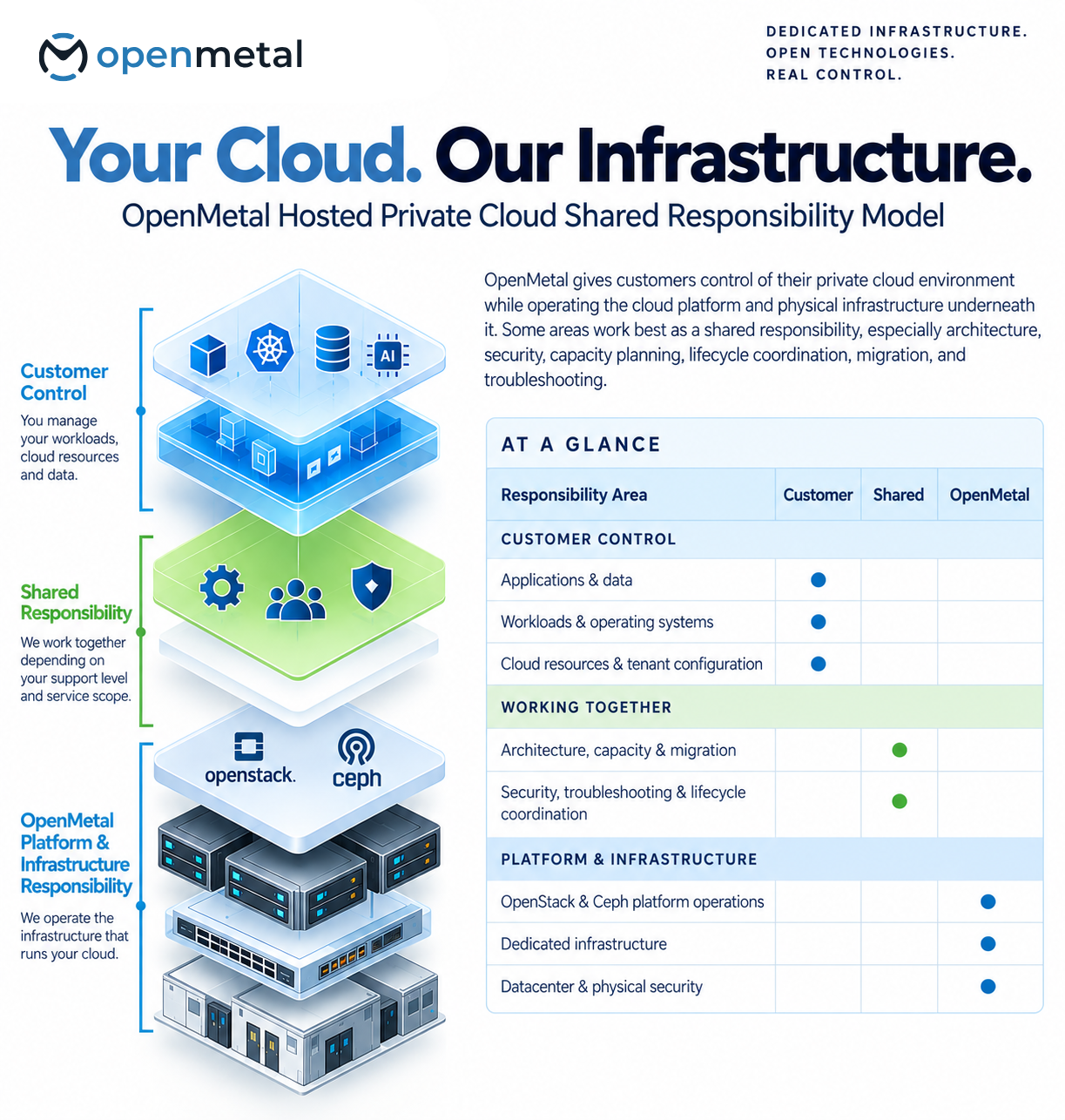
Before a team commits to a hosted private cloud, it needs a clear answer to one question: when something goes wrong, whose job is it? On an OpenMetal hosted private cloud, the short answer is that we run the physical infrastructure and the platform underneath your cloud, and you control everything inside the cloud itself. The details matter, though, because the line sits in a different place than it does on public cloud or in a colocation cage, and teams that understand it up front plan their staffing and runbooks accordingly.
The problem shows up after go-live, not before. A team assumes the provider handles something, the provider assumes the team does, and the gap appears during an incident. It might be a storage warning nobody acts on, a backup nobody configured, or a patch everybody thought someone else applied.
Our Day 2 operations overview summarizes the split in a paragraph. This article goes layer by layer so you can map it to your own team before you sign anything.
Why the Line Sits Where It Does
A hosted private cloud gives you dedicated hardware running OpenStack and Ceph, with full root and admin access. That access is the point: you can configure the cloud, its networks, and its storage the way your workloads need, and decide what runs inside it, within our Universal Terms of Use and Acceptable Use Policy.
Full control comes with ownership of what you control. So our responsibilities stop where your control begins. We make sure the hardware is healthy, the network underneath is up, and the cloud software is delivered and monitored. You decide what runs on the cloud and how it’s configured.
If you’d rather share more of the cloud layer with us, that’s what Assisted Management is for. We’ll cover it below.
Layer by Layer
Physical Hardware and the Data Center
OpenMetal handles this. We provision the servers, monitor hardware health across every node in your cluster, and handle hardware failures. Power, cooling, and physical security are handled at the data center level.
You don’t have to keep spare parts, track hardware warranties, or send someone to a data center.
The Physical Network
OpenMetal handles this. The physical switches that connect your servers and the connectivity to the internet are ours to run. That includes the dedicated VLANs assigned to your deployment at the infrastructure level.
What you configure on top of that network is yours: the VLANs and IP blocks you create in OpenMetal Central, the trusted networks on your host firewall, and the virtual networks inside OpenStack.
Cloud Software Delivery and Monitoring
OpenMetal handles delivery and monitoring. Every hosted private cloud includes Base support, which covers server provisioning, delivery of the cloud software (OpenStack and Ceph), and monitoring of all cluster nodes for hardware failures, Ceph storage health, and OpenStack service availability. Security patches to the platform are coordinated by our team with minimal disruption to running workloads.
The Cloud Layer
You control this. Once your cloud is running, the OpenStack layer is yours:
- OpenStack API access and the dashboard
- Projects, users, and quotas
- Instance lifecycle: creating, resizing, and deleting VMs
- Network topology inside the cloud, including VPCs, routers, and security groups
- Storage policies
- Custom instance flavors
This is the same control you’d have over a cloud you built yourself, without having to build or rack it.
Inside Your VMs
You control this. The operating systems, applications, and data inside your VMs are yours to manage, along with their patching, monitoring, and backups.
Backups deserve a specific mention, because they’re easy to assume someone else is handling. Plan your backup approach as part of your migration, not after it. Ceph’s replication protects against hardware failure, but it doesn’t protect you from a deleted volume or corrupted data.
What Base Support Includes
Here’s what comes with every hosted private cloud:
- Hardware health monitoring for every node
- Server provisioning
- Delivery of the cloud software, OpenStack and Ceph
- Monitoring of Ceph storage health and OpenStack service availability
- Coordinated security patching of the platform
- A dedicated Account Manager, Account Engineer, and Executive Sponsor at onboarding
- A private Slack channel for engineer-to-engineer support, with optional weekly check-in calls
That last point changes how support feels in practice. Instead of filing a ticket into a queue, your engineers talk directly to ours in a shared channel.
How Assisted Management Changes the Split
Some teams want the control of a private cloud without owning every part of its operation, especially in the first year or two while their team gets comfortable with OpenStack. Assisted Management is an optional tier that moves more of the cloud layer into shared responsibility.
As our guide to managed private cloud service options explains, Assisted Management covers troubleshooting, upgrading, and general maintenance of the cloud software, as a joint responsibility between OpenMetal and your team. Changes to cloud features can require changes below the cloud level, such as inside VMs, which is why it’s shared rather than handed off entirely. Scaling the cloud’s physical footprint up or down is also a joint responsibility, and Assisted Management uses Ansible for changes.
The tier adds:
- A named Account Engineer
- Joint cloud health monitoring
- 24/7 incident response
- Monthly proactive health checks
- Assisted upgrades
For teams that want to leave most or all management to us, Complete Management is available for large deployments. Details are on our managed private cloud page.
Who Handles What: A Quick Reference
| Area | Base support | With Assisted Management |
|---|---|---|
| Hardware health and failures | OpenMetal | OpenMetal |
| Physical network and internet connectivity | OpenMetal | OpenMetal |
| Cloud software delivery and monitoring | OpenMetal | OpenMetal |
| Cloud software troubleshooting and maintenance | You, with engineer support in Slack | Joint |
| Incident response at the cloud layer | You, with engineer support in Slack | Joint, 24/7 |
| Projects, quotas, networks, and flavors | You | You, with help available |
| Scaling the physical footprint | You order through Central or the API | Joint |
| Operating systems, apps, and data inside VMs | You | You |
| Backups of your data | You | You |
How a Deployment Works
The responsibility split starts before your cloud goes live. When you move to an OpenMetal hosted private cloud, the process runs like this:
- We plan ahead. We scope the deployment with you, plan capacity, and source and stage the hardware so it’s ready, configured, and working on the date you need it, planned against your go-live date rather than your order date.
- You decide. You choose the hardware configuration, the location, how your networks are laid out, and which support level fits your team.
- We hand over. You get a running cloud with full admin access, plus your Account Manager, Account Engineer, Executive Sponsor, and a private Slack channel with our engineers. For migrations, ramp pricing and running old and new environments in parallel during cutover are available, so you aren’t paying full price for both while you move.
Questions to Ask Any Hosted Private Cloud Provider
Whether you choose OpenMetal or someone else, get clear answers to these before you sign. The answers show where the responsibility line actually sits.
- Who finds out first when hardware fails, and who replaces it? You want monitoring and replacement handled by the provider, not discovered by your team.
- Is storage health monitored, and what happens when it degrades? Distributed storage can run in a degraded state for a while before anyone notices.
- Who applies security patches to the platform, and how are they scheduled? Ask how patching is coordinated with your workloads.
- What access do you keep? Full root and admin access means you can configure anything. Restricted access means you depend on the provider for changes.
- How do you reach an engineer, and how fast? A shared channel with engineers and a ticket queue produce very different experiences during an incident.
- What’s included and what costs extra? Get the support tiers in writing, with what each adds.
- Who owns backups? If the answer is “you,” plan for it now.
Write the answers down next to your own team’s runbooks. Anything that isn’t clearly owned by someone is a gap to close before go-live.
Which Support Level Fits Your Team
Base support fits teams that:
- Have engineers comfortable running OpenStack, or want to build that skill in-house
- Want full control of the cloud layer and are ready to own it
- Value direct access to our engineers over a managed service
Assisted Management fits teams that:
- Are new to OpenStack and want a partner for the first year or two
- Need 24/7 incident response at the cloud layer
- Want proactive health checks and help with upgrades
- Have a small infrastructure team covering a lot of ground
Neither changes:
- Your full root and admin access
- Your responsibility for what runs inside your VMs, including backups
The Short Version
On an OpenMetal hosted private cloud, we run what’s underneath your cloud and you run what’s inside it, with direct access to our engineers either way. Assisted Management moves more of the cloud layer into shared hands for teams that want it.
If you want to talk through which support level fits your team, contact us. You can also price a deployment, including Assisted Management, with our private cloud pricing calculator, or apply for a proof of concept to see how support works before you commit.
Frequently Asked Questions
Does OpenMetal manage my private cloud?
OpenMetal manages the hardware, the physical network, and delivery and monitoring of the cloud software. You control the cloud layer: projects, instances, networks, storage policies, and flavors. Assisted Management adds shared responsibility for troubleshooting and maintaining the cloud software.
What’s included in Base support?
Hardware health monitoring, server provisioning, delivery of OpenStack and Ceph, monitoring of Ceph health and OpenStack service availability, and coordinated security patching of the platform. Onboarding includes an Account Manager, Account Engineer, and Executive Sponsor, plus a private Slack channel with our engineers.
Who is responsible for backups?
You are. Backups of the data inside your VMs are part of the cloud layer you control. Ceph replication protects against hardware failure, not against deleted or corrupted data, so plan your backup approach before you migrate.
What does Assisted Management add?
A named Account Engineer, joint cloud health monitoring, 24/7 incident response, monthly proactive health checks, and assisted upgrades. Troubleshooting and maintenance of the cloud software become a joint responsibility.
Do I keep root access with Assisted Management?
Yes. Your admin and root access doesn’t change with the support level you choose.
Are there limits on what I can run on my private cloud?
You control what runs inside your cloud, and use of OpenMetal services is governed by our Universal Terms of Use and Acceptable Use Policy. Within those terms, the workloads, operating systems, and configurations are your choice.
Schedule a Consultation
Get a deeper assessment and discuss your unique requirements.
Read More on the OpenMetal Blog