



















In this article
- What Is a Virtual Data Center?
- How Virtual Data Centers Work
- Virtual Data Centers vs. Hosted Private Cloud Infrastructure
- When Virtual Data Centers Make Sense
- When OpenMetal’s Hosted Private Cloud Is the Better Choice
- Making the Right Infrastructure Decision
Virtual data centers have become a popular cloud computing model, offering businesses the ability to run infrastructure without maintaining physical hardware. But while virtual data centers solve some challenges, they’re not the only option for organizations seeking private cloud capabilities, and they’re not always the best one.
Understanding what a virtual data center actually is, how it differs from other infrastructure models, and when alternatives like OpenMetal’s hosted private cloud might be a better fit can help you make smarter decisions about where to run your workloads.
What Is a Virtual Data Center?
A virtual data center is a pool of cloud-based infrastructure resources that replicates the functionality of a traditional physical data center within a virtualized environment. These resources include computing power, storage, and networking capabilities, all delivered through virtualization technology rather than dedicated physical hardware.
Virtual data centers operate in multi-tenant environments where a single physical server hosts multiple virtual machines from different customers. A hypervisor manages these virtual machines, distributing hardware resources across multiple tenants. This shared infrastructure model allows cloud providers to maximize hardware utilization and offer computing resources on a flexible, pay-as-you-go basis.
Organizations typically access virtual data centers through major public cloud providers. When you provision a virtual machine on AWS, Azure, or GCP, you’re using a virtual data center—your VM runs on shared hardware managed by the cloud provider, with virtualization technology isolating your resources from other customers’ workloads.
How Virtual Data Centers Work
Virtual data centers rely on several core technologies working together to deliver computing resources:
Hypervisors create and manage virtual machines on physical servers. The hypervisor sits between the hardware and the virtual machines, allocating CPU, memory, and storage resources to each VM based on configuration and demand.
Virtual networking connects virtual machines within the data center and to external networks through software-defined networking. This includes virtual switches, routers, and load balancers that handle traffic routing and network segmentation without physical networking equipment.
Virtual storage provides persistent data storage for virtual machines through pooled storage resources. Storage systems abstract physical disks into logical volumes that can be attached to VMs, enabling features like snapshots, replication, and flexible capacity allocation.
Management platforms provide interfaces for provisioning and managing virtual resources. These platforms handle VM deployment, monitoring, scaling, and resource allocation through web consoles or APIs.
The multi-tenant nature of virtual data centers means multiple customers share the same underlying hardware. While virtualization provides isolation between tenants, you’re still running on shared infrastructure where resource availability can be affected by other workloads on the same physical servers.
Virtual Data Centers vs. Hosted Private Cloud Infrastructure
While both virtual data centers and hosted private clouds use virtualization technology, they differ fundamentally in architecture, resource allocation, and control.
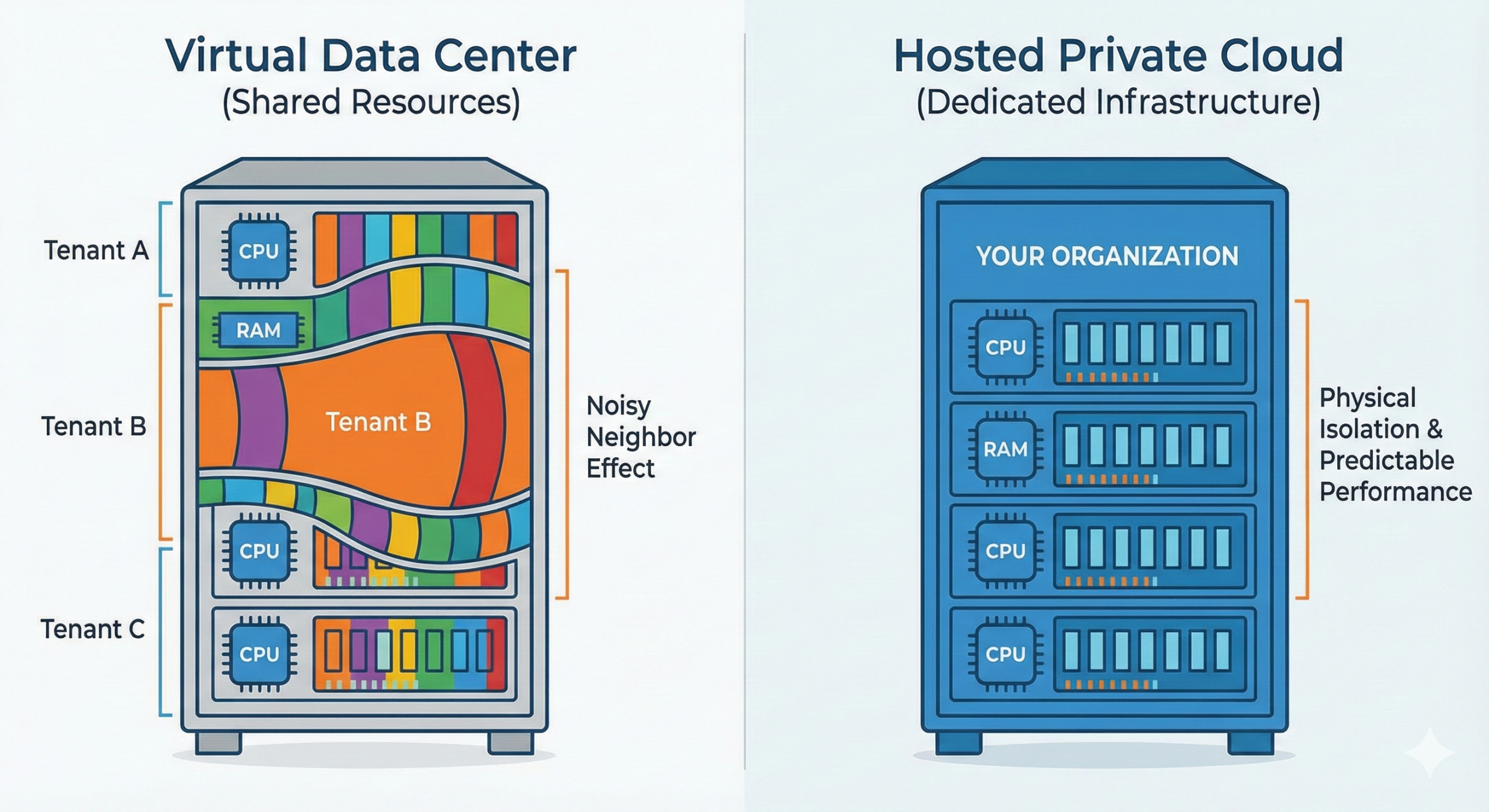
Resource dedication is the primary distinction. Virtual data centers run on shared hardware where multiple customers’ workloads compete for the same physical resources. Hosted private clouds like OpenMetal’s offering provide dedicated hardware exclusively for your infrastructure. You’re not sharing CPU cycles, memory, or storage with other organizations.
Control and customization differ between the two models. Virtual data centers typically limit hardware configuration options and restrict low-level system access. Hosted private clouds give you full control over the infrastructure stack, including hypervisor selection, storage configuration, and network architecture. With OpenMetal’s OpenStack-based platform, you can customize everything from VM resource allocation to storage IOPS to network topology.
Performance predictability varies based on the infrastructure model. In virtual data centers, performance can fluctuate due to “noisy neighbor” effects where other tenants’ workloads consume shared resources. Hosted private clouds eliminate this variability by providing dedicated hardware with consistent, predictable performance.
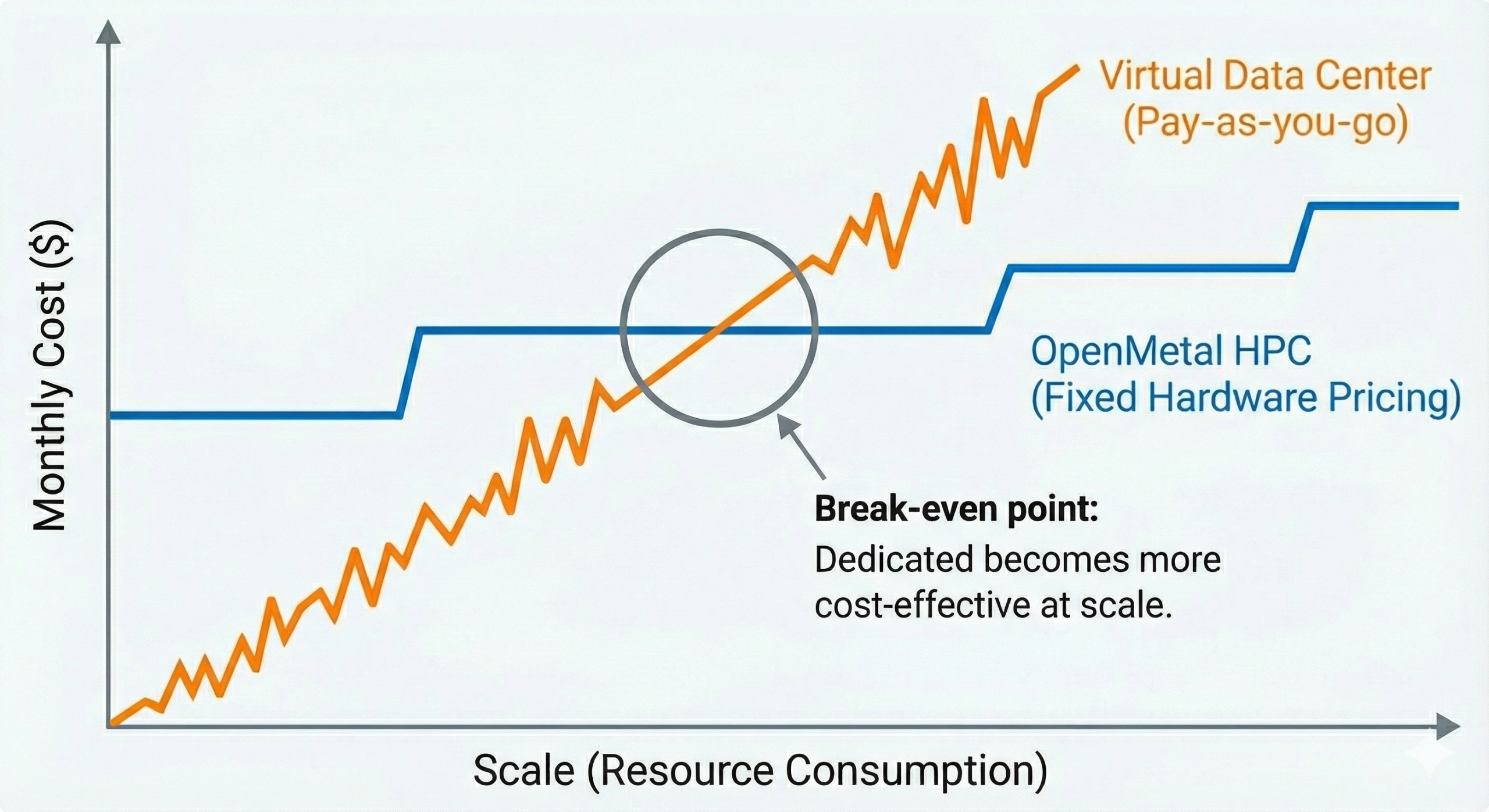
Pricing models reflect these architectural differences. Virtual data centers typically charge based on resource consumption: CPU hours, memory usage, storage capacity, and data transfer. This can lead to unpredictable costs as usage patterns change. Hosted private clouds from OpenMetal use fixed monthly pricing for dedicated hardware blocks, making costs more predictable while allowing unlimited usage within your hardware capacity.
Scaling approaches work differently in each model. Virtual data centers excel at rapid vertical scaling. You can resize VMs in minutes by adding more CPU or memory. Hosted private clouds require adding physical servers to scale horizontally, which takes longer (about 20 minutes with OpenMetal) but provides dedicated capacity that doesn’t affect existing workloads.
When Virtual Data Centers Make Sense
Virtual data centers work well for specific use cases where their characteristics align with workload requirements.
Development and testing environments benefit from the rapid provisioning and flexible resource allocation virtual data centers offer. You can spin up test environments in minutes, run tests, and tear down resources without maintaining dedicated hardware. The pay-per-use model means you only pay for compute time during active testing periods.
Variable workloads with unpredictable traffic can leverage the elastic scaling virtual data centers provide. If your application experiences significant traffic fluctuations and you need to scale resources up and down quickly, the ability to add VM capacity on demand helps match resources to current demand.
Small-scale deployments that don’t consume significant resources may find virtual data centers cost-effective. If you’re running a few small VMs with minimal storage and network requirements, the overhead of dedicated hardware might not be justified.
Short-term projects that require infrastructure for limited periods benefit from the lack of long-term commitment in virtual data center models. You can provision resources for project duration and deprovision them when complete without hardware disposal concerns.
When OpenMetal’s Hosted Private Cloud Is the Better Choice
Many workloads demand characteristics that hosted private clouds deliver better than virtual data centers.
High-performance workloads that require consistent compute, storage, or network performance benefit from dedicated hardware. Database servers, analytics platforms, and compute-intensive applications experience performance degradation in shared virtual environments. OpenMetal’s hosted private cloud provides dedicated servers that eliminate noisy neighbor effects and deliver predictable performance.
Cost-sensitive environments at scale often find hosted private clouds more economical than virtual data centers. While virtual data centers appear cheaper at small scale, costs increase linearly with resource consumption. OpenMetal’s fixed-cost model becomes more cost-effective as you utilize more of your dedicated hardware capacity. You can provision hundreds of VMs on your Cloud Core without increasing your monthly bill, unlike pay-per-VM pricing in virtual data centers.
Compliance and data governance requirements may mandate infrastructure isolation that virtual data centers cannot provide. Healthcare organizations subject to HIPAA, financial services firms with regulatory requirements, or any organization handling sensitive data benefit from the physical isolation of dedicated hardware. OpenMetal’s OpenStack-based platform gives you full control over the security stack and data residency.
AI and machine learning workloads demand GPU resources, large memory capacity, and high-throughput storage that virtual data centers often struggle to provide economically. Training models on shared infrastructure with quotas and time-slicing GPUs creates bottlenecks. OpenMetal’s infrastructure supports dedicated GPU clusters without the resource constraints typical of shared environments. As noted in a recent analysis, AI workloads are driving renewed interest in private cloud because of their demanding performance requirements and cost unpredictability in public cloud environments.
Infrastructure as a service providers who need to build their own cloud platforms benefit from OpenMetal’s hosted private cloud model. You can deploy multiple customer environments, each with its own isolated infrastructure, using OpenMetal’s OpenStack Projects to create VPC-like segments. MSPs and hosting providers use this capability to deliver private cloud services to their customers without building and managing physical infrastructure.
Containerized workloads and Kubernetes deployments often perform better on dedicated infrastructure. While virtual data centers support containers, the virtualization overhead affects performance. OpenMetal’s bare metal infrastructure combined with OpenStack and Kubernetes integration delivers the performance benefits of running containers on dedicated hardware while maintaining cloud orchestration capabilities.
Data-intensive workloads that process large datasets or require high-throughput storage benefit from dedicated storage performance. Virtual data centers often have IOPS limits and throttling on shared storage. OpenMetal’s Ceph-based storage architecture provides high-performance block and object storage without the usage-based costs typical of virtual data centers.
Making the Right Infrastructure Decision
Choosing between virtual data centers and hosted private cloud infrastructure depends on your specific requirements, workload characteristics, and operational constraints.
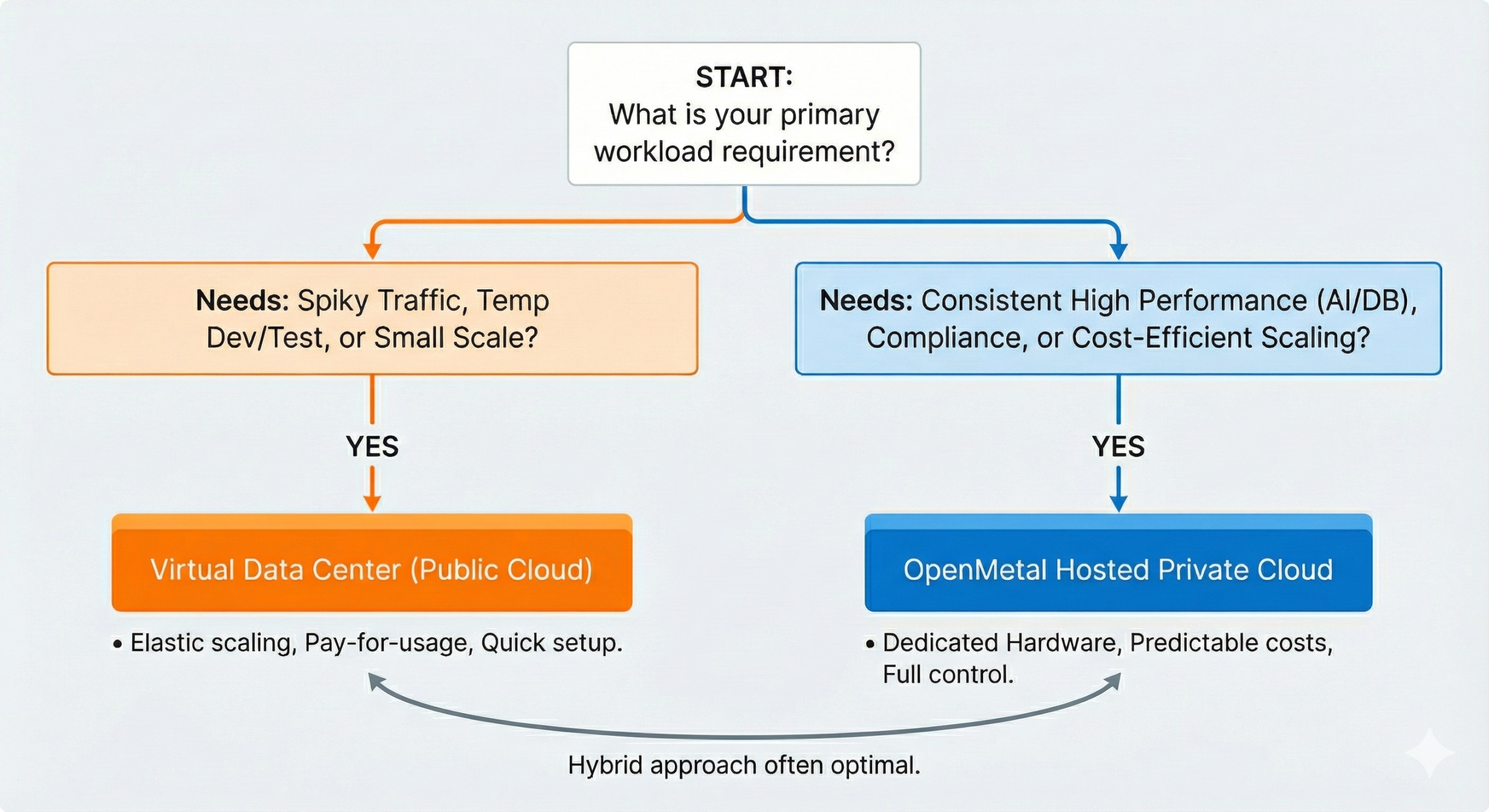
Virtual data centers work well when you need rapid provisioning, have highly variable workloads, or operate at small scale where shared infrastructure costs less than dedicated hardware. They excel at providing on-demand capacity for unpredictable workloads that benefit from elastic scaling.
Hosted private clouds like OpenMetal’s offering make more sense when you need consistent performance, predictable costs at scale, infrastructure control, or physical isolation for compliance. It delivers dedicated hardware benefits (no noisy neighbors, full customization, and stable performance) without requiring you to build and manage physical infrastructure.
The decision isn’t always either/or. Many organizations use both models strategically. They use virtual data centers for variable workloads that benefit from elastic scaling, and hosted private clouds for core applications that require consistent performance and cost predictability. This hybrid approach, which OpenMetal’s architecture supports, lets you place workloads on the infrastructure model that best matches their requirements.
If you’re evaluating infrastructure options, consider not just current needs but how requirements might evolve. Virtual data centers offer flexibility at the cost of performance variability and potentially higher costs at scale. Hosted private clouds require more planning but deliver consistent performance and cost predictability that many production workloads demand.
OpenMetal’s 45-second deployment makes exploring hosted private cloud infrastructure practical. You can deploy a Cloud Core and evaluate performance, management capabilities, and economics without lengthy procurement cycles. Whether you ultimately choose virtual data centers, hosted private clouds, or a combination of both, understanding the actual differences helps you make infrastructure decisions that support your applications rather than constrain them.
Schedule a Consultation
Get a deeper assessment and discuss your unique requirements.
Read More on the OpenMetal Blog