























In this article
Singapore has attracted more than $55 billion in AI infrastructure commitments since 2025, and for good reason. This post walks through the power, connectivity, and regulatory factors that make it a practical choice for AI/ML teams, alongside OpenMetal’s bare metal offerings at Digital Realty’s SIN10 facility in Jurong East.
If you’re building or fine-tuning large language models and need infrastructure in Asia-Pacific, you’ve probably evaluated the obvious candidates: AWS Tokyo, GCP Sydney, Azure Singapore. The hyperscaler path is familiar, but for teams that need dedicated compute, predictable costs, and actual control over their hardware, the decision looks different.
Singapore has emerged as the primary APAC location for serious AI infrastructure work. Not because of marketing, but because of a specific combination of factors: its position at the center of Southeast Asian submarine cable networks, a regulatory environment that doesn’t treat data like a political liability, and a growing supply of enterprise-grade bare metal hardware purpose-built for compute-intensive workloads.
This article covers what makes Singapore a strong choice for LLM training and inference, what the hardware options actually look like, and where OpenMetal fits into that picture.
Why AI Teams Are Looking at Singapore
The short version: Singapore sits at the geographic and regulatory center of the Asia-Pacific AI buildout.
Southeast Asia attracted more than $55 billion in AI infrastructure commitments in 2025, with Singapore anchoring that investment. Microsoft, Google, and AWS have all made multi-billion-dollar commitments to Singapore infrastructure. Singapore’s data center capacity currently operates at just 1.4% vacancy, the lowest in APAC, which reflects genuine demand rather than speculative overbuilding.
For AI teams, this matters for a few concrete reasons:
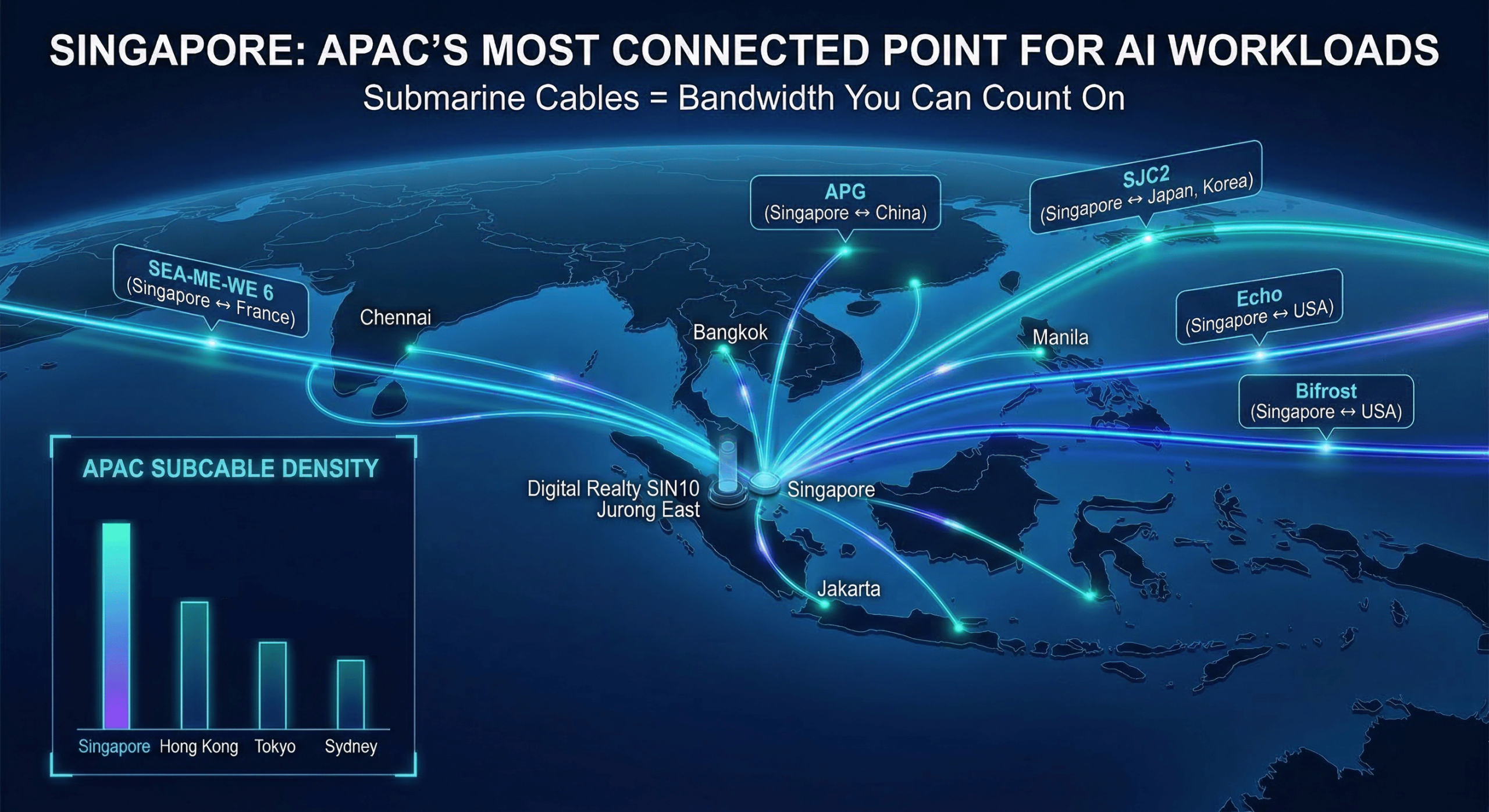
Submarine cable density. Singapore is one of the most connected points on the planet for trans-Pacific and intra-Asia routing. When you’re pulling large training datasets from distributed sources, or shipping model artifacts to teams in multiple time zones, your pipeline depends on bandwidth you can actually count on.
Regulatory clarity. Singapore’s AI governance framework is one of the most developed in the region. The Infocomm Media Development Authority (IMDA) has published specific guidance for generative AI through its Model AI Governance Framework for Generative AI, finalized in May 2024. Unlike some APAC jurisdictions that impose data localization mandates or have ambiguous rules around model training data, Singapore provides a stable, predictable regulatory environment that supports cross-border data flows.
No data localization requirements. Singapore does not require that data about its residents stay in-country. This is a meaningful distinction from Indonesia, Vietnam, and India, which have enacted or are enacting localization requirements. Training data pipelines that span multiple countries are operationally simpler when your infrastructure sits in a jurisdiction that doesn’t add legal complexity to data movement.
English as the official business language. Contracts, compliance documentation, and support all happen in English. This is a practical advantage for non-Singaporean companies that often gets overlooked until they’re trying to navigate legal agreements in Japanese or Bahasa Indonesia.
Government investment in AI. Singapore has committed S$70 million to building Southeast Asia’s first LLM ecosystem, including high-performance computing resources for local researchers and AI startups. The government’s AI Singapore initiative (AISG) has produced SEA-LION, an open-source LLM trained on 11 regional languages. The policy environment is explicitly oriented toward attracting serious AI work.
The Power and Cooling Reality
Power is the constraint that defines LLM training at scale. A single training run for a 70B+ parameter model can consume hundreds of thousands of GPU-hours, and the cost of that compute is a direct function of your power costs and infrastructure efficiency.
Singapore’s government made efficiency a condition of new data center construction. Facilities must achieve a Power Usage Effectiveness (PUE) of 1.3 or lower, with liquid cooling becoming a mandatory standard in 2025. This isn’t just a green certification checkbox; it directly affects the actual cost per GPU-hour you’re paying.
OpenMetal’s Singapore deployment is housed at Digital Realty’s SIN10 data center at 29A International Business Park in Jurong East. The facility is a seven-story, 377,000 square foot building with 2N UPS configuration and N+2 cooling redundancy. The certifications include SOC 2, SOC 3, ISO 27001, ISO 50001, and the Singapore-specific SS564 Green Data Center Standard, along with BCA Green Mark Platinum for sustainability. The facility also meets requirements set by the Monetary Authority of Singapore (MAS).
For AI teams, the practical significance of 2N power is that your training jobs don’t fail mid-run because of a power event. For multi-day or multi-week training runs, that reliability translates directly to reproducibility and cost control.
OpenMetal’s Singapore Bare Metal Hardware
OpenMetal’s Singapore bare metal catalog is built around dual-socket Intel Xeon configurations designed to handle memory-intensive and compute-intensive workloads. Here’s what’s currently available:
XXL v4
- 2x Intel Xeon Gold 6530 (64C/128T, 2.1/4.0GHz)
- 2048GB DDR5 4800MHz
- 6x 6.4TB NVMe + 2x 960GB Boot Disk
- 20Gbps private / 10Gbps public bandwidth
- $3,556.80/month (with month-to-month agreement)
XL v4 (Top Seller)
- 2x Intel Xeon Gold 6530 (64C/128T, 2.1/4.0GHz)
- 1024GB DDR5 4800MHz
- 4x 6.4TB NVMe + 2x 960GB Boot Disk
- 20Gbps private / 6Gbps public bandwidth
- $2,541.60/month
XL v4 High Frequency
- 2x Intel Xeon Gold 6544Y (32C/64T, 3.6/4.1GHz)
- 1024GB DDR5 5200MHz
- 4x 6.4TB NVMe + 2x 960GB Boot Disk
- 20Gbps private / 6Gbps public bandwidth
- $2,800.80/month
Large v4 (Top Seller)
- 2x Intel Xeon Gold 6526Y (32C/64T, 2.8/3.9GHz)
- 512GB DDR5 5200MHz
- 2x 6.4TB NVMe + 2x 960GB Boot Disk
- 20Gbps private / 4Gbps public bandwidth
- $1,504.80/month
Medium v4 (Top Seller)
- 2x Intel Xeon Silver 4510 (24C/48T, 2.4/4.1GHz)
- 256GB DDR5 4400MHz
- 6.4TB NVMe + 2x 960GB Boot Disk
- 20Gbps private / 2Gbps public bandwidth
- $792.00/month
Note: The XL and XXL servers meet the hardware requirements for Intel SGX and TDX out of the box, which is relevant for teams running confidential AI workloads or operating in regulated industries that need hardware-level data isolation during training or inference.
What This Hardware Actually Means for LLM Work
Memory bandwidth for training
The move to DDR5 across all configurations matters for transformer-based training workloads. DDR5 4800MHz and 5200MHz provides substantially higher memory bandwidth than DDR4 at the same capacity tier. For training runs where you’re batching large sequences through attention layers, memory bandwidth is often the actual bottleneck, not raw clock speed.
The XXL v4 with 2TB of DDR5 is built for the kind of large-batch, high-throughput work you’d run when pre-training or fine-tuning models that need to keep substantial parameter state in memory. If you’re running distributed training across multiple nodes, the 20Gbps private network interconnect between nodes keeps your communication overhead from eating your GPU utilization.
NVMe storage for dataset pipelines
Training pipelines that pull from local storage perform better than those waiting on network I/O. The NVMe configurations on the XL and XXL tiers, up to 38.4TB of raw NVMe across the six-drive XXL build, give you enough local scratch space to stage substantial portions of your training corpus without constant network round trips. For tokenized dataset preparation and checkpoint storage, this matters.
The High Frequency option for inference
The XL v4 High Frequency tier runs the Xeon Gold 6544Y at 3.6GHz base with a 4.1GHz boost. For inference workloads where you’re serving requests with lower batch sizes and latency matters more than bulk throughput, the higher per-core clock speed gives you faster token generation. Teams that train on the XL v4 and then need an inference-optimized configuration have a clear path without changing their infrastructure provider or data center location.
Hosted Private Cloud for multi-tenant or orchestrated workloads
If your team needs to run a mix of training jobs, preprocessing pipelines, data storage, and serving infrastructure, OpenMetal’s Hosted Private Cloud gives you an OpenStack-based environment where you can allocate compute, storage, and networking independently. This is useful when different parts of your ML workflow have different resource profiles and you want to avoid paying for bare metal that sits idle during phases when you don’t need all the CPU cores.
For teams already using Kubernetes for their ML orchestration, OpenMetal’s platform supports Kubernetes workloads natively, so you’re not rebuilding your toolchain when you move from a public cloud environment.
Comparing Against Hyperscaler APAC Options
The decision to use bare metal in Singapore typically comes down to a few specific scenarios:
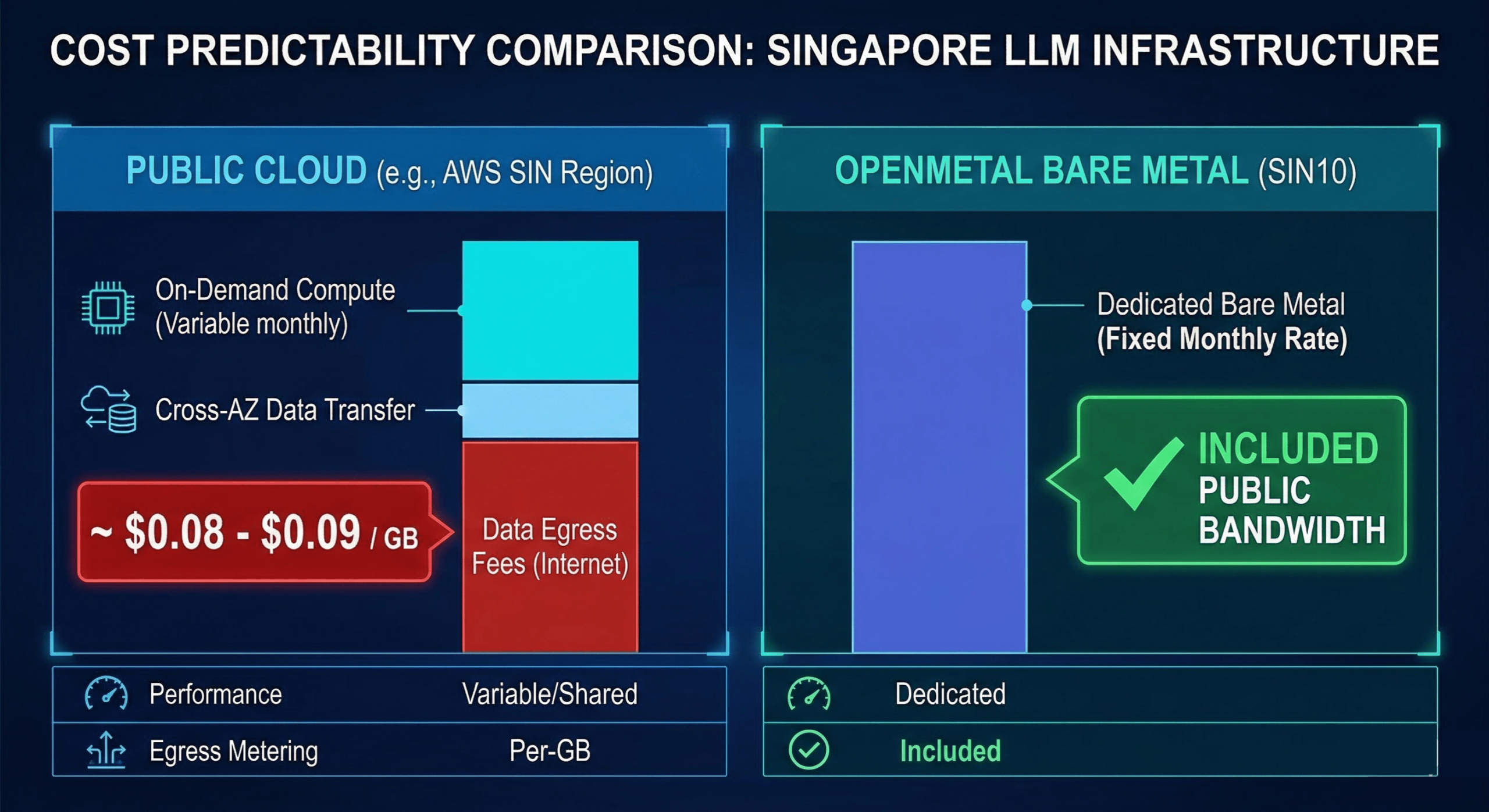
Training cost predictability. On AWS or GCP, a long training run on p4d or A100 instances accumulates costs that are hard to budget precisely, especially when your egress costs in Singapore are some of the highest in the AWS network. OpenMetal’s bare metal pricing is fixed monthly. You know your cost before you start the run.
Data egress. AWS charges $0.08-$0.09/GB for egress from its Singapore region. For teams moving large datasets in and out, or shipping model checkpoints to other locations, those charges compound quickly on training-sized data volumes. OpenMetal’s bare metal plans include substantial bandwidth allocations without per-GB egress metering.
Hardware control. Shared GPU instances on public clouds run on shared physical hardware. For teams that need reproducible benchmarks, specific NUMA configurations, or direct BIOS access for tuning, hypervisors and shared tenancy introduce variables that bare metal eliminates. OpenMetal’s dedicated servers give you the hardware and nothing else runs on it.
OpenStack compatibility. If you’re already running OpenStack in other regions or on-premises, OpenMetal’s Singapore infrastructure fits into existing tooling without requiring you to maintain separate management planes for your APAC workloads.
For GPU-specific training, OpenMetal also offers GPU servers and clusters — worth reviewing if your training stack requires dedicated GPU compute alongside the CPU infrastructure in Singapore.
Data Sovereignty and the Regulatory Angle
For AI teams building models that will be deployed commercially in Asia, where your training data lives has become a compliance question, not just a technical one.
Singapore’s Personal Data Protection Act (PDPA) provides a clear framework for handling personal data without imposing the kind of localization requirements that complicate training pipelines in other APAC markets. The government has explicitly positioned Singapore as a cross-border data hub, which means the regulatory environment is designed to accommodate organizations that aggregate data from multiple countries.
The Digital Realty SIN10 facility’s MAS compliance is specifically relevant for teams serving financial services customers in Southeast Asia. If your model is being trained on financial data, or you’re a fintech company deploying AI features to Singaporean or regional customers, operating within an MAS-compliant facility simplifies your compliance documentation.
The facility’s ISO 27001 certification covers information security management, which matters when you’re documenting security controls to enterprise customers or investors who ask about your infrastructure compliance posture.
Who This Setup Fits
Not every team needs this. A few profiles where OpenMetal Singapore makes practical sense:
AI labs and startups running pre-training or large fine-tuning jobs that need to keep costs predictable and don’t want to negotiate reserved instance pricing with hyperscalers.
Companies building APAC-specific models that need to be trained or fine-tuned on Southeast Asian language data and want low-latency access to regional data sources during training.
Enterprises with data residency considerations that need their training data and model artifacts to stay within Singapore’s jurisdiction while still having access to the broader APAC internet through the SIN10 connectivity fabric.
Teams already using OpenStack in US or European regions that want to extend their private cloud footprint into APAC without adding a new platform to manage.
Inference teams that need a well-connected, low-latency endpoint for serving Southeast Asian users, where latency to Jakarta, Kuala Lumpur, Bangkok, and Manila matters for user experience.
For a broader look at what OpenMetal’s Private AI infrastructure looks like across use cases, that page covers the full scope of what teams are building on the platform. The ML workflow acceleration post also walks through how ML and data analytics teams specifically have used OpenMetal’s storage-heavy configurations, which maps well to the NVMe-heavy Singapore catalog.
Getting Started
OpenMetal’s Singapore location is live at Digital Realty SIN10. You can review the full bare metal catalog and current pricing at openmetal.io/bare-metal-pricing, or use the cloud deployment calculator if you’re scoping a private cloud configuration.
If you have questions about specific hardware configurations for your training workload, data sovereignty requirements, or want to talk through how a Singapore deployment would fit into an existing multi-region setup, we’re here to help!
Schedule a Consultation
Get a deeper assessment and discuss your unique requirements.
Read More on the OpenMetal Blog