


















In this article
The case for public cloud has always been speed and flexibility. For teams running stable, predictable workloads at scale, the math has shifted, and hosted private cloud is where more of those workloads are landing.
Public cloud was the obvious answer for most teams a decade ago. Pay only for what you use, skip the hardware headaches, and scale as fast as the business demanded. That trade works well for some workloads and some stages of growth. But it does not work as well when utilization stabilizes, compliance requirements harden, and the monthly bill starts arriving with line items your team cannot explain.
This article covers the eight reasons most commonly driving migration decisions in 2026, with context on what each one means in practice and where hosted private cloud actually solves the problem rather than just shifting it.
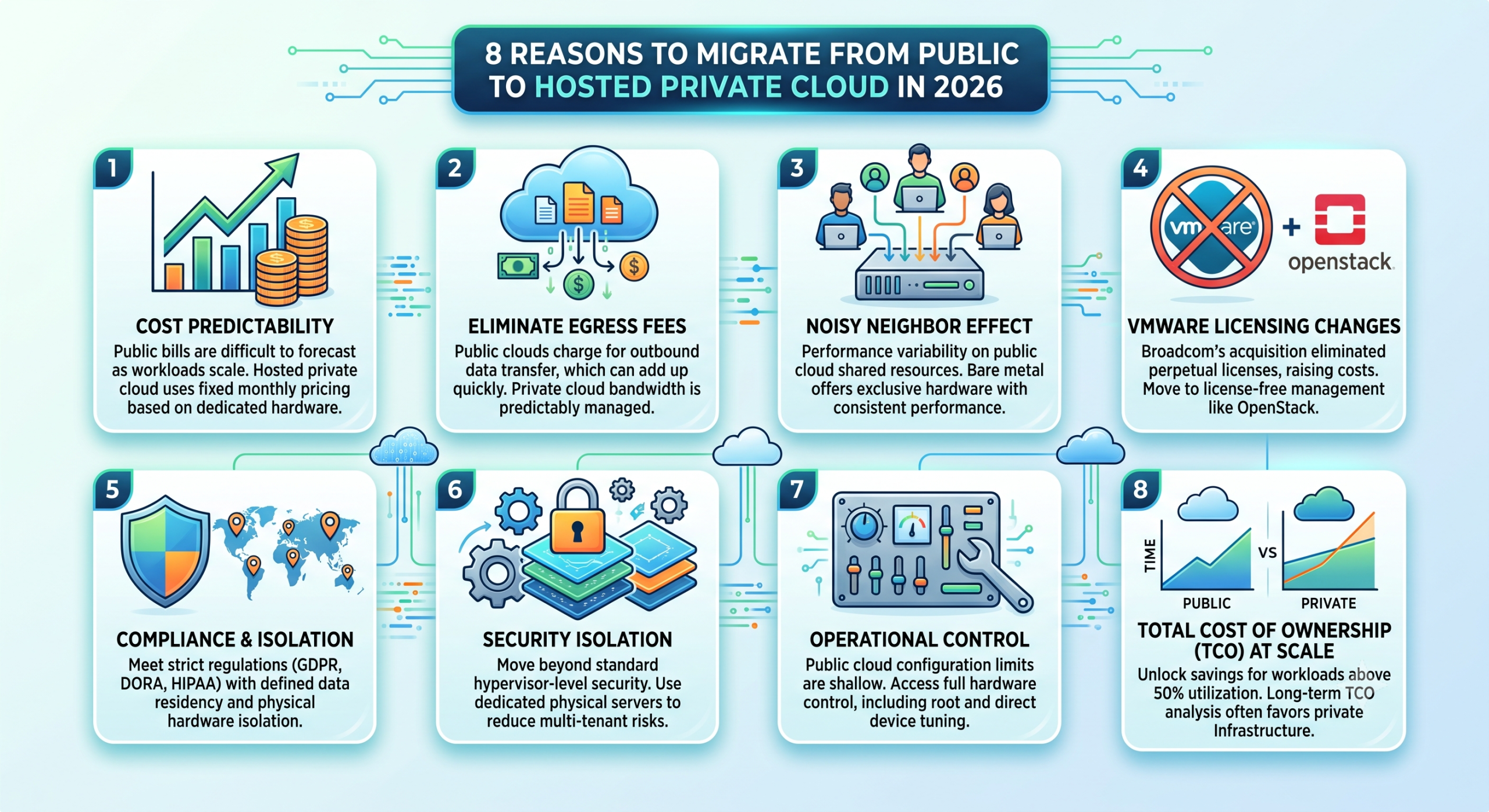
1. Bills that refuse to stay predictable
Public cloud pricing is consumption-based, which sounds efficient until you try to budget for it six months out. Compute, storage, data transfer, API calls, support tiers, and service-specific fees each carry their own pricing model. A carefully constructed estimate in January can blow past budget by March because one service scaled faster than expected, or because egress on a new feature launched higher than projected.
The problem is not that public cloud is inherently expensive. It is that the cost model is genuinely difficult to forecast once a workload grows past a certain size and complexity. Finance teams running quarterly or annual budgets do not work well with variable-by-design infrastructure costs.
Hosted private cloud runs on fixed monthly pricing tied to dedicated hardware. OpenMetal charges by server configuration rather than by resource consumption. A three-server private cloud cluster has the same cost whether your team runs 20 virtual machines or 80. That predictability changes how infrastructure decisions get made internally, particularly when engineering teams need budget sign-off from finance. For a direct comparison of how the two billing models stack up, see OpenMetal vs. public cloud pricing.
2. Egress fees punish data-intensive workloads
Egress is the line item that surprises most teams the first time they look at a scaled-up public cloud bill. AWS, GCP, and Azure all charge for data leaving their networks. Standard rates run around $0.08 to $0.09 per GB after a small free tier, though exact pricing varies by region and destination.
At volume, that adds up quickly. A workload pushing 50TB of outbound traffic per month is looking at roughly $4,000 to $4,500 in egress alone, before a single dollar of compute or storage. Teams running analytics platforms, media delivery infrastructure, or data pipelines that move large datasets regularly find egress becomes a meaningful fraction of the total bill.
OpenMetal bills egress on 95th percentile bandwidth measurement rather than total bytes transferred. Overage beyond each server’s included allocation is charged at $375 per Gbps. That model rewards workloads with consistent traffic profiles over workloads with extreme spikes, and it is not the right fit for pure content delivery at CDN scale. But for infrastructure-heavy workloads where egress has become a real budget line, the comparison is usually favorable. You can plug your own traffic numbers into the OpenMetal pricing calculator to see where the crossover falls for your workload.
3. Noisy neighbor effect on shared infrastructure
Public cloud compute runs on shared physical hardware. The hypervisor abstracts that from you, but it cannot eliminate the performance variability that comes from sharing CPUs, memory bandwidth, and network fabric with other tenants. Latency-sensitive APIs, database-heavy workloads, and real-time processing pipelines all feel this in ways that are difficult to trace and impossible to fully prevent.
Burstable instance types compound the issue. When a workload hits the CPU credit ceiling, compute throttles in ways that produce erratic performance that looks like an application problem rather than an infrastructure one.
Bare metal and dedicated private cloud eliminate the noisy neighbor problem by design. On an OpenMetal bare metal server, the hardware is yours exclusively. An XL v5, for example, gives you 64 cores, 128 threads, 1TB of DDR5-6400 RAM, and 25.6TB of NVMe storage with no competing tenants and no hypervisor overhead eating into the available capacity. Performance stays consistent because nothing else is competing for the same resources.
4. VMware licensing costs after the Broadcom acquisition
Infrastructure teams running VMware vSphere had their cost assumptions reset by the Broadcom acquisition, which closed in late 2023. Broadcom eliminated perpetual VMware licenses, moved the product to subscription-only bundles, and restructured the SKU lineup in ways that forced many existing enterprise customers into packages with capabilities they did not need. For some organizations, the effective cost increase ran to several times the prior annual spend.
VMware migration is now one of the most active conversations in enterprise infrastructure, and it has created a genuine secondary driver for private cloud evaluation. The question teams face is which direction to go: toward public cloud (which solves the VMware problem but may introduce others), toward an alternative platform like Proxmox on bare metal, or toward an OpenStack-based private cloud that provides comparable VM management without the licensing overhead.
OpenMetal runs on OpenStack. There are no per-VM licensing fees. Nova (compute), Cinder (block storage), Neutron (networking), and the rest of the OpenStack core all run in Docker containers deployed via Kolla-Ansible. A new private cloud cluster deploys in approximately 45 seconds. The management model differs from vSphere, but the operational concept is familiar: compute pools, defined networking, and storage you can size and configure yourself.
For teams already leaning toward Proxmox, OpenMetal supports Proxmox deployments on bare metal as well, which gives teams the hypervisor they prefer running on dedicated hardware under their control.
5. Compliance requirements that shared infrastructure cannot satisfy
HIPAA, PCI DSS, DORA, SOC 2, and the EU AI Act all impose constraints on how data is stored, processed, and isolated. Meeting those requirements on public cloud is achievable but involves navigating shared responsibility models, purchasing compliance-specific services that carry their own costs, and in some cases negotiating with auditors over what the provider’s multi-tenant architecture actually guarantees.
Data residency is the most concrete requirement for EU workloads. Data must remain within specific geographic boundaries. Public cloud providers offer regions that nominally satisfy this, but the underlying infrastructure is multi-tenant, and questions about who can access what and under which legal framework remain complicated.
Dedicated private cloud gives teams hardware in a defined location with no other tenants. OpenMetal operates data centers in Ashburn VA, Los Angeles CA, Amsterdam NL, and Singapore. For EU teams dealing with GDPR or DORA requirements, Amsterdam provides a clear data residency answer without the architectural gymnastics that multi-tenant compliance usually requires.
For workloads requiring hardware-level isolation proof, Intel TDX goes further. TDX creates encrypted Trust Domains around entire virtual machines such that even the infrastructure operator cannot access the workload in plaintext. OpenMetal runs TDX on bare metal on XL v4 and XL v5 servers, which is relevant for healthcare PHI processing, financial services key management, and any regulated workload where auditors require hardware-level attestation rather than a contractual assurance. For a detailed breakdown of what TDX actually requires at the hardware level, see Enabling Intel SGX and TDX on OpenMetal v4 and v5 Servers.
6. Security isolation that goes beyond the hypervisor
Related to compliance but distinct from it: some organizations need dedicated infrastructure for security reasons independent of regulatory requirements. Multi-tenant cloud means that, at some layer, workloads share physical hardware with unknown parties. Hypervisor vulnerabilities, side-channel exploits, and the general attack surface of shared infrastructure are real considerations for security teams running sensitive workloads.
Dedicated bare metal removes shared-tenancy risk by giving each customer their own physical servers. There is no hypervisor below your workload. For key management infrastructure, payment processing, healthcare record systems, or any environment where a breach carries meaningful legal or financial consequence, the isolation guarantee matters more than the cost difference between shared and dedicated compute.
OpenMetal assigns dedicated VLANs to each customer for both bare metal and private cloud deployments. Private bandwidth between servers runs at 20 Gbps aggregate per server and stays within the customer’s isolated network. The infrastructure-level private network is separate from the OpenStack VXLAN overlay used inside private cloud deployments, which means isolation is enforced at the physical layer, not just the software layer.
7. Operational control that public cloud does not offer
Public cloud platforms are built for breadth. The configuration options available to most users are wide but not deep. Teams running specialized workloads, custom networking topologies, hardware-bound software licensing, or storage architectures that depend on direct device access eventually run into limits.
Root access to the physical hypervisor is not something public cloud providers offer. Direct NVMe device access for database performance tuning, kernel configuration for specific workload profiles, NUMA topology control, and hardware performance counters for profiling are all constrained or unavailable. Teams that need those controls typically work around them with additional tooling, which adds complexity and cost.
On bare metal, those constraints disappear. OpenMetal customers have full hardware access including IPMI for hardware-level management, direct NVMe access, and complete control over the kernel and network stack. Private cloud deployments run OpenStack, which provides the API surface for virtual machines, storage, and networking while leaving the underlying hardware configuration in the customer’s hands.
Management runs through OpenMetal Central, OpenStack Horizon, the OpenStack API and CLI, and IPMI. For teams that want the control of colocation without managing physical facilities, that access model covers the use cases that public cloud cannot.
8. Total cost of ownership at sustained utilization
The economics of public cloud favor low, variable utilization. When a workload averages 10-20% CPU and spikes occasionally, pay-per-use is genuinely efficient. When a workload runs at 60-80% utilization month over month, you are effectively paying the cloud provider’s margin on dedicated hardware that never goes idle between your runs.
The crossover point varies by workload type, region, and configuration, but most infrastructure teams doing honest TCO analysis find that stable, high-utilization workloads break even or favor private infrastructure within 12-18 months. The comparison has to include egress, storage IOPS charges, licensing for managed services, and support costs alongside raw compute to be accurate. Comparing only virtual machine hourly rates misses most of where the cost difference actually lives.
OpenMetal’s pricing is fixed by server configuration. A three-server private cloud cluster at 70% sustained utilization costs the same as one at 30%. The value of fixed pricing scales with utilization. For teams with workloads they can characterize accurately, the TCO comparison is worth running with real numbers rather than estimates.
Is hosted private cloud the right answer for every workload?
No, and it is worth being direct about that. Public cloud is still the better fit for workloads that are genuinely variable, short-lived, or require instant global burst capacity. Greenfield development environments, batch jobs with unpredictable timing, and anything that benefits from managed services without deep configuration needs often stay on public cloud for good reasons.
Most mature infrastructure strategies are not all-or-nothing. Stable, compliance-sensitive, or compute-intensive workloads tend to belong on dedicated private infrastructure. More dynamic workloads stay on public cloud or burst to it when needed. The triggers worth watching for are consistent utilization above 50-60%, egress that shows up as a material budget line, compliance work consuming disproportionate engineering time, and workloads running on hardware that was over-provisioned just to ensure headroom.
If your team is at the point where the numbers need to close before a decision, OpenMetal runs a proof-of-concept program where you can bring a specific workload and test it on dedicated infrastructure before committing to a migration: OpenMetal PoC program.
Frequently Asked Questions
Why are companies leaving public cloud in 2026?
The most common drivers are cost predictability, egress fees, compliance and data residency requirements, VMware licensing changes after the Broadcom acquisition, and performance consistency on workloads that have stabilized. The combination of rising public cloud costs and mature private cloud alternatives has made the move more practical than it was five years ago.
At what scale does hosted private cloud become cost-effective?
There is no single threshold, but teams running stable workloads at 50-60% or higher utilization tend to find that the TCO comparison favors private infrastructure. The analysis needs to include egress, storage charges, and support costs alongside compute to be accurate.
Does hosted private cloud mean giving up scalability?
The scaling model is different, not absent. Hosted private cloud scales by adding physical servers rather than spinning up more instances. OpenMetal can add a server to an existing cluster in approximately 20 minutes. That model suits predictable workload growth well. It does not suit unpredictable spikes that need capacity in seconds.
Is hosted private cloud the same as on-premises infrastructure?
No. Hosted private cloud means your dedicated hardware sits in a managed data center. You get the isolation of dedicated infrastructure without managing physical facilities, power, cooling, or hardware maintenance. The operational model is closer to managed colocation, but with infrastructure provisioning and networking included.
What compliance requirements does dedicated private cloud address?
Dedicated infrastructure helps with data residency requirements under GDPR and DORA, hardware isolation requirements under HIPAA, and network isolation requirements under PCI DSS. For workloads requiring hardware-level attestation that a contractual assurance cannot provide, Intel TDX on bare metal adds cryptographic isolation at the VM level.
What is cloud repatriation?
Cloud repatriation refers to moving workloads back from public cloud providers to private infrastructure, either on-premises or in a hosted private cloud. It is not a reversal of cloud strategy but a rebalancing, typically driven by cost, performance, or compliance requirements that are better served by dedicated infrastructure than by shared multi-tenant platforms.
Schedule a Consultation
Get a deeper assessment and discuss your unique requirements.
Read More on the OpenMetal Blog