




















Interested in our v5 hardware?
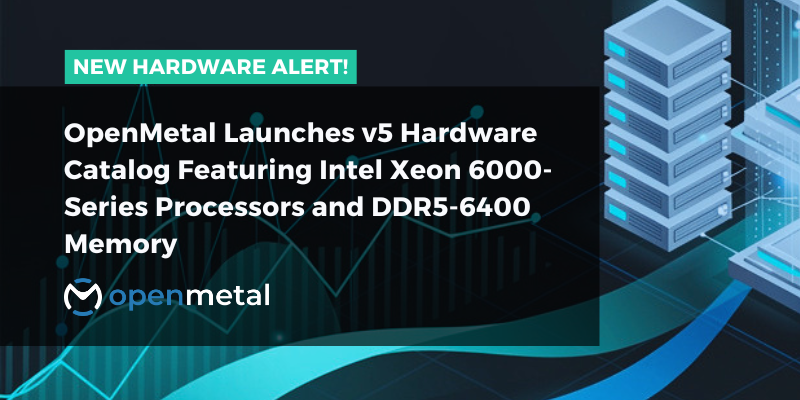
v5 hardware is currently available for deployment in our Ashburn, VA data center and can be ordered directly through our Bare Metal and Private Cloud catalogs. For deployments in other data center locations or for custom configurations, please contact our team.
There’s a gap that shows up in almost every infrastructure conversation we have right now. Teams know what they’re running today, and they have a pretty good idea of what they’ll be running in eighteen months. The two rarely match. AI inference creeps into the roadmap. Analytics pipelines get hungrier. A database that was comfortable last year is suddenly the bottleneck.
Hardware should absorb that pressure, not add to it. That’s the lens we built v5 through.
Designed for what’s coming, not just what’s here
OpenMetal v5 is built on dual-socket Intel Xeon 6 processors, the Granite Rapids generation on Intel’s 3 process node, paired with DDR5-6400 memory and high-endurance Micron 7500 MAX NVMe storage. More cores, more memory bandwidth, faster and more durable storage. The interesting part is which of those tends to bite you first as you scale.
For most teams, it’s memory bandwidth. As core counts climb, the limiting factor is rarely the cores themselves, it’s whether you can keep them fed. The Large v5, for example, moves around 819 GB/s of aggregate memory bandwidth, and inference serving, in-memory analytics, and large working-set databases feel that long before they’re compute-bound. Granite Rapids also brings a big jump in on-die cache (the Large v5 nearly doubles its L3 over the prior generation), which keeps more hot data resident and cuts the DRAM round-trips that dominate query latency.
Storage is the other quiet killer. A drive that benchmarks well on day one is a different thing from a drive that holds its latency through month nine of sustained writes. We standardized on the Micron 7500 MAX, rated at 3 drive writes per day over a five-year warranty, specifically because so much of what runs on this hardware is write-heavy: transactional databases, log and metrics pipelines, and Ceph OSDs in the private cloud configuration, where the drives are doing real, continuous work. That storage is persistent and part of the server, not a separately metered volume service charging you per IOPS.
Three tiers, one architecture
v5 comes in three sizes, and the differences are deliberate rather than just “more of everything.”
- XL v5 is the flagship: dual Xeon 6530P, 64 cores and 128 threads, 1 TB of DDR5-6400 across 16 of its 32 DIMM slots, and four 6.4TB NVMe drives for 25.6TB of persistent storage. It’s built for dense virtualization, large in-memory datasets, and AI inference where you want to pack a lot into one node.
- Large v5 is the one we expect a lot of practitioners to reach for. Dual Xeon 6517P at 32 cores, but with the highest base clock in the lineup at 3.2GHz and nearly double the L3 cache of the previous generation. High clock plus a deep cache plus moderate core count is the right shape for latency-sensitive services, single-threaded-heavy workloads, and virtualization hosts where per-core responsiveness matters more than raw thread count.
- Medium v5 is the efficient entry point: dual Xeon 6505P, 24 cores, 256GB of memory, a single 6.4TB NVMe drive. It’s a sensible home for control planes, dev and test, web tiers, and steady-state production that doesn’t need to be oversized.
Across all three, the architecture is shared in the ways that matter to whoever runs it. Boot drives are a separate RAID 1 mirror, isolated from the data NVMe, so a kernel update or a forced re-image never puts your data at risk. And every server gives you full root plus BIOS and IPMI access, so you can pin cores, tune NUMA, disable hyperthreading, or set Speed Select profiles without filing a ticket. You can also mix tiers in a single deployment, big nodes for the heavy lifting, smaller ones for the supporting cast, without managing two different worlds.
Bare metal or a private cloud. Your call.
Every v5 configuration deploys two ways, from the same hardware.
Take it as single-tenant bare metal and you get the whole machine: full root access, no hypervisor tax, predictable NUMA behavior, and the scheduler to yourself. For latency-sensitive and performance-critical workloads, that determinism is often worth more than any single spec.
Or take it as a hosted private cloud: three identical v5 servers stood up as a hyper-converged cluster running OpenStack (Nova, Cinder, Neutron) for the control plane and Ceph for distributed storage, with the cluster live in well under a minute. Hyper-converged means compute and storage live on the same nodes, with Ceph replicating data across all three so the loss of a node doesn’t take your data with it. There’s no separate SAN to buy or babysit, and you scale out by adding more identical nodes. You get the full OpenStack API and Horizon dashboard, and the Day 2 work, version upgrades, patching, Ceph health, and hardware replacement, is handled by our team.
Networking is built around that model. Each node carries 40 Gbps of private bandwidth for east-west traffic and Ceph replication, kept off the public path and not billed as egress, with public bandwidth scaling by tier up to 6Gbps. The replication chatter that makes a distributed cluster work stays on the private fabric where it belongs.
Same machines underneath. The difference is how much of the platform you want us to run for you.
Choose v5 hardware as standalone bare metal servers or as a fully managed three-server hyperconverged private cloud.
v5 is available now in Ashburn, VA (US East). Order today from the catalog and deploy in minutes.
A note on sensitive workloads
More of what teams run now carries compliance weight, and increasingly it needs protection while it’s in use, not just at rest and in transit. v5 supports Intel’s confidential computing for exactly that. On the XL v5, which ships with 1 TB of memory across 16 of its 32 DIMM slots, Intel TDX is ready to enable in the server BIOS — a BIOS toggle activates it, so you can launch hardware-isolated trust domains without a RAM upgrade or maintenance window. On Large and Medium it’s a memory upgrade away, and Intel SGX is available at the base memory configuration across the line for narrower enclave use cases like key management and certificate signing. Combined with OpenMetal’s organization-level HIPAA and BAA, that makes v5 a fit for regulated financial, healthcare, and sovereign workloads, capability the big clouds tend to treat as a premium add-on.
The part we care about most: pricing you can predict
Here’s where we’ll be a little opinionated.
Raw performance is table stakes. Plenty of providers can sell you fast hardware. What’s harder to find is fast hardware with a bill you can actually plan around.
The hyperscalers made cloud easy to start and genuinely painful to predict, with metered egress, opaque line items, and rates that climb as you grow.
v5 keeps the model our customers stay for. Pricing is fixed and monthly, with no surprise egress charges. Public bandwidth is billed on the 95th percentile rather than per gigabyte, so a deployment that bursts during a window but averages low doesn’t get punished for every byte it moves. Storage is persistent and included rather than metered per IOPS. You get full root access on open source, and infrastructure that is actually yours rather than rented through a black box. The performance you’d expect from the big clouds, with the ownership and predictability they don’t offer.
That combination is the whole point. Not just a faster machine, but a faster machine on terms that still make sense at the end of the quarter.
If you’ve been waiting for a reason to revisit your infrastructure, or you’re staring at a cloud bill wondering where it all went, this is a good moment to take a look. Dig into the full specs for the XL v5, Large v5, and Medium v5, and then talk to our team about the right fit for what you’re building.
Read More Blog Posts