

















Our CEO Todd Robinson recently joined The Cloudcast podcast to discuss the resurgence of bare metal and private cloud solutions. Here are some of the key takeaways from a conversation that’s capturing attention across the industry.
The cloud landscape is shifting, and infrastructure leaders are taking notice. In a recent episode of The Cloudcast, OpenMetal’s founder and president Todd Robinson sat down with hosts Aaron Delp and Brian Gracely to explore why bare metal and private cloud are experiencing a comeback.
What’s Driving the Shift
Several converging factors are creating what Todd calls “a perfect storm” for bare metal adoption:
The Steady State Reality Check
Companies that went all-in on public cloud are now facing a hard truth: many workloads don’t actually need infinite scalability. As Todd explained, “I’m looking at my AWS bill and I go from, you know, $95,000 a month to a hundred and to 95 to a hundred to 95 to a hundred. You’re not going 95 to zero. So now your problem really is $95,000 a month.” When your AWS bill consistently hovers around the same amount month after month, you’re essentially paying a premium for scaling capabilities you’re not using.
The Broadcom VMware Shake-Up
The VMware licensing changes under Broadcom have created an unexpected catalyst. Organizations halfway through their renewal cycles are getting bills that are 2x to 5x higher for the same functionality. As Todd noted, many are asking themselves: “Am I getting 5x value? No, you’re getting the same thing.”
AI and Big Data Workloads
Modern applications like large-scale ClickHouse clusters, Hadoop deployments, and Kafka workloads are naturally suited for bare metal. These systems are resilient and self-managing, offering the high availability that companies traditionally depended on cloud providers to deliver.
The Economics Have Flipped
One of the most compelling points from the conversation was about unit economics. Todd highlighted a frustrating reality for many companies, SaaS in particular: “You scale and it gets more expensive.” Instead of achieving the expected economies of scale, many organizations find their cloud costs growing faster than their revenue.
For companies paying 40% of their top-line revenue to cloud providers without seeing incremental benefits as they grow, the math simply doesn’t add up. This is why we’re seeing more C-suite executives finally saying “that’s it” and demanding alternatives.
Cloud Native Ease Without Cloud Native Costs
Here’s what makes today’s bare metal different from the infrastructure of the past: you don’t have to sacrifice the automation and self-service capabilities you’ve grown accustomed to.
Modern private cloud solutions built on mature open source technologies like OpenStack and Ceph deliver the same API-first, cloud-native experience. If your team is already using Terraform or OpenTofu to manage infrastructure, you can simply point those same scripts at a private cloud environment. You can now get the benefits of bare metal and private cloud without the need to buy, manage, troubleshoot, or replace hardware yourself, and with on-demand scaling capabilities as well, just like public cloud.
The Hybrid Approach as a Best of Both Worlds
Interestingly, Todd mentioned that many large organizations aren’t going all-or-nothing. Instead, they’re adopting a strategic hybrid approach:
- Use private cloud for steady-state workloads (often 70% of their infrastructure)
- Maintain public cloud presence for truly variable or experimental workloads (30%)
- Leverage the private cloud provider’s expertise for development, learning, and education
This approach allows companies to optimize costs while maintaining the flexibility to scale when truly needed.
Starting the Migration: A Practical Roadmap
For organizations considering the move, Todd outlined a practical migration strategy:
- Start with Development Environments: These are typically more portable and don’t have the same uptime requirements as production systems.
- Look for “Bang for the Buck” Workloads: Target applications you pay for constantly but rarely use at full capacity.
- Leverage Infrastructure as Code: If you’re already managing infrastructure with code, migration is often just a matter of pointing to a different API endpoint.
- Plan in Tranches: Nobody moves a petabyte overnight. Scale your private cloud incrementally as you migrate workloads.
Beyond the Private Cloud Stigma
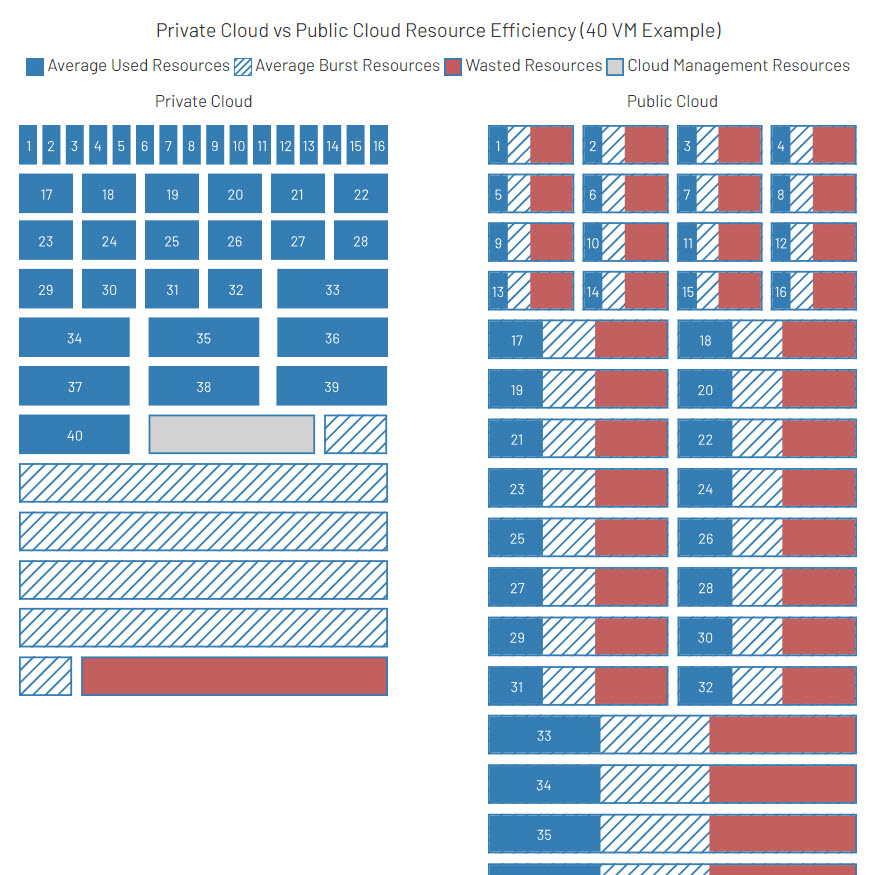
The conversation also addressed the lingering stigma around “private cloud”. Todd emphasized that modern private cloud solutions are fundamentally different from the rigid, monolithic systems of the past. Today’s private cloud scales up and down dynamically and is organized into virtual private clouds just like any public cloud provider.
The key difference? You’re paying at the hardware level, not the VM level. When resources aren’t being used by one application, they’re immediately available to others in your environment.
The Bottom Line
As Todd put it, the fundamental value proposition has shifted. The “special sauce” of easy, API-driven infrastructure management is no longer special, it’s table stakes. What matters now is getting that same ease of use without paying a premium for capabilities you don’t need.
For organizations with steady-state workloads, predictable usage patterns, or large-scale data processing needs, bare metal and private cloud aren’t just alternatives, they’re often the more logical choice.
Ready to explore how bare metal could work for your organization? Listen to the full Cloudcast episode for deeper insights into the technical details and real-world case studies, or reach out to learn more about OpenMetal’s on-demand private cloud and bare metal solutions.
Want to hear more? Listen to the complete episode of The Cloudcast featuring Todd Robinson.
Schedule a Consultation
Get a deeper assessment and discuss your unique requirements.
Read More on the OpenMetal Blog