
























OpenMetal Private Cloud Core v4 is a major platform release that updates the core infrastructure behind new OpenMetal private cloud deployments.
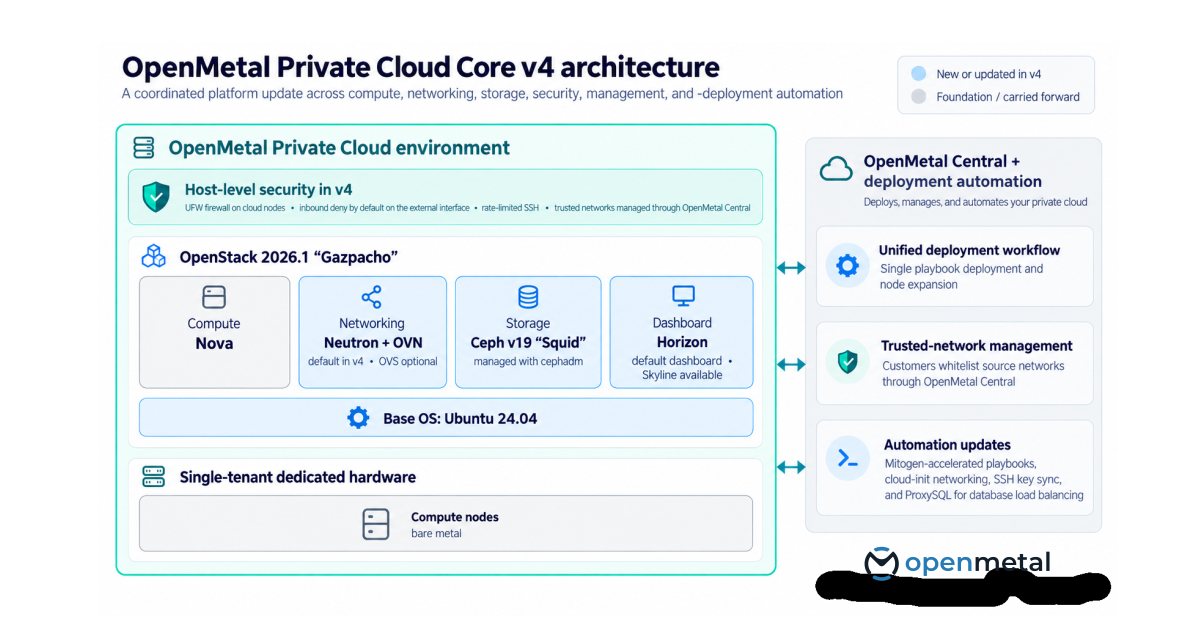
The release moves the platform to Ubuntu 24.04, OpenStack 2026.1 “Gazpacho,” and Ceph v19 “Squid,” while introducing OVN as the default OpenStack networking architecture, Skyline as an optional dashboard toggle in OpenMetal Central, host-level firewalling across cloud nodes, and expanded deployment automation.
Together, these changes establish the next generation of the OpenMetal private cloud platform, with updates spanning compute, networking, storage, security, management, and the automation used to deploy and expand a cloud.
OpenMetal Private Cloud Core v4 is generally available for new deployments beginning September 14, 2026.
A new foundation for the OpenMetal private cloud
At the center of PCC v4 is a coordinated update of the underlying software stack.
Cloud nodes now run Ubuntu 24.04. OpenStack moves to the 2026.1 “Gazpacho” release, while the storage layer moves to Ceph v19 “Squid.” Ceph orchestration is handled through cephadm, and Kolla-Ansible has been updated to track the OpenStack 2026.1 release.
Updating these layers together gives PCC v4 a consistent platform baseline across the operating system, OpenStack services, networking, and distributed storage.
The release has also been tested against the OpenStack Tempest suite on OpenStack 2026.1. Every test included in the run passed, with 19 tests excluded and the expected Tempest skips for services not enabled in the OpenMetal configuration.
For OpenMetal engineering, this represents more than moving individual version numbers forward. It establishes the foundation on which new private cloud capabilities can be built throughout the PCC v4 release cycle.
OVN becomes the default OpenStack networking architecture
One of the most significant architectural changes in PCC v4 is networking.
OVN is now the default Neutron plugin for new OpenMetal Private Cloud deployments, replacing OVS as the default.
OVN provides the networking layer used by Neutron to manage virtual networks within the OpenStack environment. Making it the default in PCC v4 brings OpenMetal’s networking architecture onto the OVN-based model now used broadly across the OpenStack ecosystem. With OVN selected, Octavia uses the OVN provider driver for Layer 4 source-IP and port load balancing.
OVS can be made available as a deployment option for environments that require it, such as those requiring the Amphora provider. The networking architecture of choice can be discussed with the OpenMetal team at deployment time.
Security is built into the PCC v4 node configuration
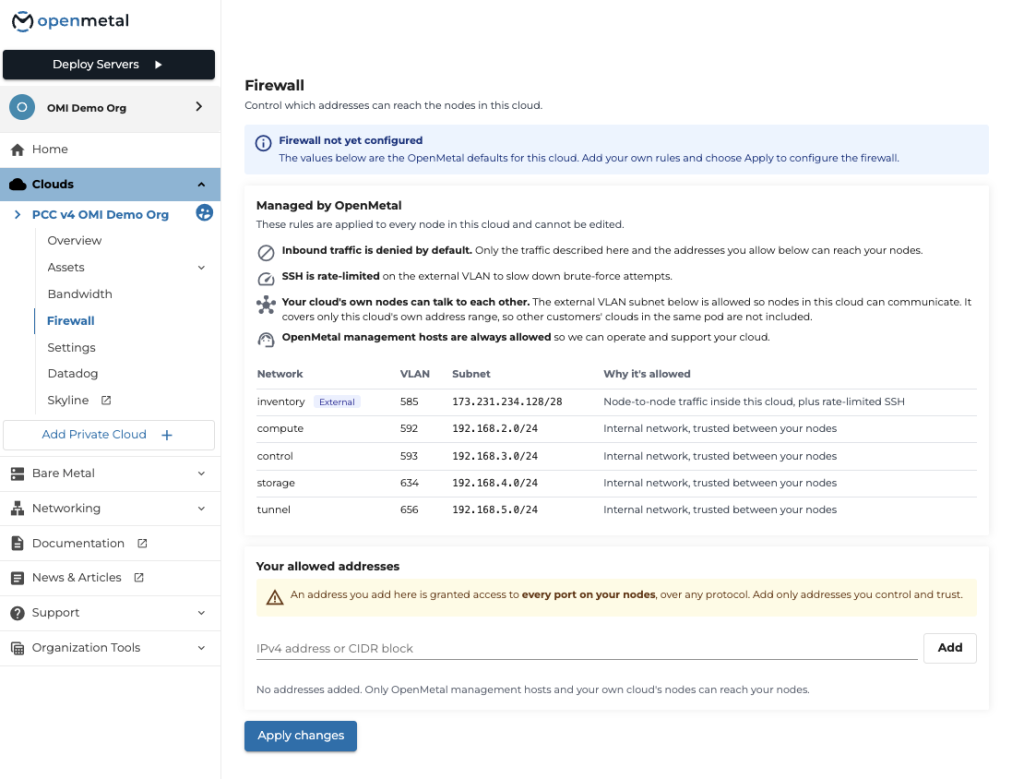
PCC v4 also introduces host-level firewalling as a standard part of the Private Cloud deployment.
A UFW-based firewall is applied across PCC nodes. On the external-facing interface, inbound traffic is denied by default, with rate-limited SSH initially available. Customers can then add trusted networks through OpenMetal Central as additional access is required.
That means the firewall policy is part of the deployed platform itself rather than an additional layer that must be introduced separately.
The underlying configuration also distinguishes between external, management, and OpenMetal-operated network access, giving the platform a defined host-level access model across the different networks that make up a Private Cloud environment.
For customers, the interaction remains straightforward: trusted source networks can be managed through OpenMetal Central while the underlying firewall configuration is handled as part of the platform.
Horizon remains the default dashboard, with Skyline now available
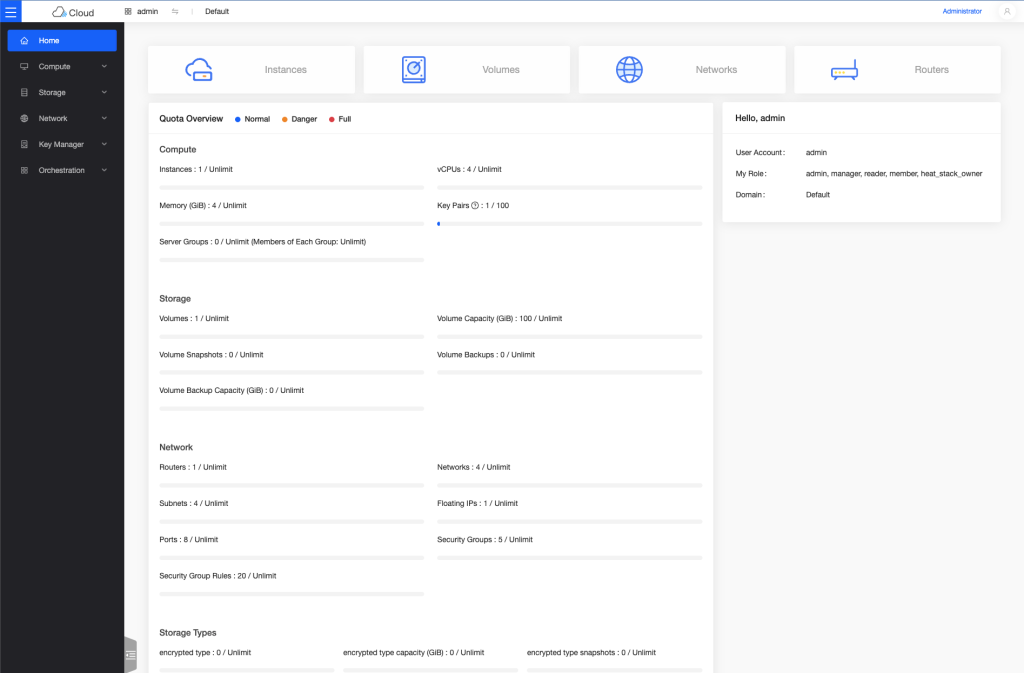
Horizon remains the default OpenStack dashboard for all PCC v4 clouds for now, giving users the familiar interface they already know for interacting with their cloud.
Skyline is now available as an optional dashboard that users can enable through a toggle in OpenMetal Central when they want to work with the newer interface.
That lets teams stay on Horizon by default while giving them the option to switch to Skyline whenever it suits their workflows.
The change is another example of the broader PCC v4 approach: advancing the default platform while retaining flexibility where customers or operators require a different option.
A more unified deployment workflow
A significant part of PCC v4 is also in the automation behind the platform.
The same Ansible playbook suite can now handle both the initial deployment of a Private Cloud and the addition of new nodes. Previously separate workflows are brought together under the PCC v4 automation suite.
That is particularly important as clouds grow after their initial deployment. Adding capacity becomes part of the same automation model used to establish the environment in the first place.
The Mitogen strategy plugin is also enabled across PCC repositories. OpenMetal’s engineering results show approximately a 1.25× to 1.5× improvement in Ansible playbook execution speed.
Several supporting pieces of the deployment process have also moved forward. Network configuration is now handled through cloud-init, SSH keys are synchronized to a cloud through Central after deployment, and the PCC suite explicitly selects the Python interpreter used by Semaphore. Database connection load balancing now uses ProxySQL rather than HAProxy.
These changes may operate below the level most users see, but they are an important part of PCC v4: the deployment system is evolving alongside the cloud platform it manages.
A coordinated update across the Private Cloud platform
OpenMetal Private Cloud Core v4 brings a coordinated set of improvements across the core areas of the platform: compute, networking, storage, security, management, and deployment automation.
The release moves the platform to Ubuntu 24.04, OpenStack 2026.1 “Gazpacho,” and Ceph v19 “Squid,” while introducing OVN as the default Neutron networking architecture and Skyline as an optional dashboard toggle in OpenMetal Central. Host-level firewalling is now part of the standard node configuration, deployment automation has been expanded to support both initial deployments and node additions, and Mitogen improves Ansible execution performance.
Taken together, these changes represent a significant evolution of the OpenMetal Private Cloud platform. PCC v4 modernizes the core software stack, advances the networking and security architecture, and streamlines how clouds are deployed and expanded.
Bring Your Next Workload to Private Cloud
If you are planning a new private cloud, OpenMetal Private Cloud Core v4 gives you a current OpenStack foundation with Ubuntu 24.04, OpenStack 2026.1, Ceph Squid, OVN networking, stronger host-level security, and a more unified deployment workflow already built into the platform. Talk to OpenMetal about designing a new Private Cloud around the workloads you need to run.