


















NVIDIA AI Enterprise (NVAIE) is a support and integration product, and knowing that up front settles most of the buying decision. It does not unlock faster GPUs or a private tier of models: you can run vLLM, plain Triton, open PyTorch or TensorFlow, and community CUDA containers, and self-host almost any open model on a bare GPU at full performance with no NVAIE license. What the entitlement buys is a different thing, and a valuable one for the right buyer: a named vendor who carries the risk, owns the integration, and can be held accountable to a regulator or a board when a production model needs a fix. This guide walks through what the entitlement actually grants, why customers with the budget pay for it, and how to tell quickly which side of that line you sit on.
Key Takeaways
- NVAIE is a support and integration product, not a performance product. The same models and engines run at the same speed on a bare GPU with no license, so you are buying a contract and a validated stack, not throughput.
- The single biggest reason to buy it is a vendor you can point an auditor at. Regulated and risk-averse organizations often cannot run production AI on best-effort community software, and an SLA-backed support contract with CVE notifications is what unblocks sign-off.
- NIM is the feature people actually reach for. Prepackaged, pre-tuned inference microservices turn a model card into a production endpoint in minutes instead of a week of hand-tuning, which is worth real money when engineer-hours are the scarce resource.
- The person who wants it and the person who pays for it are often different. Engineers who are comfortable owning their own stack rarely need it; procurement, compliance, and risk functions buy it anyway, which is exactly why it belongs as an optional line item rather than a default.
- On single-tenant bare metal it is a clean yes-or-no. The GPU-slicing licensing that forces NVAIE in the virtualized world does not apply, so you run the free stack or bring an NVAIE entitlement entirely on your own terms.
What the Entitlement Actually Grants
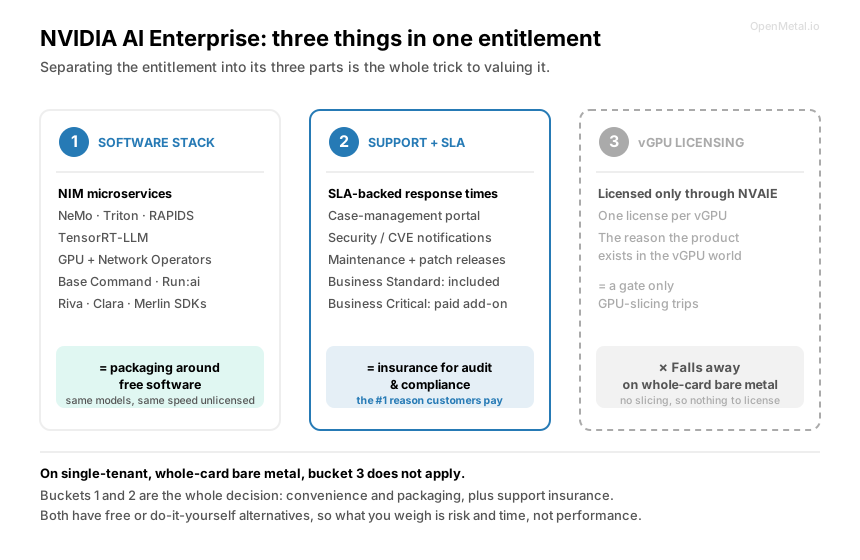
NVAIE bundles three distinct things, and separating them is the whole trick to valuing it.
The first is the software stack, and this is the bulk of what you are handed: production-grade, NVIDIA-supported builds of tools you can mostly get for free elsewhere. That includes NIM microservices (prepackaged, optimized inference containers for popular models, and the headline feature lately), NeMo (the framework for LLM training, customization, and RAG), Triton Inference Server, RAPIDS for GPU-accelerated data science, TensorRT and TensorRT-LLM, the GPU Operator and Network Operator for Kubernetes, the Container Toolkit, and cluster-management pieces such as Base Command Manager and Run:ai scheduling. It also includes pretrained models and domain SDKs (Riva for speech, Clara for medical imaging, Merlin for recommenders, and others). Nearly every one of these has a free, open, or community-supported equivalent that performs identically on the same silicon.
The second is enterprise support with an SLA, and this is the part most paying customers are really buying. It means direct access to NVIDIA support engineering with SLA-backed response times, a case-management portal, security notifications, and maintenance and patch releases against the versions you have deployed. Business Standard support is included with the entitlement; Business Critical, with tighter response commitments, is an upsell.
The third is licensing enforcement for virtualization, and it matters only if you slice GPUs. vGPU-for-Compute is licensed exclusively through NVAIE, which is the structural reason the product exists at all in the vGPU world. On a dedicated, whole-card bare-metal deployment there is nothing to license here, so this bucket simply falls away.
The three buckets divide cleanly. Bucket one is convenience and packaging around free software; bucket two is insurance; bucket three is a licensing gate that only some deployment models trip. What you are deciding, then, is how much you value the insurance and the packaging.
Why Customers Actually Pay
Four reasons come up again and again, and only one of them is about the software itself.
A support contract they can point an auditor or a boss at. This is the number one reason, and it is a procurement and compliance concern rather than a technical one. Regulated industries (finance, healthcare, government) and risk-averse enterprises frequently cannot put a production model on software described as community-supported and best-effort. NVAIE gives them a named vendor with SLA response times, a security-notification channel, and patch releases they can cite in a vendor-risk questionnaire. The engineering team may be perfectly happy running open vLLM; the organization still buys the contract, because the contract is what clears the review.
NIM, for deployment speed. NIM is the current draw for a reason. Instead of hand-tuning TensorRT-LLM to stand up an optimized endpoint, you pull a pre-tuned inference microservice and have a production, OpenAI-compatible endpoint running in minutes. For a team whose binding constraint is engineer-hours rather than GPU budget, that time-to-production is the value, and it is a value you feel every time you swap or add a model behind a stable interface.
A NIM launch is short by design:
docker run --rm --gpus all -e NGC_API_KEY -p 8000:8000 nvcr.io/nim/<model>:<tag>
# then an OpenAI-compatible endpoint is live on :8000
curl localhost:8000/v1/chat/completions -d '{"model":"...","messages":[...]}'
The image is pulled from the NVAIE-gated NGC registry, so the entitlement is what the pull is buying you. The container runtime and the GPU are free; access to the pre-tuned, supported image is the licensed part.
A curated, version-matched stack. NVIDIA validates the combination of driver, CUDA, framework, and operator versions so you are not the one chasing compatibility across a dozen fast-moving parts. For a small platform team standing up GPU infrastructure for a large group of data scientists, owning that compatibility matrix is close to a full-time job, and handing it off is worth real money.
Long support lifecycles. Enterprises that certify and pin a stack for years get maintenance releases and security patches against that pinned version, which the fast-moving open-source world does not promise. If your deployment revs slowly on purpose, that guarantee is a big part of what you are paying for.
Notice that three of the four reasons are about who owns risk and integration, and only NIM is about the software doing something quicker. That is the tell that NVAIE is bought by organizations, for reasons of governance and time, rather than by individual engineers for reasons of capability.
Who Wants It, and Who Does Not
The clearest way to place yourself is to look at who each side actually is.
| Buy NVAIE if… | Skip NVAIE if… |
|---|---|
| A regulator, auditor, or board has to sign off on your production stack | You are your own first line of support and comfortable with that |
| You need a named vendor with an SLA and CVE notifications on record | You run your own vLLM, PyTorch, or plain Triton stack |
| NIM’s minutes-to-endpoint saves scarce engineer-hours | Engineer-hours are not your binding constraint |
| You pin a stack for years and need patches against that version | You track upstream and rev frequently |
| You run managed Kubernetes GPU clusters at scale and want the operators and a scheduler under contract | You do not need the gated NGC containers |
In each buy-column case the payoff is the same: a governance obligation gets satisfied, or an integration burden moves off your team. The skip column describes a large share of raw-CUDA GPU renters, for whom the entitlement is cost with no matching benefit. Being your own support is a deliberate and reasonable choice, not a gap to paper over.
A short way to decide: if a compliance reviewer, an auditor, or a boss will ask “who supports this, and how fast do they respond to a CVE,” you are probably in the buy column. If the honest answer is “we do, and we are fine with that,” you almost certainly are not.
Where OpenMetal Fits
None of the above depends on OpenMetal. NVAIE is a decision about your risk posture and your team, and it travels with you regardless of where the GPU lives. On single-tenant bare metal, two specifics change the picture.
First, the virtualization-licensing bucket does not apply. OpenMetal GPU servers, built on the NVIDIA H200 NVL and the NVIDIA RTX PRO 6000 Blackwell Server Edition, are dedicated whole-card machines with full root access, not sliced vGPU instances, so there is no vGPU entitlement you are obligated to license. That removes the one place where NVAIE is structurally mandatory and leaves the decision entirely on the merits of support and packaging.
Second, because the hardware is yours end to end, this is a clean either-or that you control. You can run the free, open stack (vLLM, Triton, PyTorch, community CUDA) on the bare card, or you can bring an NVAIE entitlement and run the supported builds and NIM microservices on the same hardware. NVAIE is available as an optional add-on rather than a bundled default, which is the correct shape for a customer base where a large fraction genuinely does not need it. If you do want it in the mix, talk to OpenMetal about how to attach it to your build; pricing for an independent NVAIE license itself runs through NVIDIA and its resellers.
The Decision, In One Line
If you would have to defend your production AI stack to someone who does not write code, NVAIE is likely worth its price, and NIM will probably pay for itself in time-to-production on top. If your team is comfortable being its own support and runs its own open stack, you can serve the same models at the same speed on a bare GPU and keep the license fee. The hardware underneath is the same either way; what changes is who carries the risk, and that is a decision only you can make.
Sources
- NVIDIA AI Enterprise product overview: the software stack bundled under the entitlement (NIM, NeMo, Run:ai, CUDA-X libraries) with extended-lifetime production branches and enterprise support.
- NVIDIA NIM microservices: NIM as prepackaged, optimized inference containers with OpenAI-compatible endpoints, with production use covered under an NVIDIA AI Enterprise license.
- Support Services for NVIDIA AI Enterprise: Business Standard support included with the subscription, and Business Critical, with 24×7 coverage and faster response, available as a paid add-on.
- NVIDIA vGPU for Compute licensing: vGPU-for-Compute enforced through the NVIDIA AI Enterprise license, the bucket that falls away on whole-card bare metal.