






















In this article
We look at why financial services firms accumulate large, long-lived data retention and audit archive requirements, why hyperscaler storage pricing works against that access pattern specifically, and how a large-scale Ceph cluster handles the same requirement with predictable costs and full control.
If your firm retains years of transaction records, audit logs, and compliance documentation, you already know the data doesn’t shrink. It only grows, and most of it sits there quietly until the one day someone needs to pull a specific record from three years ago under a deadline.
That access pattern, mostly cold, occasionally urgent, retained for years by regulation rather than by choice, is exactly the kind of storage workload that hyperscaler pricing models are least suited to.
Why Financial Services Data Retention Is a Distinct Storage Problem
Regulatory retention requirements in financial services commonly run five to seven years or longer, depending on jurisdiction and record type, covering transaction records, audit trails, communications archives, and compliance documentation. That data isn’t actively queried most of the time. It sits, waiting to satisfy an audit request, a regulatory inquiry, or a legal hold, and the volume only accumulates over time since very little of it is ever deleted early.
This creates a specific set of requirements that differ from a typical application storage workload:
- Retrieval needs to be reliable and reasonably fast when it happens, since audit and regulatory deadlines don’t bend for slow storage.
- The data needs to be durable over a multi-year horizon without active management overhead.
- And because retention periods are set by regulation rather than convenience, the total footprint is large and only moves in one direction: up.
Where Hyperscaler Pricing Works Against This Pattern
Public cloud object storage pricing generally splits into a storage rate and a retrieval or egress rate, and the retrieval side is where long-retention workloads get expensive in ways that aren’t obvious until the bill arrives. Cold storage tiers designed for infrequent access often charge meaningfully more per request or per gigabyte retrieved than standard tiers, on the assumption that data in cold storage stays untouched.
That assumption doesn’t hold well for audit data, because audits are unpredictable. A regulatory request can require pulling a large volume of historical records with no advance notice, and that’s precisely the scenario where cold-tier retrieval fees and egress charges compound fastest.
The billing model itself creates a planning problem too. Multi-year retained data at accumulating scale, priced per gigabyte per month indefinitely, means the storage line item keeps growing on its own even if your business doesn’t, since none of that data can be deleted before its retention period ends. Budgeting for a cost that grows automatically, tied to a regulatory clock rather than to usage you control, is a difficult position for a finance team to be in.
Why a Large-Scale Ceph Cluster Fits This Requirement
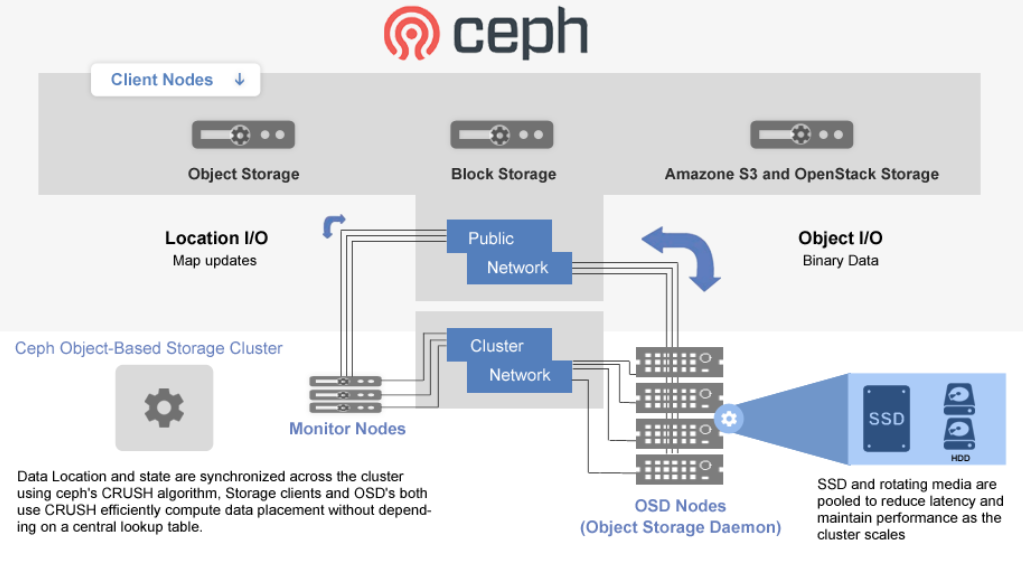
Ceph’s distributed object storage, the same architecture behind S3-compatible cloud storage generally, handles this access pattern well for a straightforward reason: it doesn’t charge per retrieval. Once you’re running your own cluster, pulling a large volume of archived records during an audit doesn’t trigger a retrieval fee or an egress bill on top of what you already pay for the infrastructure. The cost is the cluster itself, not the act of using it.
That matters specifically for the “audits are unpredictable” problem. A firm running Ceph at scale can pull whatever volume of historical data a regulatory request demands without that request itself becoming a cost event. The infrastructure spend is fixed and known in advance, which is the opposite of a storage bill that compounds based on how the request happens to unfold.
Ceph’s architecture also fits the durability requirement. Data is distributed and replicated (or erasure-coded, depending on configuration) across multiple nodes with no single point of failure, which is the same property that makes it suitable for multi-year retention where losing a drive can’t mean losing records you’re legally required to keep. And because it presents S3-compatible object storage, existing tooling and workflows built against S3 APIs generally work against a self-hosted Ceph cluster with minimal rework.
For the tiering question specifically, a common configuration pairs NVMe as a fast-access layer for recently retained or frequently referenced records with higher-capacity HDDs for the bulk of older, rarely accessed archives, a design covered in more depth in our overview of OpenMetal’s storage tiers. That split keeps cost proportional to capacity rather than to activity, since the archive tier is priced for bulk retention, not for retrieval speed.
This isn’t a theoretical scale argument. MyMiniFactory, a large digital content platform, runs roughly 2.5 petabytes on OpenMetal’s Ceph storage today, and cut its AWS bill by 50% moving off hyperscaler infrastructure. That’s a real, production-scale deployment of exactly the kind of large, growing, mostly-cold storage footprint this article is describing, running on the same architecture a financial services retention archive would use.
Who This Fits Best
This is aimed at firms with serious, real retention volumes, commonly in the tens to low hundreds of terabytes for mid-market financial services firms, though the same architecture holds up well beyond that range. If your priority is reliable, controllable, audit-ready storage that doesn’t punish you for pulling data during an audit, this is the right fit.
Where This Connects to Broader Compliance Requirements
Retention and audit-readiness increasingly sit alongside other regulatory infrastructure questions financial services firms are already navigating, including operational resilience obligations under frameworks like DORA. A storage architecture you fully control, with data in open, portable formats rather than a proprietary hyperscaler format, is also easier to demonstrate as part of a documented exit strategy or concentration-risk review, since the data isn’t locked into a single provider’s retrieval mechanics to begin with.
Getting Started
Large-scale Ceph storage clusters are priced on our storage cluster pricing page, with predictable egress pricing that doesn’t scale against you the way retrieval fees on cold cloud storage tiers can. For workloads that also need data protected while it’s being actively processed, not just archived, see our confidential cloud storage with Ceph piece, which covers the security side of this same storage layer.
FAQ
How long do financial services firms typically need to retain transaction and audit data?
Retention requirements vary by jurisdiction and record type, but five to seven years is common, and some categories of records require longer. Confirm specific requirements with your compliance and legal team, since this varies by regulation and record type.
Why does hyperscaler cold storage get expensive for audit data specifically?
Cold storage tiers are typically priced assuming infrequent access, with per-request or per-gigabyte retrieval charges layered on top of the storage rate. Audit and regulatory requests are unpredictable and can require pulling large volumes of historical data with no advance notice, which is exactly the scenario that triggers the highest retrieval and egress costs on a cold-tier pricing model.
Is Ceph a good fit for genuinely hyperscale, multi-petabyte bulk storage?
Yes. Ceph’s architecture scales to exabyte level and is used at genuinely massive scale across the industry, including some of the largest storage deployments in production today. It’s a proven fit at any scale a financial services retention archive is likely to reach.
Does self-hosted storage help with regulatory exit strategy or concentration risk requirements?
Storage built on open, portable formats that you control directly, rather than locked into a single provider’s proprietary retrieval mechanics, is generally easier to document as part of an exit strategy or concentration-risk review. Whether it satisfies a specific regulatory requirement like DORA’s Article 28 depends on your full compliance program and should be confirmed with your legal or compliance team.
Schedule a Consultation
Get a deeper assessment and discuss your unique requirements.
Read More on the OpenMetal Blog