

























In this article
We look at what the GENIUS Act actually requires of payment stablecoin issuers, why reserve tracking, redemption, and transaction monitoring systems need dedicated and auditable infrastructure rather than shared platforms, and where that requirement does and doesn’t touch broader blockchain infrastructure.
If your institution issues, or is considering issuing, a payment stablecoin, you’re now operating under a real federal compliance framework instead of the patchwork of state rules that existed before. That framework has specific infrastructure implications that go beyond the legal and licensing questions most of the current coverage focuses on.
The GENIUS Act, signed into law in July 2025, is the first comprehensive federal framework for payment stablecoins in the US. Federal regulators, including the OCC, FDIC, and NCUA, have spent 2026 turning its provisions into specific rules, several of which carry real infrastructure requirements for issuers.
What The GENIUS Act Actually Requires
At its core, the Act limits stablecoin issuance to “permitted payment stablecoin issuers”, meaning entities approved by the OCC or an equivalent state regulator under a harmonized federal or state licensing path. Permitted issuers must back every stablecoin with 100% reserves in cash or short-term Treasuries and disclose reserve composition publicly on a regular basis. Issuers with more than $10 billion in outstanding issuance face additional requirements, including audited financial statements, while smaller issuers can operate under state supervision if that state’s regime is certified as substantially similar to the federal framework.
Separately, the Act directs Treasury to treat permitted issuers as financial institutions under the Bank Secrecy Act, meaning standard anti-money-laundering and sanctions-compliance obligations apply to stablecoin issuance the same way they apply to other regulated payment activity. Proposed rules from the FDIC and OCC, still moving through the comment and rulemaking process as of mid-2026, would also set specific operational standards, including redemption timelines for supervised issuers.
These specifics are still being finalized, so treat exact figures as directional until the rules are final rather than settled law.
Why This Is An Infrastructure Question, Not Just A Legal One
Most current coverage of the GENIUS Act comes from law firms, compliance-as-a-service vendors, and crypto-native custody platforms, and it’s almost entirely focused on licensing pathways, legal structuring, and go-to-market strategy. That’s necessary reading, but it skips a real question underneath it: what does the infrastructure actually running reserve tracking, redemption processing, and transaction monitoring need to look like to hold up under this framework.
A few of the Act’s requirements translate directly into infrastructure decisions. Reserve composition disclosure means the systems tracking reserve holdings need to produce accurate, auditable records on a predictable schedule, not a best-effort export from a shared system.
BSA and sanctions-compliance obligations mean transaction monitoring needs to run continuously against sensitive financial data, which raises the same data-handling questions any regulated financial workload raises. And redemption processing, however the final timelines land, needs infrastructure that performs reliably under real load, since a redemption system that’s slow or unavailable during a demand spike is exactly the kind of operational failure a federal regulator will ask about.
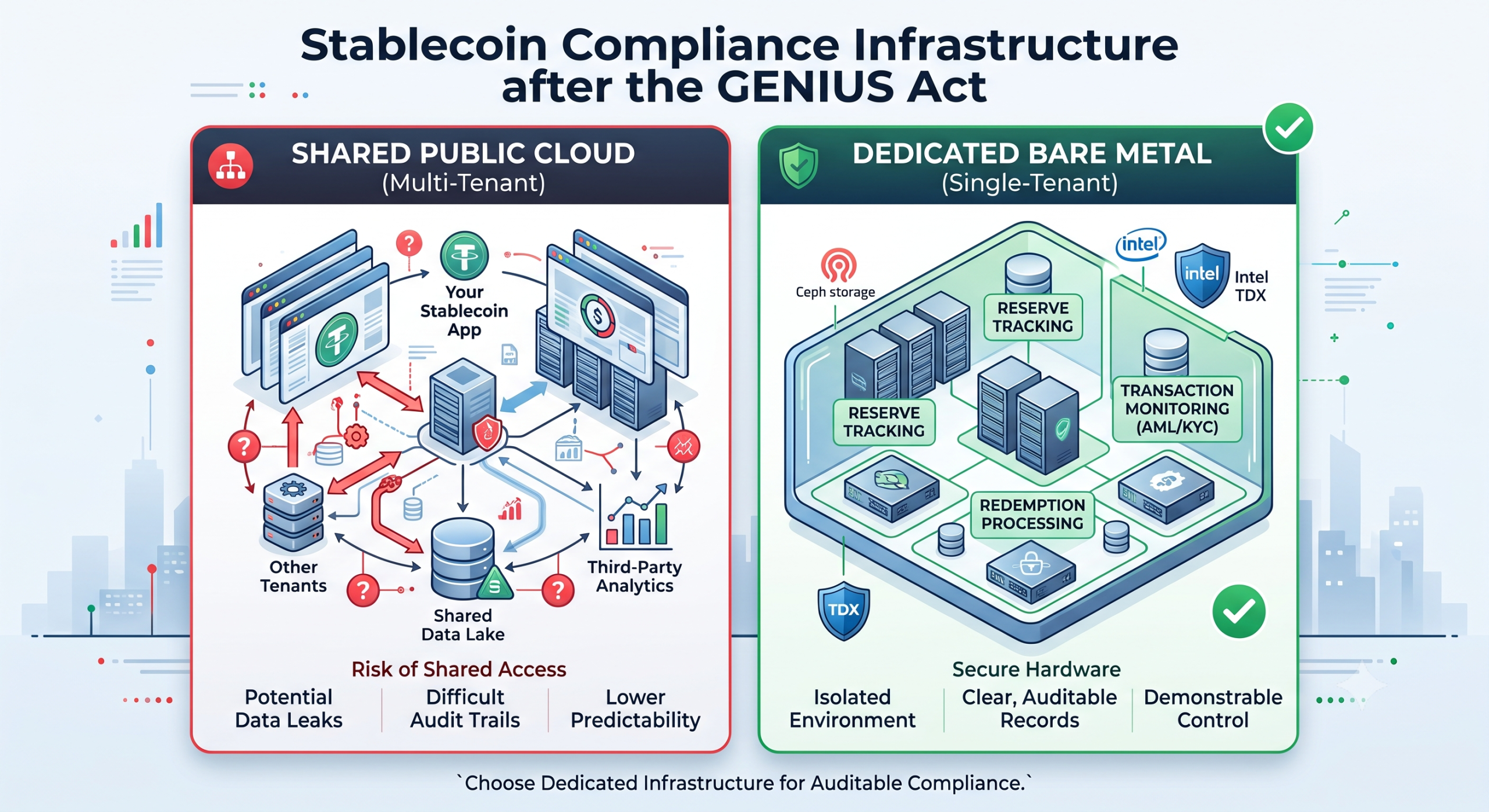
None of that is well served by a shared, multi-tenant platform where you don’t control the underlying hardware or have full visibility into what’s running alongside your workload. It’s better served by dedicated, single-tenant infrastructure that you can point to directly when a regulator or an internal audit asks how a specific control was implemented.
Where Dedicated Infrastructure Fits Specifically
Reserve and transaction-monitoring systems benefit from the same argument that applies to other regulated financial workloads: dedicated, single-tenant hardware gives you a clean, demonstrable boundary around sensitive processing, without a shared platform’s other tenants or the provider’s own broad access to the environment sitting in the way.
For sanctions-screening and AML systems processing sensitive transaction data specifically, Intel TDX confidential computing adds a further layer, protecting that data even while it’s actively being processed, on bare-metal hardware built for exactly that purpose.
For the audit and disclosure side, reserve records, redemption logs, and compliance documentation accumulate the same way financial audit trails do in any regulated industry: they grow steadily, need to be retrievable reliably when a regulator asks, and are rarely deleted early. A large-scale Ceph storage cluster handles that pattern well, without the retrieval fees that make pulling a large volume of historical records expensive on hyperscaler cold-storage tiers.
This same reasoning extends to regulated financial institutions running blockchain infrastructure more broadly, not just stablecoin issuance specifically. See our broader look at blockchain infrastructure for regulated finance for how the same compliance-and-control argument applies to tokenization platforms and other regulated blockchain use cases.
What This Doesn’t Cover
The GENIUS Act’s compliance weight falls on permitted issuers and the vendors whose infrastructure directly touches reserves, transactions, or end users, not on blockchain infrastructure broadly. Industry groups have specifically pushed regulators to keep blockchain validators, open-source protocols, and non-financial software providers outside the Act’s direct compliance scope, and that’s a meaningfully different question from what this article covers.
If you’re running validator infrastructure rather than issuing or processing a payment stablecoin yourself, this compliance framework doesn’t apply to you the same way, though the underlying case for dedicated bare metal still holds for different reasons.
This also isn’t legal advice. Whether a specific infrastructure setup satisfies your obligations as a permitted issuer, a vendor to one, or an institution evaluating whether to issue a stablecoin at all is a question for your legal and compliance team, particularly while several implementing rules are still in draft form.
Getting Started
Dedicated bare metal servers and hosted private cloud configurations are on our bare metal pricing page and cloud deployment page, with fixed monthly costs that make budgeting for a compliance program more predictable than infrastructure billed against transaction volume.
FAQ
Does the GENIUS Act apply to blockchain validators?
Not directly, based on how the framework and its implementing rules have developed. The Act’s compliance obligations target permitted payment stablecoin issuers and the vendors whose infrastructure directly handles reserves, transactions, or end users. Industry groups have pushed to keep validators and open protocols outside that scope specifically.
What are the reserve requirements under the GENIUS Act?
Permitted issuers must back stablecoins with 100% reserves in cash or short-term Treasuries and disclose reserve composition publicly on a regular basis. Issuers above $10 billion in outstanding issuance face additional requirements, including audited financial statements.
How fast do stablecoin issuers need to process redemptions?
Specific redemption timelines are still moving through the federal rulemaking process as of mid-2026, with proposed rules from federal regulators addressing this directly. Confirm current requirements with your legal and compliance team rather than relying on any figure cited before the rules are finalized.
Why would a stablecoin issuer need dedicated infrastructure instead of a shared cloud platform?
Reserve tracking, transaction monitoring, and redemption processing all benefit from infrastructure you fully control and can point to directly for audit and disclosure purposes. Dedicated, single-tenant hardware avoids the shared-platform visibility and access questions that come with multi-tenant infrastructure, which matters more once BSA and sanctions-compliance obligations apply to the workload.
Schedule a Consultation
Get a deeper assessment and discuss your unique requirements.
Read More on the OpenMetal Blog