





















In this article
The moment a US SaaS company signs its first significant EU customer, a clock starts ticking. That customer’s legal team will eventually ask where their data lives, and “our servers are in Virginia” is an answer that creates friction. The instinct is to either ignore the problem or solve it by standing up full EU operations. There’s a middle path that most companies miss.
EU expansion is a revenue milestone for most US software companies. It’s also the point where infrastructure decisions that worked fine domestically start creating complications. EU customers, especially enterprise ones, ask questions about data residency that US hosting can’t easily answer. Compliance teams cite GDPR. Legal asks for a Data Processing Agreement that specifies where data is processed and stored.
The companies that handle this well don’t build an EU subsidiary or hire a European infrastructure team. They solve the infrastructure problem specifically, without taking on the operational complexity that surrounds it. Understanding what EU customers are actually asking for is the first step.
What EU Customers Are Actually Asking For
GDPR requires that personal data on EU residents is handled with appropriate protections. When enterprise EU customers ask where their data lives, they’re usually asking one of two related questions: is our data stored inside the EU, and who has access to it?
Hosting that data inside the EU is the most straightforward way to satisfy the first question. When EU customer data is processed and stored on infrastructure physically located in the EU, the cross-border data transfer complexity largely disappears. Data stays inside EU jurisdiction, processed under EU law, without requiring Standard Contractual Clauses or transfer impact assessments for that data.
This is an infrastructure problem, not a corporate structure problem. You don’t need an EU legal entity to run EU infrastructure. You don’t need EU employees. You need servers in the EU processing EU customer data, and a clear answer when your customer’s legal team asks about it.
The companies that confuse these two things spend months on legal and HR work before solving what is essentially a hosting decision. The companies that separate them move faster and spend less.
The Expensive Way Most Companies Solve It
The default path for US companies adding EU infrastructure is to spin up resources in a hyperscaler’s EU region. AWS eu-west-1 in Ireland and Azure West Europe in the Netherlands are the most common choices. They work, and they’re fast to provision.
The problem is that hyperscaler EU regions come with the same pricing model you’re already paying in the US, applied to a second environment you’re now running alongside your primary one. Public cloud costs that are manageable at one region become harder to justify when you’re paying them twice.
At moderate scale, the math shifts quickly. EC2 instances, EBS volumes, data transfer between regions, load balancers, and all the supporting services that come with a real production environment add up in an EU region the same way they do in the US. You’re not paying more per unit, but you’re paying full hyperscaler rates for every unit in both environments.
Beyond cost, there’s the operational question. A second cloud environment means a second set of configurations to maintain, a second billing account to monitor, and a second surface area for your team to manage. For a company with a small infrastructure team, that overhead is real.
The alternative that most companies don’t consider is fixed-cost EU infrastructure that removes the variable billing model entirely.
Why Amsterdam Specifically
If you’re going to run EU infrastructure, location within the EU matters more than it might seem. Latency from your EU infrastructure to EU customers varies considerably depending on where your servers physically sit, and some EU locations are simply better connected than others.
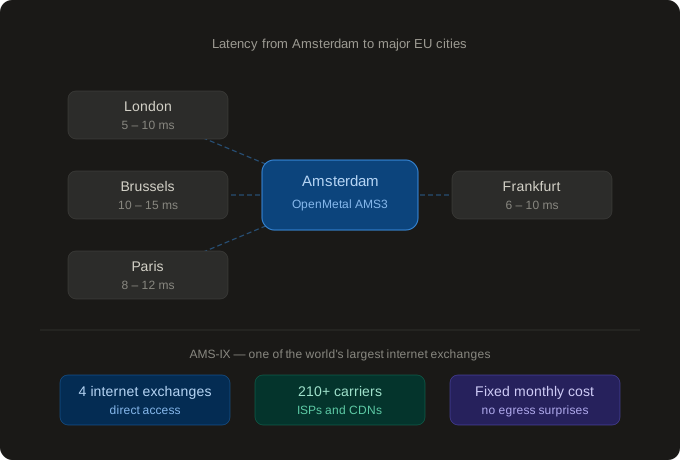
Amsterdam is Europe’s internet hub. AMS-IX, the Amsterdam Internet Exchange, is one of the largest internet exchanges in the world. OpenMetal’s Amsterdam facility connects to four internet exchanges and over 210 carriers, ISPs, and CDNs. That connectivity profile means lower latency to customers across the continent, more routing options, and generally better performance than single-datacenter alternatives in less connected EU cities.
The latency profile from Amsterdam covers the full EU customer base well. London sits around 5 to 10ms away. Paris is 8 to 12ms. Frankfurt is 6 to 10ms. Brussels is around 10 to 15ms. For a US company whose EU customers are concentrated in Western Europe, Amsterdam puts you close to the center of that market.
The regulatory environment in the Netherlands is also worth noting. The Dutch data protection authority is well-established, the legal framework for foreign companies operating infrastructure in the Netherlands is clear, and the business environment is straightforward to work in. For companies nervous about EU regulatory complexity, the Netherlands is one of the more predictable jurisdictions to operate in.
The Post-Brexit dimension matters too. UK companies serving EU customers face the same data residency questions as US companies, and Amsterdam’s proximity to the UK (roughly 10ms from London) makes it the natural choice for companies that need to serve both markets from a single EU location.
What Fixed-Cost EU Infrastructure Actually Looks Like
The alternative to hyperscaler EU billing is a hosted private cloud or bare metal server in Amsterdam at a predictable monthly price. The cost is the same whether you use 20 percent of the capacity or 100 percent. There are no per-VM fees, no egress surprises on replication traffic between your servers, and no bill that varies based on how much your EU customers actually use your application.
For a US company that’s added EU customers but isn’t yet running EU infrastructure at hyperscaler scale, this model changes the economics significantly. A three-node Cloud Core running OpenStack and Ceph in Amsterdam gives you a full private cloud environment with compute, storage, and networking at a fixed monthly rate. You can run as many VMs as the hardware supports without paying per instance. You can replicate data between your US and EU environments without paying per gigabyte for internal traffic.
OpenMetal’s managed operations mean you don’t need EU infrastructure staff. The same team that supports your US environment supports your Amsterdam environment. Engineer-to-engineer support through dedicated Slack channels, with a named team that knows your infrastructure, not a ticket queue.
For companies that need bare metal rather than a full private cloud, dedicated servers in Amsterdam are available in the same hardware configurations as US locations, with the same pricing structure.
Three Paths Compared
It’s worth being clear about when each approach makes sense, because the right answer depends on where you are.
Hyperscaler EU region makes sense when you’re early in EU expansion, your team already manages everything through a single hyperscaler, and the operational simplicity of staying on one platform outweighs the cost. If you’re running a handful of instances to serve a small EU customer base, spinning up resources in eu-west-1 is the fastest path and probably the right one.
Colocation with your own hardware makes sense when you have significant EU infrastructure needs, a team that manages hardware, and enough scale that owning the hardware is clearly cheaper than renting it. This is the right answer for mature EU operations, not for companies that are just getting started.
Hosted private cloud or bare metal in Amsterdam makes sense when you’ve outgrown the economics of hyperscaler EU billing, you want predictable EU infrastructure costs, and you don’t want to manage physical hardware yourself. This is the middle path between the flexibility of hyperscaler billing and the commitment of owning your own EU hardware. It’s also the right answer for companies with compliance requirements that benefit from dedicated, single-tenant infrastructure rather than shared hyperscaler environments.
Our cloud deployment calculator gives you itemized pricing across configurations so you can run the comparison against your current or projected EU infrastructure costs without a sales call.
What You Don’t Actually Need
This is worth stating directly for companies that are early in the EU expansion conversation, because the overhead is frequently overestimated.
You don’t need an EU legal entity to run EU infrastructure. A US company can operate servers in the Netherlands without incorporating in the Netherlands. Infrastructure contracts are commercial agreements, not corporate presence requirements.
You don’t need to hire EU staff to manage EU infrastructure. A managed hosting provider handles the hardware and the environment. Your existing team manages what runs on top of it.
You don’t need to migrate your entire stack. The most practical starting point for most US companies is scoping exactly which data needs EU residency, which is usually EU customer personal data, and running that workload in the EU while leaving everything else where it is. A hybrid architecture with US production and EU data residency for EU customers is a common and entirely workable pattern.
You don’t need to solve EU compliance in one move. Infrastructure in the EU is the foundational step. Data classification, DPA agreements, and broader GDPR compliance build on top of it. Getting the infrastructure right first gives you something concrete to point to when customers and auditors ask.
A Practical Starting Point
The lowest-risk way to approach this is to start with a scoped EU deployment for a single customer segment or workload before expanding to cover your full EU footprint.
A single bare metal server or small private cloud in Amsterdam handling EU customer data gives you a real answer to the data residency question, a working EU infrastructure environment, and concrete cost data to compare against hyperscaler alternatives. If the architecture works and the economics hold, you expand from there. If your EU business grows faster than expected, adding capacity takes roughly 20 minutes rather than months of procurement.
The EU infrastructure problem is more solvable than it looks from the outside. The companies that solve it well don’t build EU operations, they add EU infrastructure.
Ready to explore EU infrastructure options? See OpenMetal’s Amsterdam data center or use the Cloud Deployment Calculator to understand what a fixed-cost EU environment would cost for your scale.
Schedule a Consultation
Get a deeper assessment and discuss your unique requirements.
Read More on the OpenMetal Blog