















In this article
A decision guide for infrastructure leads weighing a planned hosted private cloud against public cloud or VMware, built around workload shape, scale, operating model, and the results three customers have published.
In 2021, MyMiniFactory saw a surge of new users and a run of infrastructure outages. Their platform stores and serves large 3D design files, and it ran across two other providers at the time. The interruptions did lasting damage and support was slow to respond. Their list of priorities afterward was short: scalability, data security, cost control, and control over data egress costs.
Priorities like these shape most infrastructure reviews. What changes from company to company is the order, and whether a planned private cloud deployment is the right answer to it. This guide gives you the criteria we use to judge fit, backed by figures from three customers who have published their results, and says plainly where public cloud is still the better call.
What a Planned Large Private Cloud Deployment Means
A hosted private cloud on OpenMetal is OpenStack and Ceph running on dedicated servers we rack and operate in our data centers. It starts with a three-server Cloud Core and grows through Storage+Compute nodes, Compute Only nodes, and Ceph storage clusters of three or more servers. You manage it through OpenMetal Central, the GUI and API, or hand more of the operations to our engineers with Assisted Management or Complete Management.
Large deployments are planned. We do not hold a big pool of idle hardware waiting for orders. We work with you to design the cloud, order hardware against the date you need it, and set it up so it is ready when your workloads arrive. That model rewards buyers who forecast well and plan early, and it is why fit matters so much. The rest of this guide helps you test your own situation against it.
Six Criteria for Judging Fit
1. Is Your Demand Steady or Growing in a Predictable Way?
This is the first filter. Private cloud economics depend on running capacity you can forecast. If you can say, with reasonable confidence, what you will need over the next year or two, dedicated infrastructure at a fixed monthly cost works in your favor.
Public cloud wins when demand is spiky or short-lived. If a workload scales up for a week and drops back, paying by the hour is the right model, and we would tell you that directly. A planned deployment pays back when the same infrastructure runs for years.
2. Does Your Scale Reach the Point Where Fixed Cost Wins?
Convesio, a WordPress hosting platform, gives the clearest published example. Their case study describes a move from AWS and GCP, driven by cost, slow support responses, and the fact that they were running the same instance types as their direct competitors. They also rejected smaller providers that were effectively virtual private clouds on top of hyperscalers.
The useful detail is how the cost comparison scaled. In the published comparison, a single cluster cost more on OpenMetal than on GCP. As Convesio added clusters, the public cloud cost grew with each one while a single OpenMetal build served them, and at six clusters the case study’s own figures show a large gap in OpenMetal’s favor. Convesio reports cutting its cloud spend by more than 50%.
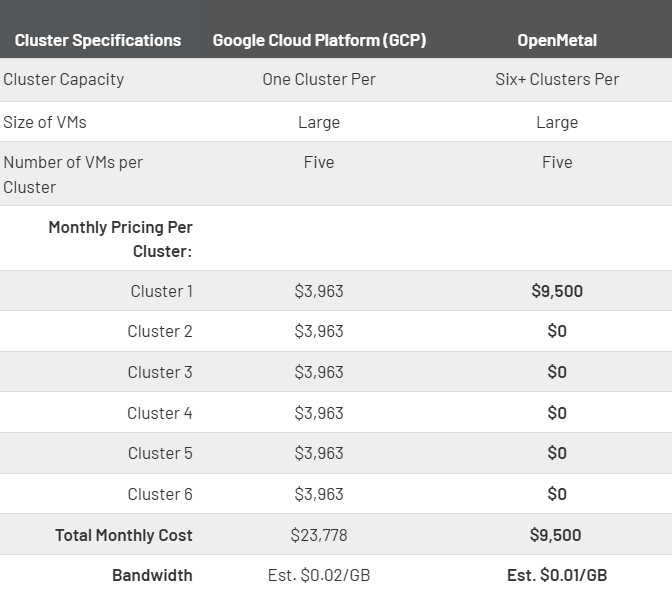
The lesson is that fixed-cost infrastructure rewards volume. A deployment sized for one small cluster may not beat public cloud. A deployment that hosts many clusters of similar workloads on the same hardware can. These figures are Convesio’s results as published by us, and your numbers will depend on your workload.
3. Can You Right-Size Instead of Renting Instance Shapes?
The Convesio case study includes a detail that is easy to skip past. They had been paying a public cloud provider for VMs with around 60 vCPUs, and rarely needed more than five or six. On dedicated hardware, they worked with OpenMetal to build spreadsheets modeling how many clients each server could hold based on CPU and disk usage, and tuned the ratio of CPU to RAM to disk through workload retrospectives.
If you are paying for fixed instance shapes that do not match what your workloads use, a private cloud gives you room to match the hardware to the work. That is a design task, and it belongs in the planning phase before you order.
4. Do Egress and Data Movement Shape Your Bill?
MyMiniFactory named egress control as one of its four priorities. Their storage cluster runs on OpenMetal in Ashburn, and each hardware unit includes a set amount of egress. Usage above that amount is billed on the 95th percentile of megabit usage, which smooths out short spikes. Convesio’s upstream bandwidth is billed the same way.
If your workload moves a lot of data out of the cloud, ask how each vendor bills it, and model your own traffic against the answer. You can compare the two models side by side on our AWS alternatives page.
5. Who Will Operate It?
A private cloud has to be run by someone. Some teams have OpenStack skills in house and use OpenMetal Central and the API directly. Others choose Assisted Management or Complete Management so our engineers carry more of the operations work. Convesio’s wishlist included assisted OpenStack management, and they began with a concern that the private cloud model might be too complicated to run.
Decide this before you order. The right answer depends on your team, and it affects how you size and staff the project.
6. Do You Have the Lead Time to Plan It?
A large order goes through design, ordering, delivery, deployment, validation, and migration. We plan each stage with you, and we set the timeline for your specific order during planning, so we do not publish a single figure. If the requirement is a large cloud within days and no prior conversation, public cloud is the faster path.
If you have a go-live date, a contract renewal, or a migration deadline several months out, planning back from that date is exactly what this model is built for.
How a Large Deployment Works Once You Decide
The process runs in stages, and each one has a clear owner. We scope the workloads and growth path with you, then design the cloud: the Cloud Core, the mix of expansion nodes and storage clusters, and the network layout. Hardware is then ordered against your go-live date, delivered, racked, and cabled by our team. With the hardware in place, the cloud software deploys in around 45 seconds. That figure covers the software deployment only, and hardware delivery follows the plan we built with you.
Before production workloads move, we recommend a proof of concept with written success criteria. After that, migration proceeds in phases, and you add nodes or storage clusters as demand grows. Our AWS to OpenMetal migration playbook covers the public cloud path in detail.
Keeping nodes consistent matters as the cloud grows. Ceph performance is limited by its slowest node, so mixing hardware generations or network speeds inside a cluster costs performance that is hard to diagnose later. Large clouds also need the control plane sized for their node count. We handle both during design.
What Three Customers Have Published
Convesio: Moving From Hyperscalers at Multi-Cluster Scale
Convesio’s case study states that they needed to deploy a minimum of two large clusters on OpenMetal. The original proof of concept design was expanded from three to five physical bare metal servers for production. After testing, they moved from a split of Ceph and direct NVMe storage to full Ceph, because direct NVMe showed little measurable performance benefit and Ceph improved resiliency and recovery from hardware failure. The final layout holds around 116 TB, and TRIM is enabled so space is freed when VM files are deleted.
MyMiniFactory: Storage That Grew Quickly
MyMiniFactory’s case study describes a Ceph cluster that started at roughly 0.5 PB and grew to 1.9 PB in less than a year. The larger cluster runs on nine storage nodes, each with 12 drives of 18 TB, using 7/2 erasure coding. Their CFO said the team was “pleasantly surprised with the monthly ongoing costs,” and the company moved to a predetermined monthly cost and redirected technology budget toward expanding the team.
Their team reported no downtime for more than 460 days in September 2023, and says technical issues were resolved within 24 hours. Those are results as of that date, reported by the customer’s infrastructure team.
RamNode: Consolidating Onto Fewer, Denser Servers
RamNode is a bare metal example. Their case study reports that eight OpenMetal servers replaced roughly 40 nodes, and that density rose from 4 customers per node to 64. It belongs in this guide because it shows the same principle from the other side. When hardware is sized to the work, fewer machines can carry more of it.
An AI Chat SaaS: Compute-Heavy Scale
An anonymized customer, an AI chat software company, runs around 140 compute instances on OpenMetal. We include it as a reference point for the size of compute-heavy deployments we plan for.
Where Large Private Cloud Projects Go Wrong
- Judging fit on a single cluster. Fixed-cost economics show up with volume. Model the full deployment, not the first piece.
- Skipping the proof of concept. Convesio’s storage layout changed after testing. A PoC is where that kind of finding happens before the production order is final. Our PoC program runs for up to 30 days at no charge.
- Underestimating operations. Decide who runs the cloud, and choose a management level to match.
- Ignoring the data path. Egress billing and network design affect total cost as much as server pricing does.
- Setting a go-live date that has no room in it. A large order needs advance planning, and a date that leaves none costs more than an earlier start would.
Comparing Your Options
Your realistic alternatives are usually public cloud, VMware, or a different private cloud approach. We keep side-by-side pages for each: AWS alternatives, Google Cloud alternatives, and VMware alternatives. For phased migrations, our write-up on ramp pricing explains how costs can step up as workloads move. The large IaaS deployments page covers the use case in more detail.
Who This Fits
- Teams running steady or predictably growing workloads, with a migration date or renewal to plan against.
- Hosting providers, SaaS companies, and platform teams that host many similar clusters or tenants.
- Storage-heavy products where egress and capacity growth shape the bill.
- Buyers who want a vendor that plans the order with them and stays accountable through the build.
Who This Does Not Fit
- Workloads with short, unpredictable bursts.
- Projects that need a large cloud within days, with no prior planning conversation.
- Teams that depend on managed services specific to one hyperscaler.
- A single small cluster with no growth in sight.
A planned large private cloud fits workloads you can forecast, at a scale where fixed monthly cost beats metered cost, and with a team or partner ready to operate it.
Test Your Workload Against a Real Design
If your workload matches the criteria above, the fastest way to confirm it is a proof of concept. Apply for a PoC to test your architecture, or contact our team to scope a design and an order against your go-live date.
Frequently Asked Questions
How large does a deployment need to be before private cloud beats public cloud on cost?
There is no single threshold. Convesio’s published comparison showed a single cluster costing more on OpenMetal than on GCP, with a large gap in OpenMetal’s favor at six clusters. The break-even depends on your workload, your instance shapes, and your data movement, so model the full deployment rather than one cluster.
Does OpenMetal keep large amounts of hardware in stock?
No. We plan large deployments with the customer and order hardware against the go-live date. That keeps idle inventory out of the cost structure and lets the design match your workload.
How is egress billed?
Each hardware unit includes a set amount of egress. Usage above that is billed on the 95th percentile of megabit usage, which smooths short spikes. Check your expected traffic against this model during planning.
Do I need OpenStack experience to run the cloud?
You can run it with your own team using OpenMetal Central and the API, or choose Assisted Management or Complete Management so our engineers take on more of the operations. The right choice depends on your team, and it is worth deciding before you order.
Can I try a design before committing to a large order?
Yes. A proof of concept runs for up to 30 days at no charge and gives you a working environment to test your storage layout, network design, and migration steps.
Are the customer figures in this article typical?
They are the results those customers published. Savings, density, and growth depend on workload, scale, and design, so treat them as examples of what planned deployments have achieved and test your own numbers in a PoC.
What if my demand is unpredictable?
Public cloud is usually the better fit for bursty or short-lived demand. A hybrid setup is an option, with steady workloads on private cloud and bursty ones on public cloud.
Schedule a Consultation
Get a deeper assessment and discuss your unique requirements.
Read More on the OpenMetal Blog