



























In this article
Where your infrastructure lives affects your compliance posture, your users’ experience, your disaster recovery options, and your ability to expand into new markets. Most organizations default to “closest to us” and revisit that decision only when something breaks. This article gives you a framework for making the decision intentionally, before the pain forces it.
Location decisions tend to get deferred. There’s always a more pressing infrastructure problem, and “we’ll figure out the geo strategy later” is a reasonable short-term call when you’re focused on shipping. The problem is that later tends to arrive in the form of an enterprise prospect asking a compliance question you can’t cleanly answer, a user base that has grown into a region you’re serving from 200ms away, or a DR plan that puts your recovery environment in the same geographic risk zone as your production environment.
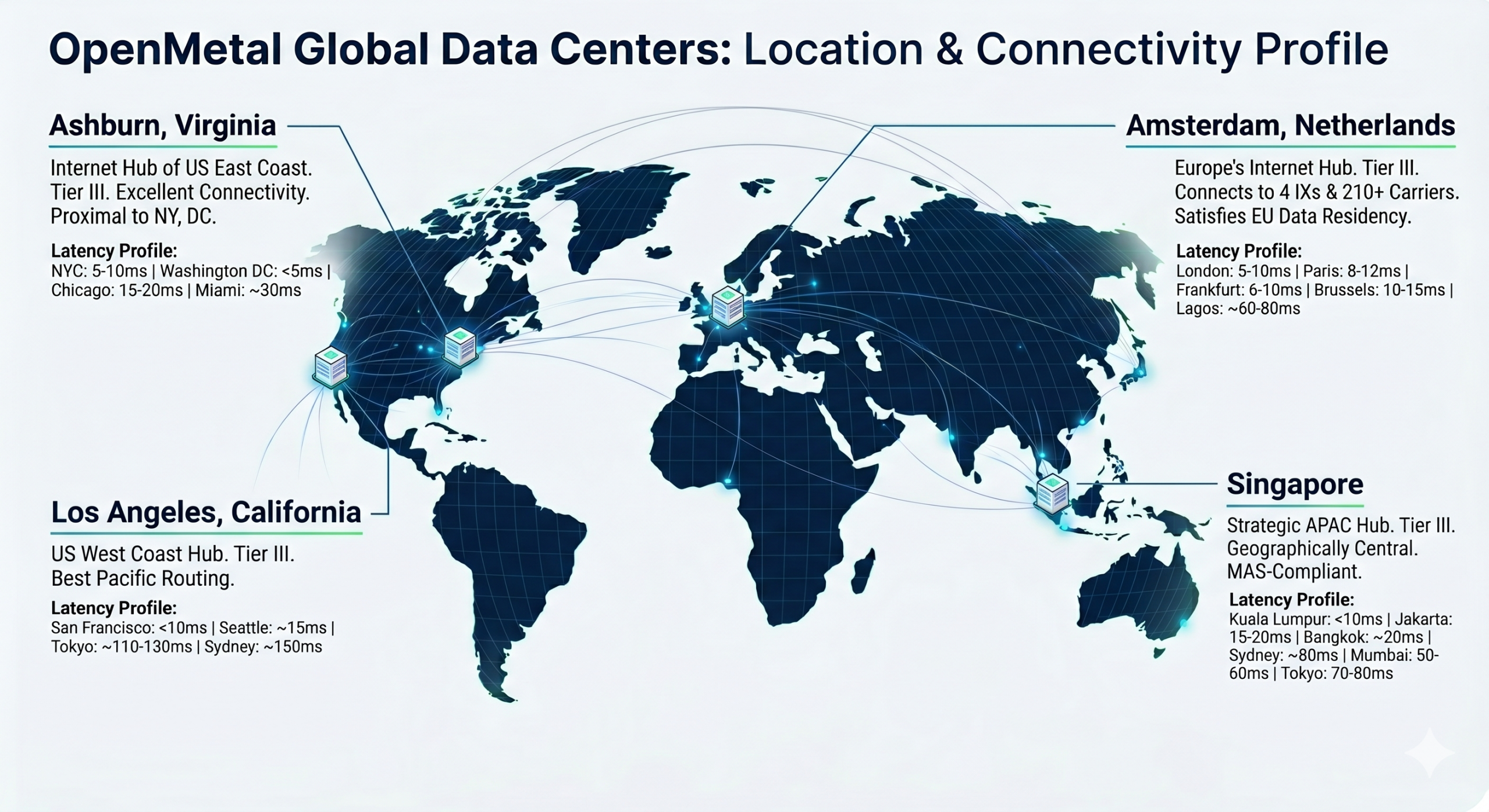
Getting ahead of that is simpler than most teams assume. OpenMetal operates Tier III data centers in four locations: Ashburn, Virginia; Los Angeles, California; Amsterdam, Netherlands; and Singapore. Each serves a distinct set of use cases, and the right starting point and expansion path depends on four factors that are worth understanding before you pick a location.
The Four Factors That Drive Location Decisions
Every data center location decision involves tradeoffs across four dimensions. Understanding these upfront makes the location-specific sections below more useful.
User geography and latency
Your users experience every millisecond of round-trip latency between their browser or app and your infrastructure. For interactive applications, APIs, and anything real-time, geographic proximity to your user base is the single most important technical factor in location selection. For batch workloads, analytics pipelines, and internal tooling, it matters much less.
Compliance and data sovereignty
GDPR, HIPAA, DORA, MAS, and other regulatory frameworks have specific requirements about where data can be physically stored and processed. These requirements don’t give you flexibility about which location “feels close enough.” If your compliance framework requires EU data residency, your data needs to be in the EU. Getting this wrong is expensive to fix after the fact.
Disaster recovery and geographic redundancy
A DR environment that shares a geographic risk zone with your production environment is limited protection against the scenarios that matter most: regional power events, natural disasters, and provider-wide incidents. DR location decisions should account for physical distance from production, not just provider diversity.
Connectivity costs between locations
If your architecture involves significant data movement between locations, whether for replication, analytics pipelines, or multi-region deployments, the cost of that traffic matters. OpenMetal’s unmetered east-west traffic between servers within a location and predictable 95th percentile billing for outbound traffic changes the economics of multi-location architectures compared to hyperscaler per-GB inter-region pricing.
Ashburn, Virginia
Ashburn is the internet hub of the US East Coast, arguably the most connected piece of real estate in North America for data center purposes. The concentration of network infrastructure in Northern Virginia means exceptionally low latency to major East Coast metros, direct connectivity to financial services infrastructure in New York, and proximity to federal government and defense contractor workloads that have historically concentrated in the region.
Great fit for: Organizations with a US-primary user base concentrated on the East Coast or Midwest. Financial services companies that need low latency to New York market infrastructure. Government-adjacent workloads. US companies whose DR strategy calls for East and West coast redundancy. Organizations that need the best possible connectivity to the broadest set of US networks from a single location.
Latency profile: New York sits around 5-10ms. Washington DC is under 5ms. Chicago is 15-20ms. Miami is around 30ms. For US East Coast users, Ashburn is the best-performing single location available.
When to pick Ashburn over LA: Your user base skews East Coast or Central US. Your compliance requirements are US-specific with no geographic constraints. You’re in financial services, government, or healthcare with strong East Coast concentration. You need a single US location and East Coast latency matters more than West Coast or Pacific Rim coverage.
Los Angeles, California
Los Angeles serves two distinct roles in infrastructure planning. For organizations with significant West Coast user bases, it’s the obvious low-latency choice. For organizations expanding toward APAC, it’s the US gateway with the best Pacific routing before committing to a Singapore deployment.
Great fit for: West Coast-primary businesses in technology, media, and entertainment. Gaming companies serving North American and Pacific Rim players. Organizations that want a US West anchor for coast-to-coast redundancy alongside Ashburn. Companies testing APAC expansion before adding a Singapore node. Media and streaming workloads with high bandwidth requirements and West Coast distribution needs.
Latency profile: San Francisco is under 10ms. Seattle is around 15ms. Tokyo is approximately 110-130ms. Sydney is around 150ms. For pure APAC reach, Singapore significantly outperforms LA, but LA provides meaningful improvement over Ashburn for Pacific Rim users.
When to pick LA over Ashburn: Your user base is primarily West Coast. You’re in media, entertainment, or gaming with West Coast production infrastructure. You want US geographic redundancy with an East-West split. You’re evaluating APAC expansion and want a Pacific staging point before adding Singapore.
Ashburn + LA together: The most common US-only multi-location combination. Ashburn and LA together cover the continental US with genuine geographic redundancy, putting your production and DR environments in different seismic zones, different power grids, and different regional network infrastructure.
Amsterdam, Netherlands
Amsterdam is Europe’s internet hub. AMS-IX, the Amsterdam Internet Exchange, is one of the largest internet exchanges in the world. OpenMetal’s Amsterdam facility connects to four internet exchanges and over 210 carriers, ISPs, and CDNs, giving it exceptional connectivity across the continent and beyond.
Great fit for: Organizations with EU compliance requirements under GDPR, DORA, or sector-specific regulations. US companies that have acquired EU customers and need to satisfy data residency requirements without building full EU operations. UK companies serving EU customers after Brexit. Organizations serving both European and African markets from a single location, since Amsterdam’s submarine cable infrastructure provides workable latency to West African cities. SaaS companies that need a clean compliance answer for enterprise EU procurement.
Latency profile: London is 5-10ms. Paris is 8-12ms. Frankfurt is 6-10ms. Brussels is 10-15ms. Lagos is approximately 60-80ms, which is acceptable for many applications and significantly better than serving Africa from the US.
Compliance dimension: Data physically hosted in the Netherlands satisfies EU data residency requirements for GDPR and related frameworks. For organizations with EU customers asking compliance questions, Amsterdam infrastructure provides a concrete answer that hyperscaler contractual assurances don’t always deliver cleanly. The EU AI Act’s infrastructure requirements for high-risk AI systems add another dimension to the EU location decision for organizations running AI workloads.
When to pick Amsterdam: You have EU customers and compliance questions you need to answer definitively. You’re a non-EU company that needs EU data residency without EU corporate presence. You’re serving both European and African markets. You need EU DR for a US-primary production environment.
Singapore
Singapore is the strategic hub of Southeast Asia, with infrastructure characteristics that make it the right choice for APAC deployments well beyond its immediate geography. The city-state’s position between major APAC markets, its political neutrality relative to US-China tensions, its English-speaking business environment, and its mature financial services regulatory framework under MAS make it the default APAC anchor for international organizations.
Great fit for: US companies expanding into APAC who want a single location covering Southeast Asia, Australia, India, and Japan. Indian technology companies serving Southeast Asian markets. Financial services organizations that need MAS-compliant infrastructure for Singapore operations. Gaming and esports platforms serving Southeast Asia’s rapidly growing player base. Organizations that need a neutral jurisdiction for operations spanning multiple APAC markets including India and China. Companies where Tokyo’s infrastructure costs are prohibitive and Sydney’s latency profile is too far east for Southeast Asian users.
Latency profile: Kuala Lumpur is under 10ms. Jakarta is 15-20ms. Bangkok is around 20ms. Sydney is approximately 80ms. Mumbai is 50-60ms. Tokyo is 70-80ms. Singapore covers the Southeast Asian core better than any other single location, and provides usable latency to both Australia and Northeast Asia.
Why Singapore over Tokyo: Singapore outperforms Tokyo for most APAC use cases on three dimensions: cost (approximately 50% lower infrastructure costs), geographic centrality (better latency to Southeast Asia’s 700 million users than Tokyo provides), and regulatory environment (Singapore’s MAS framework is more accessible for international companies than Japan’s regulatory complexity).
When to pick Singapore: You’re expanding into APAC and Southeast Asia is your primary market. You need MAS-compliant infrastructure for fintech operations. You want a neutral APAC jurisdiction for operations that span India, Southeast Asia, and potentially China. You need better APAC coverage than US West can provide and the cost of Tokyo infrastructure is a constraint.
Multi-Location Combinations Worth Considering
Most organizations start with one location and add others as their user base, compliance requirements, or DR strategy evolves. Here are the combinations that come up most frequently and what each solves.
Ashburn + Amsterdam
The most common combination for US companies with EU customers. Ashburn handles US production workloads, Amsterdam satisfies EU data residency requirements. Clean DR story across regulatory jurisdictions. Relevant for any organization that needs to answer GDPR compliance questions while keeping US infrastructure primary.
Ashburn + Singapore
US primary with APAC expansion. Good choice for US SaaS companies that have grown into APAC markets and need better latency for Southeast Asian and Australian users. Also works well as a US East plus APAC DR combination for organizations with business continuity requirements across continents.
LA + Singapore
Pacific Rim focus. Strong choice for gaming, media, and technology companies whose user base and operations are concentrated along the Pacific. Lower latency from both coasts of the Pacific compared to an Ashburn-anchored strategy.
Ashburn + Amsterdam + Singapore
Three-continent coverage. US, EU, and APAC from a single provider with consistent infrastructure management, no per-GB inter-region billing surprises, and data sovereignty coverage across the three major regulatory jurisdictions. The right architecture for organizations that are genuinely global and need compliance-ready infrastructure in each region.
All four locations
Full global coverage with US geographic redundancy. Adds meaningful value for organizations with significant US West Coast operations or Pacific Rim traffic alongside global requirements. Most organizations don’t need all four from the start, but the expansion path is available when the business case develops.
A Practical Decision Framework
Rather than abstracting this further, here are the questions worth answering before picking a starting location:
Where are your current users? Map your user base geographically. If 80 percent of your users are in one region, definitely start there. Latency optimization for your actual users is the most straightforward location argument.
Do you have compliance requirements that specify geography? GDPR means EU. MAS fintech compliance means Singapore. HIPAA doesn’t specify geography but your enterprise customers may. If a compliance framework applies to your business, that requirement narrows the location decision before anything else.
What does your DR strategy require? A DR environment in the same city as production isn’t a DR environment for regional events. Your DR location should be in a different geographic risk zone from your production environment.
Where do you expect to grow? If your roadmap includes EU expansion in the next 18 months, building EU infrastructure now is a lower-friction approach than retrofitting data residency later. Geographic infrastructure decisions made ahead of growth tend to be smoother than those made under pressure.
What’s your starting budget for infrastructure? A single well-chosen location on fixed-cost dedicated infrastructure is the right starting point for most organizations. Adding locations as business requirements develop is a straightforward expansion, not a rearchitecting project.
Ready to evaluate specific locations and configurations? See OpenMetal’s data center locations or use the cloud deployment calculator to compare configurations across locations without a sales call.
Schedule a Consultation
Get a deeper assessment and discuss your unique requirements.
Read More on the OpenMetal Blog