





















In this article
This guide covers how to build global infrastructure using OpenMetal’s four strategic locations in Los Angeles, Ashburn, Amsterdam, and Singapore. We examine use cases from disaster recovery to compliance, architecture patterns for multi-region deployment, real pricing, and cost comparisons showing $1M-$4.5M annual savings vs AWS.
Companies expanding globally face a critical infrastructure question: how do you serve customers worldwide without breaking the bank on hyperscaler costs? The answer lies in strategic multi-region deployment across North America, Europe, and Asia-Pacific.
This guide shows you how to build global infrastructure using bare metal servers and hosted private cloud deployments in Los Angeles, Ashburn, Amsterdam, and Singapore. You’ll get geographic diversity for disaster recovery, performance optimization for global users, and data sovereignty compliance, all while spending 70% less than AWS or Azure global deployments.
Why Multi-Region Infrastructure Matters
Building infrastructure in a single location creates risks that enterprise companies can’t afford. Server failures happen. Network issues occur. Data centers experience outages. Natural disasters impact regions. When your entire infrastructure sits in one place, any of these events can take your business offline.
Multi-region infrastructure spreads these risks across geographies. An earthquake in California doesn’t affect your Amsterdam servers. A data center power issue in Virginia doesn’t impact Singapore operations. Network problems on the US East Coast don’t disrupt service in Europe or Asia.
Beyond disaster recovery, multi-region deployment solves three other challenges:
Performance optimization: Users in Tokyo shouldn’t wait for data to travel from Virginia. Companies serving global customers need infrastructure positioned close to those users. A 200ms request-response cycle from across the world feels slow. A 20ms cycle from a nearby data center feels instant.
Data sovereignty and compliance: Financial regulations in the EU require customer data remain in Europe. Healthcare data in Asia may need to stay in APAC. US government contracts often mandate US-based infrastructure. Multi-region deployment lets you comply with data residency requirements while maintaining a unified architecture.
Cost reduction: Hyperscalers charge premium prices for multi-region deployments, with complex pricing tiers and egress fees that multiply costs. Private cloud infrastructure eliminates these variable costs. Fixed monthly pricing with generous bandwidth allocations means you can build global infrastructure without budget anxiety.
OpenMetal’s Four Strategic Locations
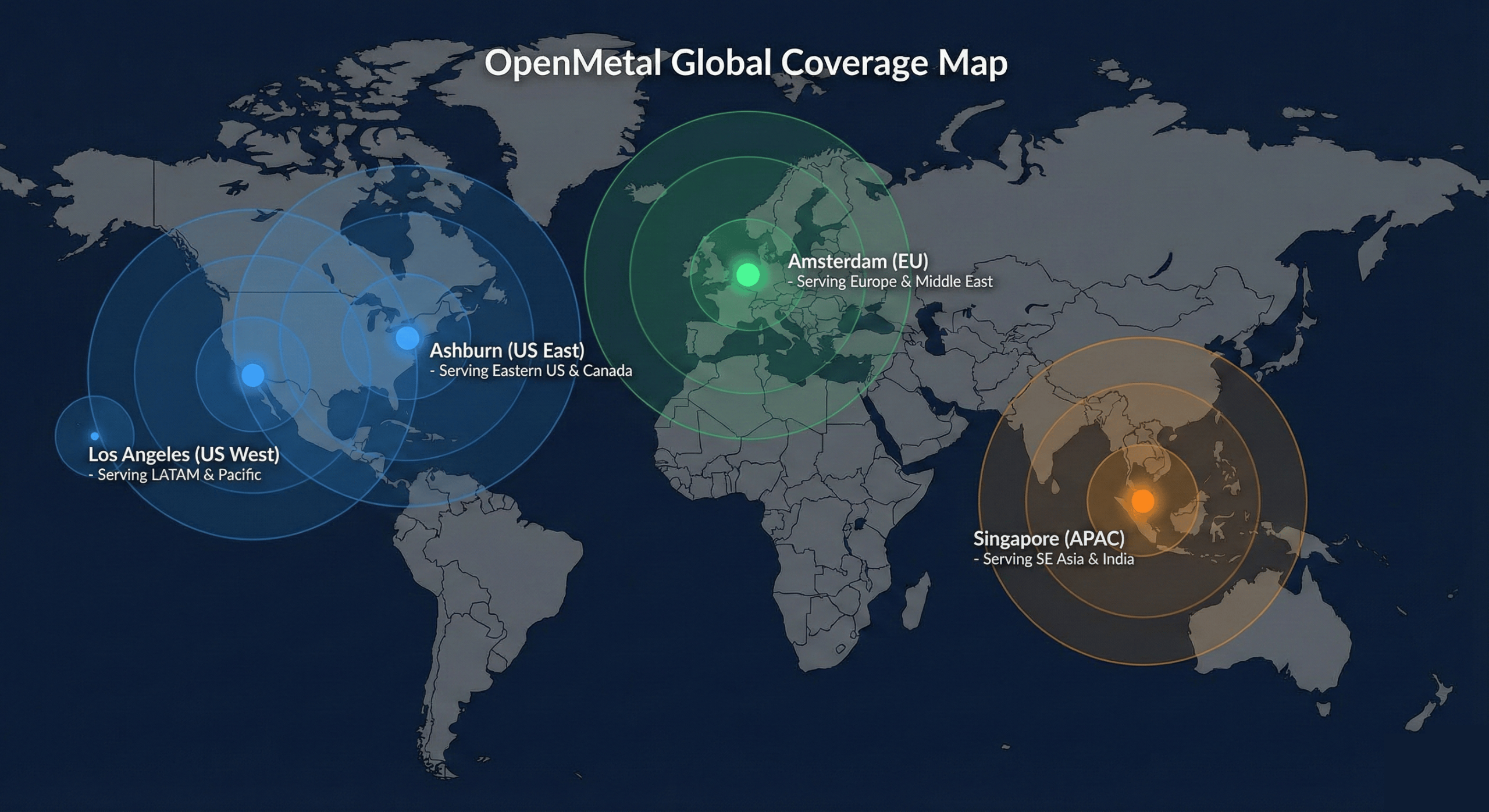
OpenMetal operates data centers in four strategic locations spanning three continents. Each location provides world-class infrastructure in Tier III facilities with carrier-grade networking and enterprise-grade security.
Los Angeles, California (US West Coast)
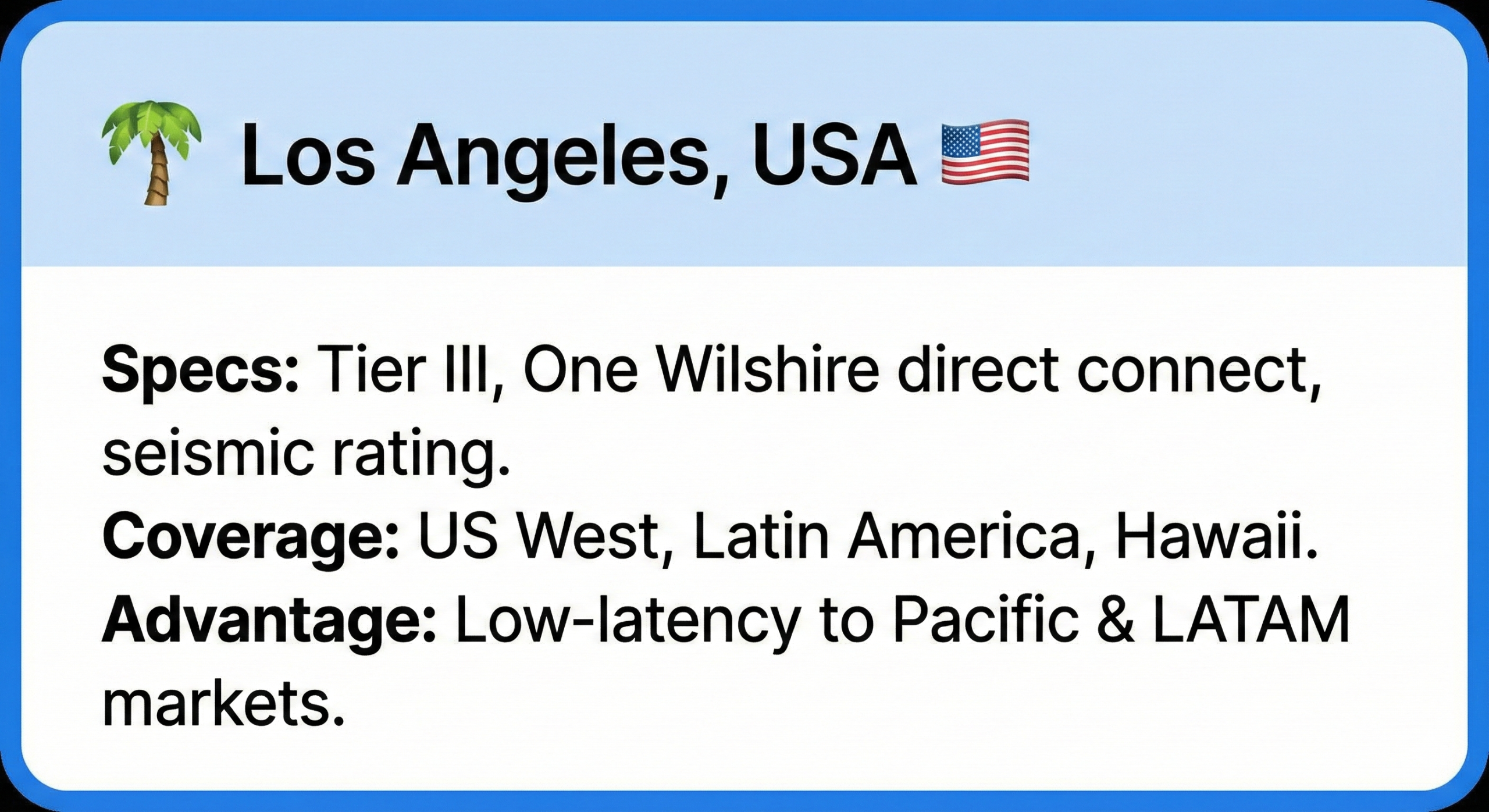
Located in downtown Los Angeles at a Digital Realty facility recognized as an LA Green Business, this deployment point serves the Pacific region with seismically rated infrastructure and direct connectivity to One Wilshire, one of the world’s major telecommunications hubs.
Geographic coverage: West Coast US, Latin America, Hawaii, parts of Asia-Pacific
Network highlights:
- 2×100G circuits from edge routers
- Carrier-grade network core from Arista
- Multiple redundancy layers via BGP multi-homing
- LAN redundancy through 802.3ad and VRRP
Best for: Serving US West Coast users, Latin American markets, backup/DR for East Coast operations
Ashburn, Virginia (US East Coast)
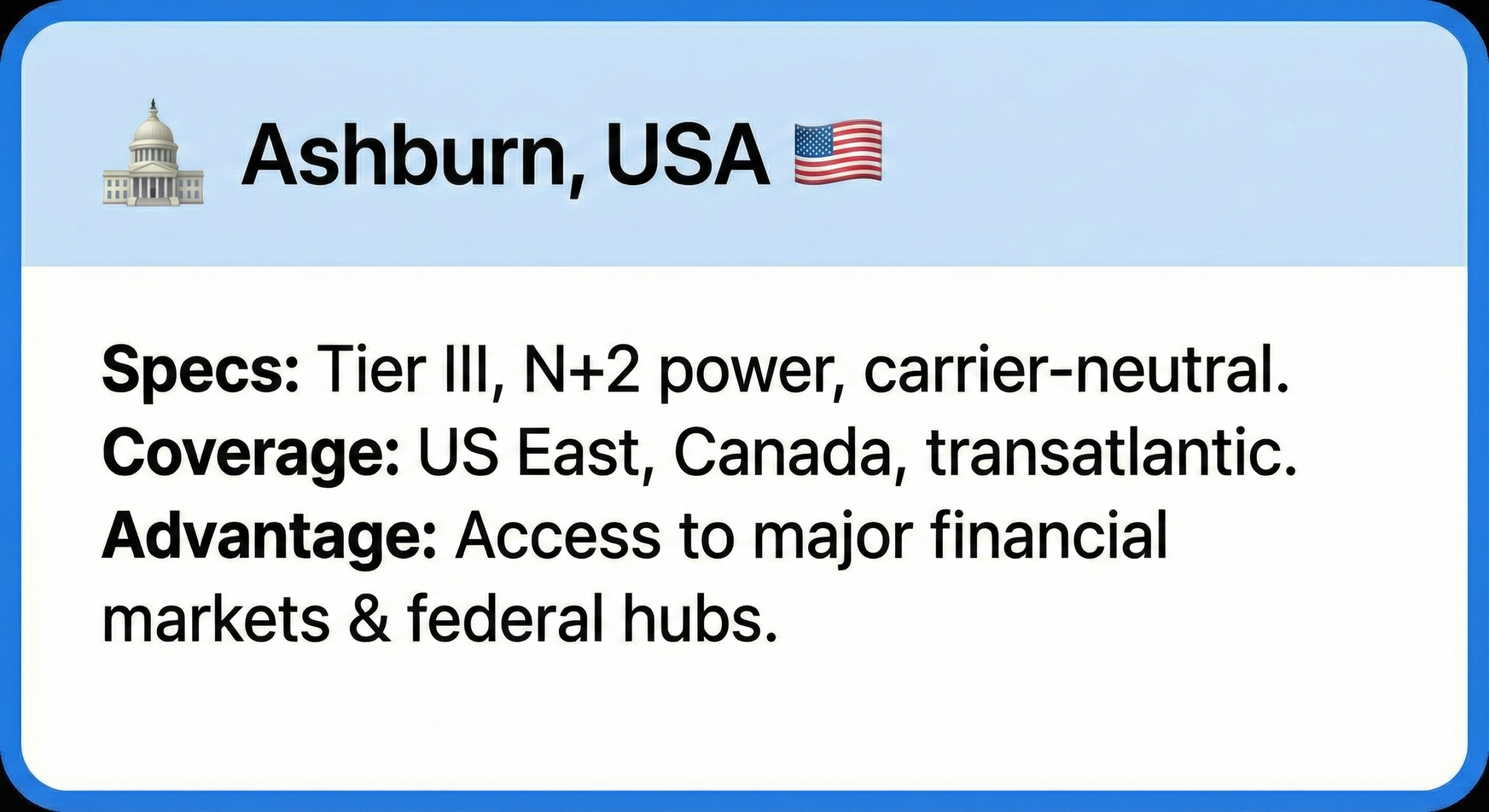
Situated in Virginia’s “Data Center Alley” at an NTT facility, Ashburn provides access to one of the world’s most developed network infrastructure regions. This 224MW campus offers three diverse fiber entry points and houses multiple Tier-1 carriers including Cogent, Comcast, and Level 3.
Geographic coverage: East Coast US, Eastern Canada, South America, Europe (transatlantic)
Network highlights:
- 12.6MW IT load with N+2 power redundancy
- Carrier-neutral with 3 fiber entries
- Access to largest peering exchange on US East Coast
- Direct connections to Chicago, New York, and London
Best for: Primary US operations, federal compliance requirements, low-latency access to Eastern US financial markets
Amsterdam, Netherlands (Europe)
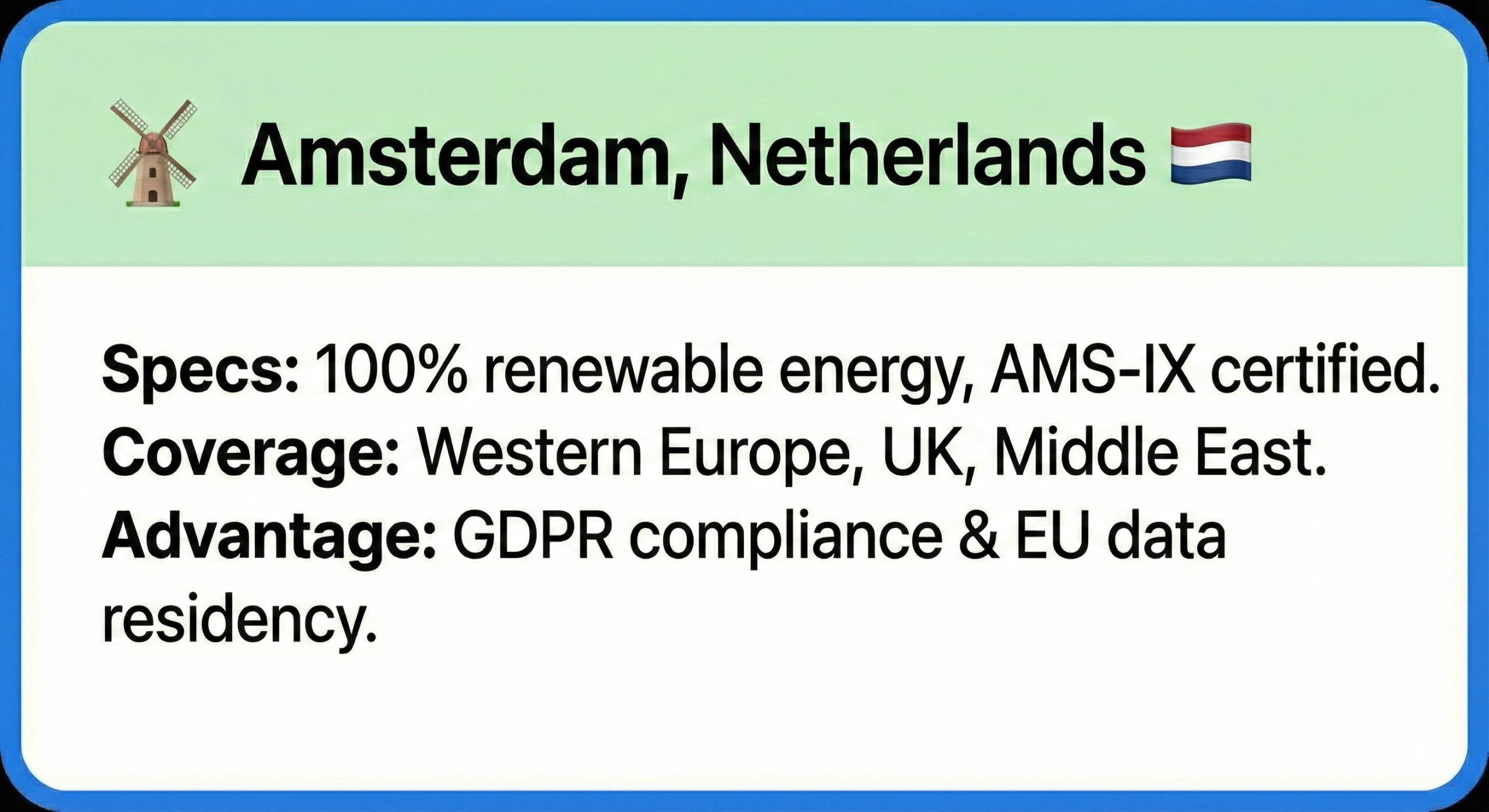
Amsterdam serves as Europe’s digital hub from a Digital Realty facility operating on 100% renewable energy. Located just 10 minutes from Schiphol Airport, this carrier-neutral facility provides direct access to 4 IXPs and AMS-IX certification.
Geographic coverage: Western Europe, UK, Scandinavia, Middle East, parts of Africa
Network highlights:
- Direct access to 4 internet exchange points
- AMS-IX certified connectivity
- Dual-entry fiber from two separate carrier routes
- 100% renewable and carbon-free energy
Best for: EU data residency compliance, serving European customers, GDPR requirements, backup for UK operations post-Brexit
Singapore (Asia-Pacific)
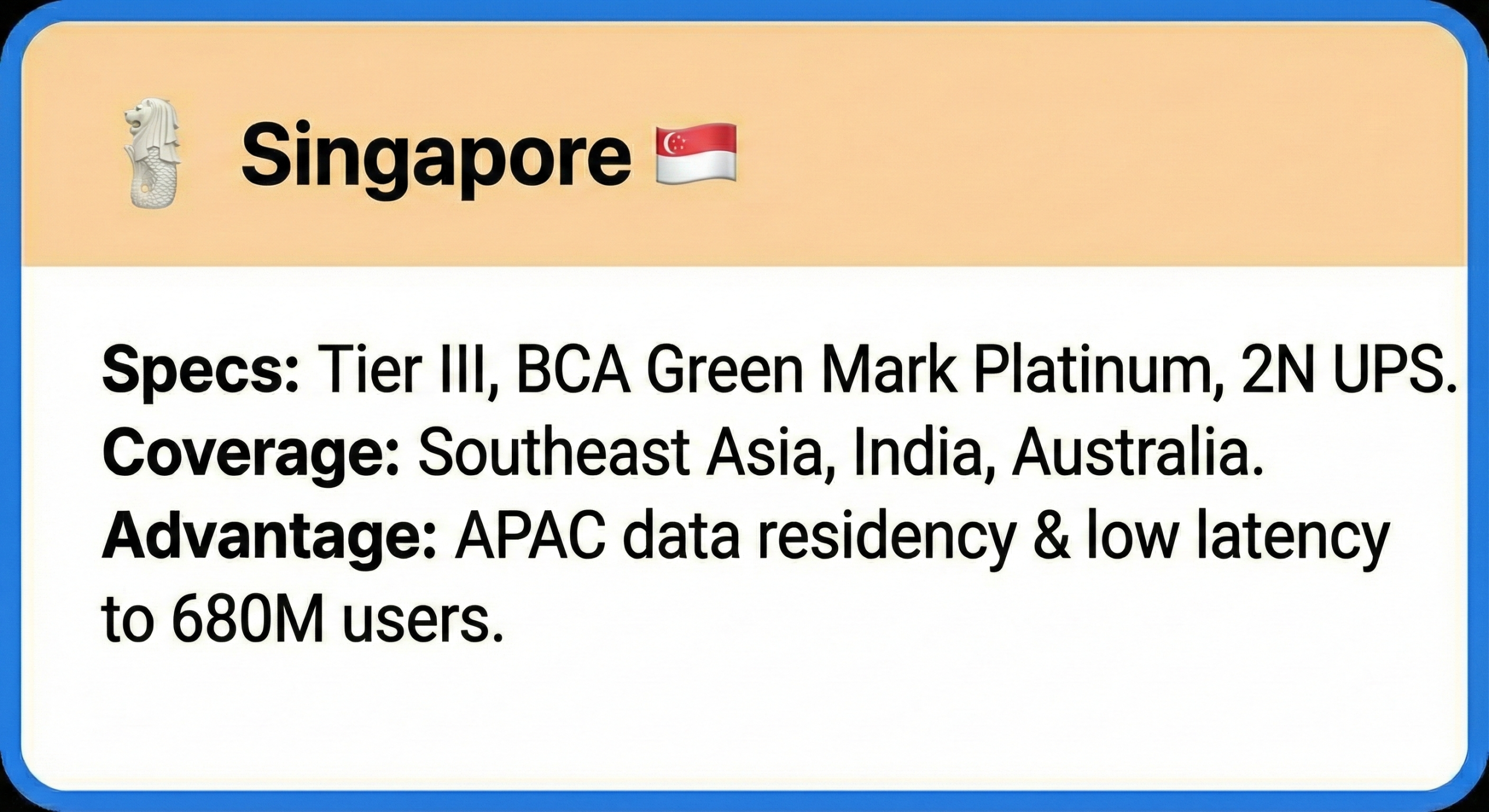
Singapore infrastructure runs from Digital Realty’s SIN10 facility, a seven-story data center spanning 377,000 square feet. Strategically positioned in Southeast Asia’s technology hub, this facility provides 2N UPS and N+2 cooling redundancy with comprehensive compliance certifications.
Geographic coverage: Southeast Asia, India, Australia, Hong Kong, Japan
Network highlights:
- 24×7 on-site security and surveillance
- Multiple compliance certifications (SOC2, SOC3, PCI-DSS, ISO 27001, MAS)
- BCA Green Mark Platinum and SS564 sustainability certifications
- Robust connectivity to APAC submarine cable networks
Best for: Serving Asian markets, low-latency access to Southeast Asia’s 680M internet users, APAC data residency
Use Cases for Multi-Region Deployment
Different business needs drive multi-region infrastructure decisions. Understanding your primary use case helps determine the right architecture pattern and location selection.
Disaster Recovery and Business Continuity
The original use case for multi-region infrastructure remains one of the most important. Companies can’t afford downtime that costs thousands or millions per hour in lost revenue and damaged reputation.
Traditional DR approaches involve maintaining duplicate infrastructure that sits idle until needed. This creates wasteful spending on unused capacity. Modern multi-region architecture uses active-active or active-passive patterns where DR infrastructure serves real traffic, eliminating waste while maintaining protection.
Architecture pattern: Deploy primary operations in one region with synchronized replication to a secondary region. If primary fails, traffic automatically routes to secondary. Once primary recovers, fail back occurs seamlessly.
Example configuration:
- Primary: Ashburn Large V4 Cloud Core ($4,298.40/month)
- DR: Los Angeles Large V4 Cloud Core ($4,298.40/month)
- Total cost: $8,596.80/month
- Protection: Cross-country geographic diversity, different power grids, separate network providers
This configuration provides true business continuity for $103,161.60 annually – less than AWS charges for a single Medium V4 equivalent with comparable bandwidth in one region.
Global Performance Optimization
Applications serving users worldwide need infrastructure positioned close to those users. A financial services platform with customers in New York, London, and Tokyo can’t provide good performance from a single location. Physics limits data transmission speed – you can’t beat the speed of light.
Multi-region deployment puts compute and data near users, keeping response times low regardless of where users connect from.
Architecture pattern: Deploy infrastructure in regions matching your user distribution. Use DNS-based routing or global load balancing to direct users to their nearest region. Replicate data between regions to keep everything synchronized.
Example configuration:
- Americas: Ashburn Large V4 Cloud Core
- Europe: Amsterdam Large V4 Cloud Core
- Asia: Singapore Large V4 Cloud Core
- Total: $12,895.20/month
This three-region deployment serves global users with <50ms latency to major markets while costing $154,742.40 annually – less than half what AWS would charge for equivalent single-region infrastructure.
Data Sovereignty and Compliance
Financial services companies operating in Europe must comply with GDPR and keep EU citizen data within the European Economic Area. Healthcare providers in Asia face data residency requirements. US government contractors need US-based infrastructure.
Multi-region deployment lets companies meet these requirements without maintaining completely separate systems. You can build unified architecture with regional data segregation.
Architecture pattern: Deploy infrastructure in regions matching compliance requirements. Configure applications to store user data in the user’s home region while maintaining centralized control and monitoring.
Example configuration:
- US operations: Ashburn Large V4 Cloud Core
- EU operations: Amsterdam Large V4 Cloud Core
- APAC operations: Singapore Large V4 Cloud Core
- Management/monitoring: Centralized across all regions
This architecture meets data residency requirements in all three major markets while maintaining operational consistency and centralized visibility.
Cost Optimization Through Geographic Arbitrage
Hyperscalers charge different prices in different regions, with premium pricing in popular locations. They also charge egress fees that make multi-region data transfer expensive.
Dedicated infrastructure eliminates these variable costs. You pay fixed monthly rates regardless of bandwidth consumption (within generous included allocations). This makes multi-region architectures economically viable where hyperscaler pricing makes them prohibitively expensive.
Example: A video streaming platform serves 1 PB of content monthly across Americas, Europe, and Asia. On AWS, egress alone costs approximately $90,000/month. With OpenMetal’s included bandwidth across three Large V4 Cloud Cores (11,391TB combined), the platform operates within included allocations, saving over $1M annually on bandwidth alone.
Development, Testing, and Staging Environments
Large enterprises run multiple environments: development, testing, staging, and production. Rather than paying premium prices for non-production workloads in expensive regions, companies can deploy dev/test infrastructure in cost-effective locations while keeping production in premium locations.
Architecture pattern: Deploy production workloads in regions optimized for user proximity and compliance. Deploy development and testing infrastructure in cost-effective regions with lower pricing.
Example configuration:
- Production: Ashburn and Amsterdam Large V4 Cloud Cores
- Dev/Test: Los Angeles Medium V4 Cloud Core ($2,376/month)
- Staging: Singapore Medium V4 Cloud Core ($2,376/month)
This approach saves money on non-production environments while maintaining full testing capability across global infrastructure.
Hybrid and Multi-Cloud Architectures
Some workloads make sense on hyperscaler platforms – managed services, serverless functions, specific regional services. But most compute, storage, and networking workloads run more economically on dedicated infrastructure.
Multi-region OpenMetal deployment provides the foundation for hybrid cloud, with hyperscaler services used selectively where they add value.
Architecture pattern: Run core infrastructure (compute, storage, databases) on OpenMetal across multiple regions. Use hyperscaler services for specific managed offerings or regional presence where OpenMetal doesn’t have facilities.
This hybrid approach combines cost efficiency of dedicated infrastructure with flexibility of hyperscaler services where appropriate.
Architecture Patterns for Multi-Region Deployment
Understanding architecture patterns helps you design systems that meet your specific requirements for availability, performance, and cost.
Active-Passive (DR Focus)
Active-passive architecture runs production traffic from one region while maintaining standby capacity in another region. The passive region stays ready to take over if the active region fails.
How it works: Primary region handles all traffic. Data replicates continuously to secondary region. Monitoring systems detect primary region failures and trigger automatic failover to secondary. Once primary recovers, failback returns operations to normal.
Advantages: Simpler to manage than active-active, clear operational model, lower complexity in application design
Considerations: Secondary region sits mostly idle (though it can serve read-only traffic or development workloads), requires careful failover testing, potential data loss window during failover
Best for: Companies prioritizing disaster recovery with straightforward failover requirements
Active-Active (Performance Focus)
Active-active architecture runs production traffic from multiple regions simultaneously. Users connect to their nearest region for best performance.
How it works: All regions serve production traffic. DNS or global load balancing directs users to optimal regions based on geography. Data replicates between regions to maintain consistency. If one region fails, traffic automatically redistributes to healthy regions.
Advantages: Better global performance, higher overall availability, full utilization of infrastructure investment, no wasted idle capacity
Considerations: More complex application design for data consistency, requires careful consideration of data replication and conflict resolution, higher operational complexity
Best for: Global applications prioritizing performance and availability over operational simplicity
Geographic Distribution (Compliance Focus)
Geographic distribution architecture keeps specific data in specific regions to meet regulatory requirements while maintaining unified application architecture.
How it works: Applications determine user location and store data in compliant regions. US users’ data stays in US regions, EU users’ data stays in EU regions, APAC users’ data stays in APAC regions. Applications may run in all regions but data boundaries are enforced.
Advantages: Meets data residency requirements, maintains unified application architecture, provides local performance for all users
Considerations: Requires application awareness of data locality, potential complexity in cross-region operations, careful audit trail maintenance for compliance
Best for: Companies with strict data residency requirements across multiple jurisdictions
Hub-and-Spoke (Centralized Management)
Hub-and-spoke architecture maintains centralized services in one region with distributed compute in multiple regions.
How it works: Central hub region hosts shared services like databases, authentication, monitoring, and management. Spoke regions provide compute capacity for serving users in their geographies. Applications in spoke regions connect to hub for shared services.
Advantages: Centralized management and visibility, shared infrastructure reduces duplication, simpler data management than fully distributed
Considerations: Hub becomes critical dependency (mitigated with hub redundancy), potential latency for hub-spoke communication, requires careful design of what’s centralized vs distributed
Best for: Organizations wanting multi-region presence with centralized operations
OpenMetal Multi-Region Pricing
OpenMetal offers flexible deployment options from individual bare metal servers to fully managed hosted private cloud using 3-server Cloud Core bundles. Pricing remains consistent whether you deploy in one region or four.
Bare Metal Server Pricing (per server, monthly)
US Locations (Los Angeles & Ashburn):
- Medium V4: $619.20/month – 24C/48T CPU, 256GB RAM, 6.4TB NVMe, 2Gbps bandwidth
- Large V4: $1,173.60/month – 32C/64T CPU, 512GB RAM, 2× 6.4TB NVMe, 4Gbps bandwidth
- XL V4: $1,987.20/month – 64C/128T CPU, 1024GB RAM, 4× 6.4TB NVMe, 6Gbps bandwidth
- XXL V4: $2,779.20/month – 64C/128T CPU, 2048GB RAM, 6× 6.4TB NVMe, 10Gbps bandwidth
Amsterdam: Same pricing as US locations with €-based billing available
Singapore:
- Medium V4: $792/month
- Large V4: $1,504.80/month
- XL V4: $2,541.60/month
- XXL V4: $3,556.80/month
Singapore pricing reflects higher regional infrastructure costs (approximately 28% premium vs US locations)
Hosted Private Cloud Core Pricing (3-server bundles, monthly)
All Locations:
- Medium V4 Cloud Core: $2,376/month – 1,008 vCPUs, ~66 VMs, 1,898TB egress
- Large V4 Cloud Core: $4,298.40/month – 1,296 vCPUs, ~142 VMs, 3,797TB egress
- XL V4 Cloud Core: $7,149.60/month – 2,736 vCPUs, ~293 VMs, 5,695TB egress
- XXL V4 Cloud Core: $10,238.40/month – 2,784 vCPUs, ~557 VMs, 9,491TB egress
Longer-Term Commitment Savings
5-year agreements provide up to 34% savings over monthly pricing:
- Medium V4: $522.72/month per server (34% savings)
- Large V4: $993.17/month per server (34% savings)
- XL V4: $1,677.46/month per server (34% savings)
- XXL V4: $2,347.49/month per server (34% savings)
Common Multi-Region Configurations
Two-Region DR Setup:
- Primary: Large V4 Cloud Core ($4,298.40/month)
- DR: Large V4 Cloud Core ($4,298.40/month)
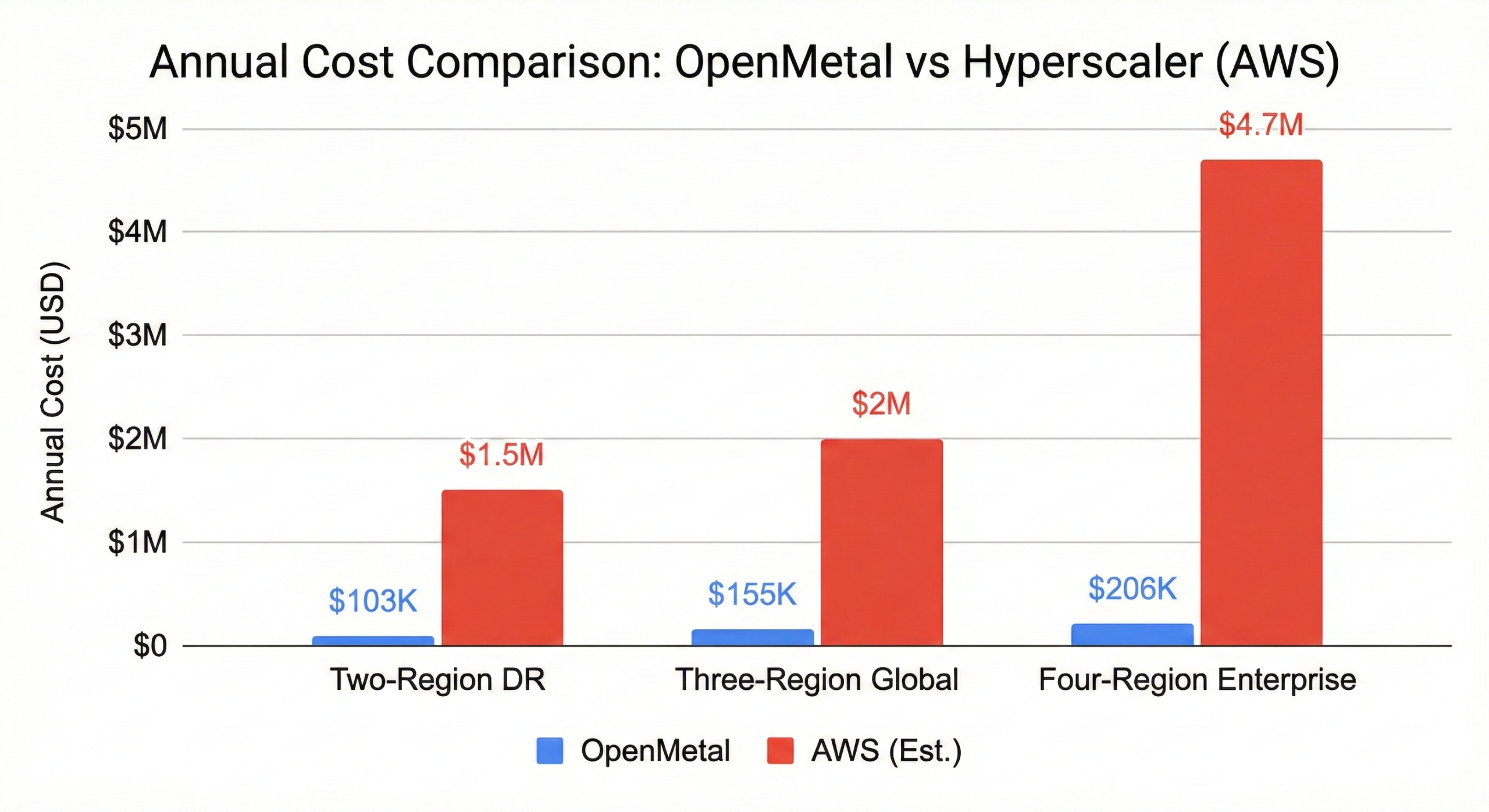
- Total: $8,596.80/month ($103,161.60/year)
Three-Region Global Setup:
- Americas: Large V4 Cloud Core ($4,298.40/month)
- Europe: Large V4 Cloud Core ($4,298.40/month)
- Asia: Large V4 Cloud Core ($4,298.40/month)
- Total: $12,895.20/month ($154,742.40/year)
Four-Region Maximum Coverage:
- Los Angeles: Large V4 Cloud Core ($4,298.40/month)
- Ashburn: Large V4 Cloud Core ($4,298.40/month)
- Amsterdam: Large V4 Cloud Core ($4,298.40/month)
- Singapore: Large V4 Cloud Core ($4,298.40/month)
- Total: $17,193.60/month ($206,323.20/year)
All configurations include OpenStack for unified cloud management, Ceph distributed storage, and deploy in 45 seconds to production-ready infrastructure.
Pricing current as of February 2026 and subject to change. View current bare metal pricing | View current hosted private cloud pricing
Cost Comparison: Multi-Region OpenMetal vs Single-Region Hyperscalers
The economics of multi-region infrastructure shift dramatically when you compare dedicated infrastructure to hyperscaler pricing. Let’s examine real-world scenarios.
Scenario 1: Basic Two-Region DR
Requirements:
- 100,000 active users
- 500TB monthly bandwidth per region (1,000TB total)
- Need for disaster recovery across US regions
OpenMetal (Two Large V4 Cloud Cores):
- Ashburn: $4,298.40/month
- Los Angeles: $4,298.40/month
- Bandwidth: Included (7,594TB total capacity across both regions)
- Total: $8,596.80/month ($103,161.60/year)
AWS (Equivalent Single-Region):
- Compute: ~$2,400/month
- Storage: $1,024/month
- Egress (1,000TB @ $0.06/GB average): $60,000/month
- Total: $63,424/month ($761,088/year)
For DR in second region, double all AWS costs: $126,848/month ($1,522,176/year)
OpenMetal savings: $1,419,014 annually while providing true two-region redundancy
Scenario 2: Global Three-Region Performance Optimization
Requirements:
- 500,000 global users
- 2,000TB monthly bandwidth across three regions
- Performance optimization for Americas, Europe, and Asia
OpenMetal (Three Large V4 Cloud Cores):
- Ashburn: $4,298.40/month
- Amsterdam: $4,298.40/month
- Singapore: $4,298.40/month
- Bandwidth: Included (11,391TB total capacity)
- Total: $12,895.20/month ($154,742.40/year)
AWS (Equivalent Three-Region):
- Compute per region: ~$2,400/month × 3 = $7,200/month
- Storage per region: $1,024/month × 3 = $3,072/month
- Egress: 2,000TB @ $0.06/GB = $120,000/month
- Inter-region data transfer: $40,000/month (estimated)
- Total: $170,272/month ($2,043,264/year)
OpenMetal savings: $1,888,522 annually for truly global infrastructure
Scenario 3: Enterprise Four-Region Maximum Coverage
Requirements:
- Global enterprise with presence in all major markets
- 5,000TB monthly bandwidth across four regions
- Compliance requirements in US, EU, and APAC
OpenMetal (Four Large V4 Cloud Cores):
- Los Angeles: $4,298.40/month
- Ashburn: $4,298.40/month
- Amsterdam: $4,298.40/month
- Singapore: $4,298.40/month
- Bandwidth: Included (15,188TB total capacity)
- Total: $17,193.60/month ($206,323.20/year)
AWS (Equivalent Four-Region):
- Compute: $2,400/month × 4 = $9,600/month
- Storage: $1,024/month × 4 = $4,096/month
- Egress: 5,000TB @ $0.06/GB = $300,000/month
- Inter-region transfer: $80,000/month (estimated)
- Total: $393,696/month ($4,724,352/year)
OpenMetal savings: $4,518,029 annually for complete global coverage
Why the Massive Savings?
The cost difference comes from three factors:
Included bandwidth: OpenMetal includes generous egress allocations with every server. AWS charges per-GB for every byte that leaves their network. For bandwidth-intensive applications, egress fees often exceed compute costs by 10-20x.
Fixed pricing: OpenMetal charges fixed monthly rates regardless of usage (within capacity). AWS charges variable rates that spike with traffic, creating budget uncertainty and forcing companies to over-provision.
Dedicated hardware: OpenMetal gives you dedicated servers that you have total control over to tune and customize. AWS runs shared infrastructure where you compete with other tenants for resources. You pay premium prices for degraded, unpredictable performance.
Implementation Guide: Building Your Multi-Region Infrastructure
Moving to multi-region infrastructure requires planning, but the process is straightforward with the right approach.
Step 1: Define Your Requirements
Before deploying anything, clarify what you’re trying to achieve:
Primary goal: Is this mainly about disaster recovery? Performance? Compliance? Cost optimization? Your primary goal shapes architecture decisions.
User distribution: Where are your users? If 90% are in one region, you probably don’t need full active-active. If they’re distributed globally, you do.
Data sovereignty: Do you have regulatory requirements about where data must be stored? GDPR, HIPAA, financial regulations, or government contracts may dictate location choices.
Budget constraints: How much can you spend? Multi-region infrastructure costs more than single-region but saves money compared to hyperscaler alternatives.
Step 2: Select Your Regions
Choose regions based on your requirements:
For US-only operations: Los Angeles and Ashburn provide coast-to-coast coverage with different seismic zones and power grids.
For US + Europe: Ashburn and Amsterdam cover two major markets with transatlantic connectivity.
For global operations: Ashburn (Americas), Amsterdam (Europe), and Singapore (Asia) provide three-continent coverage serving most of the world’s internet users.
For maximum coverage: All four locations (Los Angeles, Ashburn, Amsterdam, Singapore) provide redundancy within the US plus global reach.
Step 3: Choose Your Architecture Pattern
Pick the pattern matching your primary goal:
Active-passive if you’re mainly concerned with disaster recovery and want operational simplicity. One region handles production while another stays ready for failover.
Active-active if you need maximum performance and availability. All regions serve production traffic with users directed to their nearest location.
Geographic distribution if you have data residency requirements. Keep user data in compliant regions while running applications everywhere.
Hub-and-spoke if you want centralized management with distributed compute. Central hub hosts shared services while spokes provide regional capacity.
Step 4: Design Your Network Architecture
Plan how regions will communicate:
Private networking: OpenMetal’s 20Gbps private networking within each Cloud Core handles intra-region traffic. For inter-region, use VPN tunnels or direct connections.
Data replication: Decide what data needs to replicate between regions and how often. Real-time replication keeps regions synchronized but uses bandwidth. Asynchronous replication reduces bandwidth but increases lag.
Failover mechanisms: How will you detect failures and redirect traffic? DNS-based failover is simplest but has TTL delays. Load balancer-based failover is faster but more complex.
Step 5: Deploy and Test
Start with pilot deployment before moving production workloads:
Initial deployment: Start with free 30-day trial to test performance and validate architecture. Deploy in one or two regions first.
Application migration: Move applications region by region rather than all at once. This limits risk and lets you validate each step.
Failover testing: Actually test your failover procedures. Don’t wait for real disaster to discover your DR doesn’t work. Regular failover drills ensure procedures work when needed.
Performance validation: Measure actual latency from user locations to each region. Verify your architecture delivers expected performance improvements.
Step 6: Monitor and Optimize
Once deployed, continuous monitoring ensures everything works as designed:
Monitoring: Use included Datadog integration to track performance across all regions. Watch for capacity issues, network problems, or resource constraints.
Capacity planning: Monitor resource utilization in each region. As traffic grows, you’ll need to add capacity. With OpenMetal’s 45-second deployment time, you can add servers quickly.
Cost optimization: Review bandwidth utilization monthly. If you’re consistently within included allocations across multiple smaller servers, you might consolidate to fewer larger servers. If you’re exceeding allocations, upgrade to larger tiers.
Additional Considerations for Multi-Region Success
Beyond the basic implementation, several factors contribute to long-term success with multi-region infrastructure.
Data Consistency and Replication
Multi-region deployments must handle data consistency. Databases need to replicate between regions while maintaining data integrity. Several approaches work:
Strong consistency: Every write must replicate to all regions before acknowledging success. Guarantees all regions have identical data but introduces latency and reduces availability if regions can’t communicate.
Eventual consistency: Writes succeed immediately with asynchronous replication to other regions. Better performance and availability but regions may temporarily have different data.
Conflict resolution: Active-active deployments need strategies for handling conflicting writes in different regions. Options include last-write-wins, application-specific conflict resolution, or preventing conflicts through data partitioning.
Choose the consistency model matching your application requirements. Financial transactions might need strong consistency while social media posts work fine with eventual consistency.
Security and Compliance
Multi-region deployments introduce security considerations:
Access control: Maintain consistent access policies across regions while respecting local requirements. OpenStack’s Keystone provides centralized identity management across regions.
Audit logging: Compliance requirements often mandate audit trails. Centralize logging from all regions for unified visibility and compliance reporting.
Encryption: Encrypt data in transit between regions and at rest in each region. Use VPN tunnels or direct encrypted connections for inter-region communication.
Compliance certifications: OpenMetal facilities maintain compliance certifications including SOC2, SOC3, PCI-DSS, and ISO 27001, supporting your compliance requirements.
Operational Procedures
Multi-region infrastructure requires operational discipline:
Change management: Changes in one region should generally apply to all regions to maintain consistency. Use infrastructure-as-code to ensure regions stay synchronized.
Incident response: Document procedures for handling region failures, network issues, or capacity problems. Everyone should know who does what when problems occur.
Communication: Establish clear communication channels for multi-region operations. Teams in different time zones need asynchronous communication methods.
Wrapping Up: Building for Global Success
Multi-region infrastructure used to be a luxury only large enterprises could afford. Hyperscaler pricing made global deployments prohibitively expensive for most companies. That’s changed.
With OpenMetal’s four strategic locations in Los Angeles, Ashburn, Amsterdam, and Singapore, you can build true global infrastructure for less than single-region hyperscaler deployments cost. Three-region coverage serving the Americas, Europe, and Asia costs $154,742 annually – less than AWS charges for comparable infrastructure in a single region.
The benefits extend beyond cost savings. Multi-region deployment provides disaster recovery protection that keeps your business running when regional failures occur. It delivers performance optimization that keeps users happy regardless of where they connect from. It enables compliance with data residency requirements in multiple jurisdictions. It eliminates vendor lock-in by giving you control over your infrastructure.
Whether you need two-region disaster recovery, three-region global performance, or four-region maximum coverage, OpenMetal makes it affordable and straightforward. All regions deploy the same hardware configurations, run the same OpenStack platform, and offer the same generous bandwidth allocations.
Ready to build your multi-region infrastructure? Explore OpenMetal’s cloud deployment calculator to configure infrastructure matching your requirements, or contact the team to discuss your specific global deployment needs.
Schedule a Consultation
Get a deeper assessment and discuss your unique requirements.
Read More on the OpenMetal Blog