





















In this article
Nutanix is the most common alternative IT teams get pitched after a VMware renewal shock. This article breaks down how Nutanix’s per-core licensing model works, where it genuinely delivers value, and how OpenMetal’s fixed-cost infrastructure model compares for teams evaluating both.
When a VMware renewal arrives with a 2-5x increase under Broadcom’s restructured licensing, most IT teams start the same way: get a Nutanix quote. Nutanix is a legitimate, well-regarded platform and the most recognizable name in the HCI space. It solves real problems. But the comparison is rarely done thoroughly before a decision gets made, and Nutanix’s pricing model has characteristics that matter a great deal at certain scales.
This article walks through both platforms honestly so you can decide if Nutanix is the right answer for your situation and not just the easiest one to buy.
What Nutanix Is and How Its Pricing Model Works
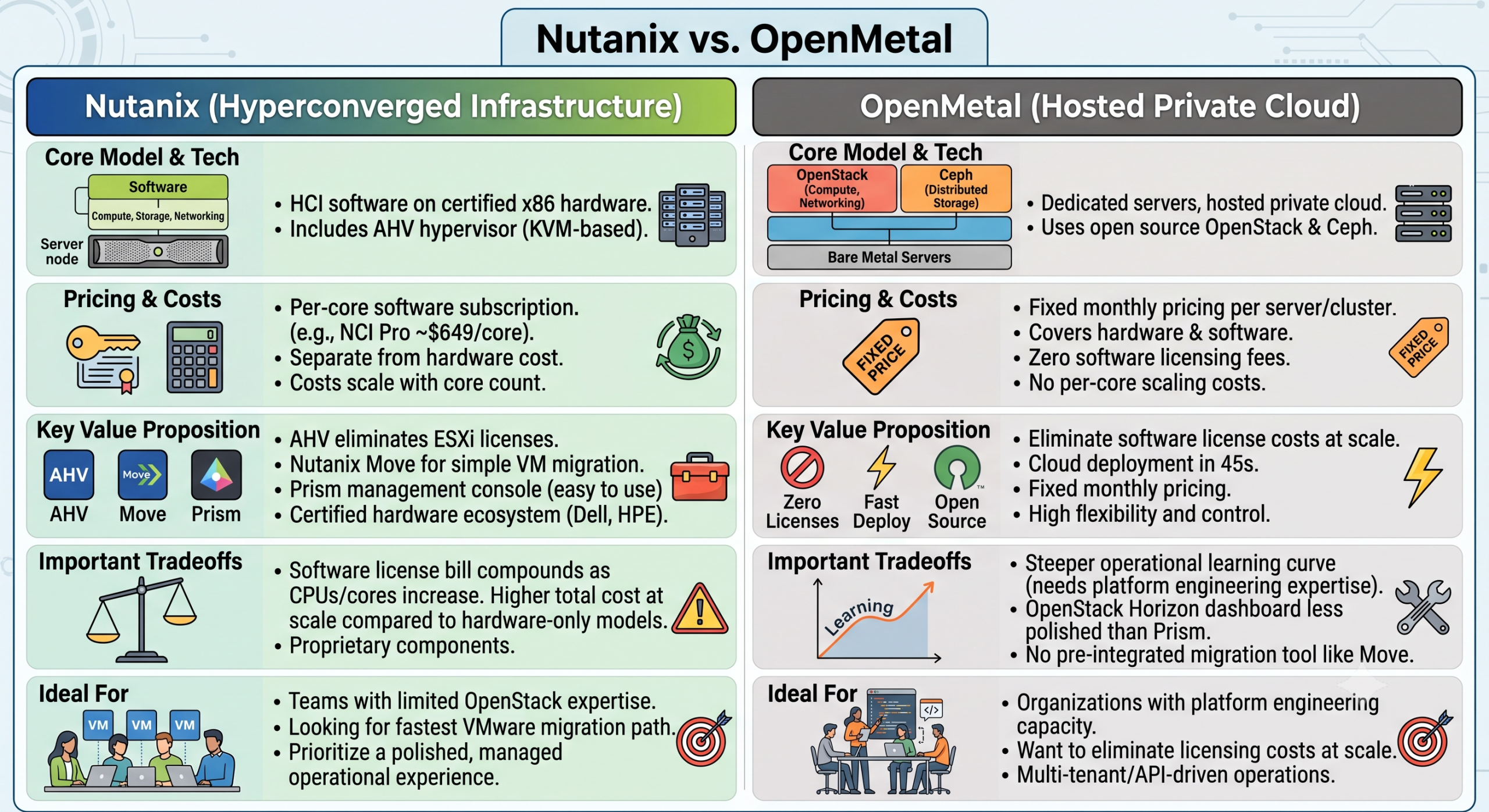
Nutanix provides hyperconverged infrastructure (HCI) software that runs on certified x86 hardware. The core platform, called Nutanix Cloud Infrastructure (NCI), consolidates compute, storage, and networking management into a single software layer. The AHV hypervisor is included at no extra charge, which is one of Nutanix’s real advantages over VMware: switching to Nutanix AHV eliminates the ESXi licensing line entirely.
The pricing model is a per-core software subscription on top of hardware costs. You buy or lease certified hardware from Dell, HPE, Lenovo, Supermicro, or Nutanix’s own NX appliances, and you pay Nutanix separately for the software licenses that run on top of it. Reseller-listed NCI Pro pricing, the tier most enterprise deployments use, runs approximately $648.99 per core, though Nutanix doesn’t publish official list prices and actual transaction pricing varies. Certified hardware typically represents 40-60% of the total investment, meaning the software license and hardware are roughly comparable in cost.
NCI comes in three tiers:
- Starter is limited in features and caps at 12 nodes with no erasure coding or data-at-rest encryption, making it unsuitable for most production deployments.
- Pro is the standard tier for enterprise workloads, adding full data protection, replication, and Kubernetes (via Nutanix Kubernetes Platform).
- Ultimate adds security analytics and advanced automation. Three-year contracts are standard, with 1-5 year terms available.
The implications of per-core licensing compound as you scale. A cluster of three nodes each carrying dual 32-core CPUs has 192 cores. At Pro rates, the software license on that cluster represents a significant annual recurring cost independent of hardware. Adding more powerful CPUs to improve performance increases your license bill proportionally. That’s a fundamentally different cost structure than paying for hardware capacity.
Where Nutanix Genuinely Delivers Value
Before the comparison, it’s worth being clear about what Nutanix does well, because it does several things genuinely well.
AHV is a real hypervisor included at no extra cost
For teams running ESXi and absorbing the full impact of Broadcom’s restructured pricing, switching to AHV eliminates an expensive license line. Nutanix’s internal benchmarks and customer reviews generally confirm AHV performs comparably to ESXi for standard VM workloads.
Nutanix Move simplifies VM migration
The Move tool handles cross-hypervisor VM migration, including batch migrations from VMware ESXi to AHV. Organizations have migrated thousands of VMs using Move, and it reduces the complexity of what is otherwise a labor-intensive process. For teams with large VMware estates, this tooling has real value.
Prism is a well-regarded management interface
Nutanix’s Prism management console is consistently cited positively in customer reviews for its clarity and ease of use. Teams moving from vCenter will find Prism familiar in concept and less steep in learning curve than alternatives.
Certified hardware ecosystem
Nutanix runs on hardware from major OEMs with full support coverage. For enterprises with existing Dell or HPE relationships, procuring Nutanix-certified nodes through those channels fits established procurement processes.
Hybrid cloud integration
Nutanix Cloud Clusters (NC2) allow workload portability between on-premises Nutanix clusters and public cloud environments. For teams running hybrid architectures, the ability to extend the same management plane to AWS or Azure has operational value.
How OpenMetal’s Model Compares
OpenMetal’s infrastructure is bare metal dedicated servers and hosted private cloud on OpenStack and Ceph, both open source, with zero software licensing fees. The pricing is fixed monthly per server or per cluster, covering hardware, compute, storage, and networking in one number. There are no per-core license fees, no tier gates on features, and no software subscription separate from the hardware cost.
The practical difference is that on OpenMetal, adding a server with dual 64-core Xeon processors doesn’t change your software licensing cost. The core count change is only reflected in the hardware price. On Nutanix, adding higher-core hardware increases both hardware cost and the per-core license bill.
OpenStack is the platform layer. It provides Nova for compute, Cinder for block storage, Swift for object storage, Neutron for networking, and Keystone for identity management. The API surface is mature, widely documented, and used in production by organizations ranging from CERN to Walmart. Ceph provides the distributed storage layer with S3-compatible object storage, block storage, and file storage.
OpenMetal deploys new private clouds in approximately 45 seconds using proprietary automation. New servers are added to existing clusters in approximately 20 minutes. The fixed monthly pricing applies regardless of how many virtual machines run on the cluster.
Where OpenMetal Has Tradeoffs
The comparison wouldn’t be useful without being honest about where Nutanix is a stronger choice.
Prism vs Horizon
OpenStack’s Horizon dashboard is functional but less polished than Nutanix Prism. Teams used to vCenter or Prism will find the learning curve steeper. OpenStack’s management depth rewards teams with infrastructure engineering expertise and frustrates those looking for a simpler operational experience.
No pre-integrated migration tooling
OpenMetal doesn’t offer a Nutanix Move equivalent. VMware to OpenStack migrations use open source tools like virt-v2v and Coriolis, which work but require more hands-on configuration. The beginner’s guide to migrating from VMware to OpenStack covers the process, but it’s more involved than Nutanix’s one-tool approach.
No certified hardware bundles
Nutanix’s certified OEM ecosystem means you can procure hardware and software through a single vendor relationship. OpenMetal provides the hardware directly. For enterprises with strict procurement requirements around certified OEM configurations, this matters.
Operational complexity
OpenStack is a more complex platform to administer than Nutanix’s HCI stack. Nutanix’s hyperconverged design makes day-two operations like node expansion, storage management, and health monitoring straightforward through Prism. OpenStack gives more control at the cost of more operational depth required.
How the Two Models Compare by Use Case
The right choice depends heavily on what your team looks like and what you’re optimizing for.
Teams migrating from VMware with limited OpenStack expertise who want the fastest path to production will generally find Nutanix lower-friction. AHV replaces ESXi without retraining the team heavily, Prism is familiar in concept, and Nutanix Move handles the VM migration. The software license cost is real but the operational transition is smoother.
Teams with platform engineering capacity who want to eliminate software licensing costs at scale will find OpenMetal’s model more favorable. A 20-server cluster on OpenMetal carries zero per-core license fees. Every dollar goes to hardware and the capabilities it provides. For organizations running large infrastructure estates where per-core licensing compounds, this difference is material.
Multi-tenant environments and API-driven operations favor OpenStack. OpenStack Projects provide client isolation at scale with a mature API that integrates with standard infrastructure-as-code tooling (Terraform, Ansible, Pulumi). Nutanix’s proprietary management APIs are capable but less broadly integrated in the open source tooling ecosystem.
Organizations with compliance and audit requirements benefit from OpenStack’s open-source auditability. Every component of the stack is examinable. Nutanix’s proprietary components, including Flow networking and the storage layer, require trusting Nutanix’s audit and security documentation rather than examining source code directly.
Teams considering future workloads on Kubernetes, GPU infrastructure, or confidential computing may find OpenMetal’s open platform more flexible. OpenStack integrates with standard Kubernetes tooling without requiring Nutanix Kubernetes Platform licenses. OpenMetal’s bare metal servers support Intel TDX for confidential computing workloads. GPU servers use the same infrastructure fabric as the rest of the cluster.
How to Approach the Decision
A few questions worth answering before committing:
What is your per-core count on the hardware you’re planning to deploy, and what does that translate to in annual Nutanix software licensing? Run the math at 3-year contract rates before comparing total cost against alternatives.
Does your team have the infrastructure engineering capacity to manage OpenStack operations, or do you need a more managed, less complex platform out of the box?
How many VMs are you migrating and what does the migration path look like? If you have a large VMware estate and want the fastest migration path, Nutanix Move is genuinely useful. If your migration is smaller or more complex, the tooling difference matters less.
Are there workloads on your roadmap that require open-source flexibility: confidential computing, custom network architectures, non-standard hypervisors, or GPU infrastructure integration? OpenStack’s extensibility handles these more cleanly than Nutanix’s proprietary stack.
OpenMetal’s Proxmox vs OpenStack comparison is a useful companion read for teams working through the broader VMware alternative landscape. For teams ready to evaluate OpenMetal directly, the PoC program provides an evaluation window before any commitment.
Frequently Asked Questions
Does Nutanix include a hypervisor in its pricing?
Yes. AHV, Nutanix’s KVM-based hypervisor, is included at no additional cost across all NCI editions. This is a meaningful advantage over VMware, where the hypervisor now carries substantial licensing costs under Broadcom’s restructured model. Nutanix also supports running VMware ESXi on Nutanix hardware if you prefer to maintain ESXi compatibility.
How does Nutanix pricing compare to OpenMetal?
Nutanix uses a per-core software subscription model on top of certified hardware costs. OpenMetal charges fixed monthly pricing per server with no software licensing fees. At a given hardware configuration, the Nutanix total cost includes both hardware and a per-core software subscription. OpenMetal’s total cost is the hardware monthly rate. The gap compounds at scale as core counts increase.
What is Nutanix AHV?
AHV (Acropolis Hypervisor) is Nutanix’s KVM-based hypervisor, included with all NCI editions. It provides live migration, high availability, and disaster recovery capabilities. For workloads that previously relied on proprietary VMware features, AHV covers most standard enterprise VM requirements without additional licensing cost.
What is the main operational difference between running Nutanix and running OpenStack?
Nutanix is designed to minimize operational complexity through its Prism management interface and hyperconverged design. Day-two operations like node expansion, storage health monitoring, and capacity planning are handled through a single interface. OpenStack provides more control and flexibility at the cost of a steeper operational learning curve. Teams with dedicated platform engineering capacity manage OpenStack effectively. Teams looking for a simpler operational model generally prefer Nutanix’s managed approach.
Is OpenStack a realistic alternative to Nutanix for VM-centric workloads?
Yes, for teams with appropriate infrastructure expertise. OpenStack Nova manages VMs using KVM under the hood, which is the same hypervisor technology AHV is built on. The difference is management interface, operational model, and cost structure rather than fundamental virtualization capability. Teams running pure VM workloads on OpenStack at scale include some of the largest infrastructure deployments in the world.
Can OpenMetal help with VMware migration?
Yes. OpenMetal provides engineer-assisted onboarding, and the VMware to OpenStack migration guide covers the process. OpenMetal also offers ramp pricing for migrations, providing temporary discounts during parallel-running periods to avoid paying for two environments simultaneously.
Schedule a Consultation
Get a deeper assessment and discuss your unique requirements.
Read More on the OpenMetal Blog