
























Thinking Machines ships a 4-bit checkpoint that runs one way on Blackwell and another way on Hopper, and the model’s attention design decides how much that difference costs you.
Thinking Machines published Inkling-Small as exactly two downloadable checkpoints: a BF16 reference and a first-party NVFP4 build. The 4-bit file is not a community quantization of uncertain provenance. It is the lab’s own release, which moves the numeric format from something you do to a model into something the model arrives as. And the lab is explicit that its 4-bit checkpoint runs two ways: W4A4, four-bit weights with four-bit activations, which the publisher targets at Blackwell, and W4A16, the same four-bit weights with sixteen-bit activations, which runs on Hopper.
Same file. Same memory. Different arithmetic.
That matters more than it usually would, because on a two-card node the 4-bit checkpoint is the only one of the two that fits. BF16 is 531.9 GB and needs a cluster. So the deployment question is not which format to pick. It is which card executes the one format you can actually load.
Key Takeaways
- Inkling-Small ships two checkpoints, BF16 and a first-party NVFP4, and only the 4-bit one fits on a two-card node.
- That NVFP4 file runs two ways: W4A4 needs Blackwell tensor cores, W4A16 runs on Hopper at sixteen-bit activations.
- Only 7 of the model’s 42 layers use global attention, so KV cache costs about 28 KiB per token instead of six times that.
- Two RTX PRO 6000 hold the 159 GiB checkpoint with roughly a million tokens of KV headroom, so long context is not the constraint.
- Two H200 hold about four times that KV budget, which makes concurrency, not context length, the reason to choose them.
The checkpoint is part of the hardware specification
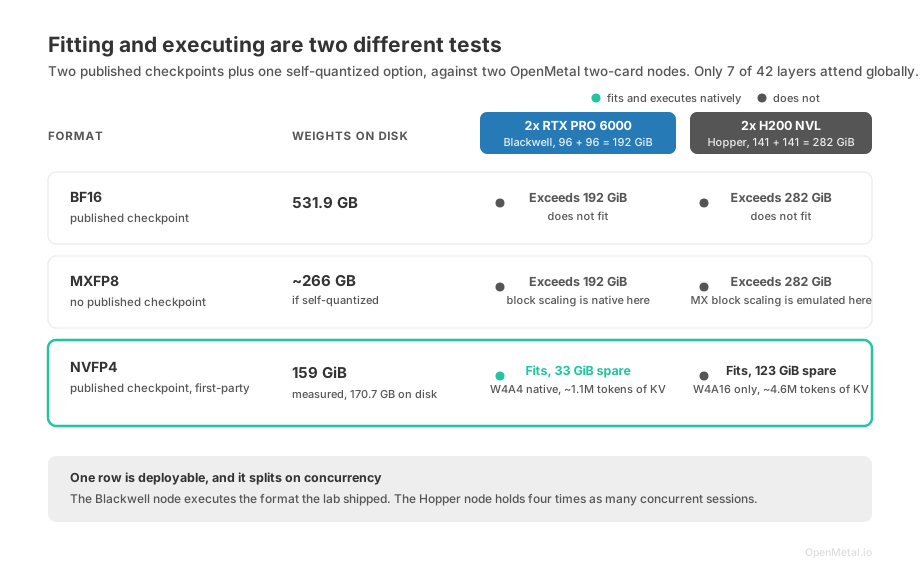
Take the weight footprints first, because they eliminate most of the options. The BF16 reference checkpoint is 531.9 GB on disk, which is 265.96B parameters at two bytes each, and it needs a cluster. The NVFP4 release is 170.7 GB on disk, or 159 GiB, rather than the naive 138 GB, because the non-expert layers stay at higher precision while the expert stacks carry the four-bit weights. Thinking Machines states a floor of 180 GB of aggregated VRAM for it, about 5% above the weights themselves.
The card also lists MXFP8 under numerics support. It is a format the model can run in. It is not a checkpoint you can download, so reaching it means quantizing the BF16 weights yourself. Whether that is worth doing depends on the card, and here a family name will mislead you. MXFP8 and FP8 are not the same thing. Hopper’s FP8 applies one scaling factor across a whole tensor. MX formats assign a separate scale to every block of 32 values, and on Blackwell that block scaling executes inside the tensor cores while Hopper emulates it in software at significant overhead. Thinking Machines draws the same line, noting that MXFP8 KV cache requires Blackwell and is not offered on H200.
The same distinction runs one level down. FP4 is not NVFP4, and NVFP4 is not one thing either. W4A4 keeps activations at four bits and needs tensor cores that multiply them there. W4A16 unpacks to sixteen bits for the matrix multiply and keeps only the memory saving. Both load the identical weight file.
| Format | Weights | 2x RTX PRO 6000 (192 GiB) | 2x H200 NVL (282 GiB) |
|---|---|---|---|
| BF16 checkpoint | 531.9 GB | Does not fit | Does not fit |
| MXFP8, no published checkpoint | ~266 GB if self-quantized | Does not fit | Does not fit |
| NVFP4 checkpoint | 159 GiB | Fits, 33 GiB spare, native W4A4 | Fits, 123 GiB spare, W4A16 only |
The sparse MoE structure raises the stakes without changing the logic. Inkling-Small routes each token to 6 of 256 routed experts plus 2 shared experts that fire on every token, so all 256 experts stay resident whatever the activation count says. Our editorial on provisioning Mixture-of-Experts models argues that case in full, and it holds here: the memory you buy follows total parameters, not active ones.
Why a 276B model is cheap on KV cache
Parameter count tells you what the weights cost. It tells you nothing about what the context costs, and on this model the two diverge sharply.
Inkling-Small has 42 layers, and its published configuration marks 35 of them as local attention with a 512-token sliding window. Only 7 layers, every sixth one, attend globally. KV cache scales with sequence length on those 7 layers alone. The other 35 hold a fixed 512-token window no matter how long the sequence runs.
The arithmetic follows directly from the model’s own config: 8 key-value heads at a head dimension of 128 is 2,048 elements per layer per token, so at 16-bit KV each global layer costs 4 KiB per token. Seven of them is 28 KiB per token, plus a flat 70 MiB per sequence for the windowed layers. A dense 42-layer model with the same attention shape would cost 168 KiB per token, six times more.
Blackwell: the arithmetic the silicon was built for
On the NVIDIA RTX PRO 6000 Blackwell Server Edition the format alignment is direct. NVIDIA’s datasheet lists FP4 precision as the first key feature of its 752 fifth-generation tensor cores, alongside 96 GB of GDDR7 with ECC at 1,597 GB/s and a peak FP4 AI figure of 4 PFLOPS. NVIDIA’s architecture documentation puts the FP4 tensor rate at twice the FP8 rate on the same silicon.
Against a first-party W4A4 checkpoint, that ratio is the reason the format matters. The memory saving and the arithmetic saving arrive together, on weights the publisher already quantized. There is no third-party recipe to evaluate and no conversion step on every forward pass.
Two cards leave 33 GiB after weights. At 28 KiB per token that is roughly 1.2 million tokens of KV cache, or about 1.08 million once you allow a few GiB for CUDA context and activations. In practice that is one long session or a few hundred short ones, and Blackwell’s FP8 KV support roughly doubles it. The card with less memory is not short of room on this model.
The kernel path is where this gets less comfortable. Thinking Machines specifies W4A4 against the SM100 Blackwell family. The RTX PRO 6000 is SM120, a different compute capability with a different kernel path. Serving frameworks have been catching up unevenly: vLLM’s backend selection has fallen through to Marlin rather than native NVFP4 kernels on SM120 in recent releases, and SGLang’s published hardware list for Inkling-Small names H200, B200, B300, GB200, and GB300 without listing the RTX PRO 6000. Practitioners do get NVFP4 running on the card through FlashInfer and CUTLASS backends. That picture moves quickly, so check your framework’s release notes as of August 2026 rather than any published account, including this one.
Whether the W4A4 path is production-ready for this model on this card is a question a benchmark answers and a datasheet cannot. It is the one open risk on this recommendation, and it is the first thing we would measure in a proof of concept on the actual hardware, before you commit to a configuration.
Hopper: the same weights, four times the sessions
The H200 NVL, also carried by OpenMetal, is the larger card on every memory line. 141 GB of HBM3e per GPU against 96 GB, and 4.8 TB/s of bandwidth against 1,597 GB/s.
It also cannot execute four-bit activations. The H200 datasheet’s precision table enumerates FP64, FP32, TF32, BFLOAT16, FP16, FP8, and INT8, and stops there, because FP4 arrived with Blackwell. So an NVFP4 checkpoint on Hopper is W4A16 by necessity, and you get the memory saving without the arithmetic saving. That is a real limitation, and it is a supported path rather than a workaround: 2x H200 is the configuration Thinking Machines names for W4A16.
What the extra memory buys is not longer context. It is more of it at once. Two H200 leave 123 GiB after weights, roughly 4.6 million tokens of KV against the Blackwell pair’s 1.1 million. Both nodes clear a single long session comfortably. Only one of them clears four of them simultaneously.
So neither card wins outright. The Blackwell node executes the format the lab shipped. The Hopper node serves more concurrent sessions of it.
Two discrete cards, and what the routing costs
OpenMetal GPU servers are bare metal dedicated servers. They are not delivered as hosted private cloud on OpenStack and Ceph, and you receive the whole machine with root access.
Both GPU SKUs ship with one card as the standard build, and a second is an orderable paid add-on. Serving Inkling-Small at NVFP4 means ordering the second GPU either way, because 159 GiB of weights does not fit on one 96 GiB card and does not fit on one 141 GiB card.
When two cards are ordered they are two discrete GPUs, not a pooled accelerator. The reason differs by card. On the RTX PRO 6000 it is a property of the part: NVIDIA’s product brief lists NVLink as not supported on the PCIe card, so there is no bridge to add. The H200 NVL is a different case, because the card does support a 2-way or 4-way NVLink bridge in principle. As OpenMetal currently builds these nodes that bridge is not present, so a two-card H200 node is also two discrete memories. Either way, plan for two memories.
Weights shard across the pair under tensor parallelism, and the 8 key-value heads divide evenly by two, so the KV cache shards cleanly as well. Traffic between the cards crosses the host PCIe 5.0 fabric, on the order of tens of GB/s per direction, well below the on-card bandwidth on either side of it.
For a sparse MoE that boundary is where expert-parallel all-to-all traffic lands, and this model’s routing softens the cost. Two of the eight experts a token touches are shared and active on every token, so they can be replicated rather than routed. Only the 6 routed experts per layer produce genuine cross-card movement, and the 12B active-parameter budget keeps that payload small.
What this looks like on OpenMetal
| Product | Bare Metal GPU server, NVIDIA RTX PRO 6000 or NVIDIA H200 NVL |
| Delivery model | Bare metal dedicated server, single-tenant, no hypervisor share. Not hosted private cloud |
| Access | Root on the physical machine, your choice of Linux distribution, you own the OS |
| Base configuration | 2x Intel Xeon 6530P, 64 cores and 128 threads, 88 PCIe 5.0 lanes per socket, 1 TB DDR5-6400, one GPU |
| What you must add | The second GPU. 159 GiB of weights exceeds one 96 GiB card and one 141 GiB card |
| Local storage | 1x 6.4 TB NVMe for weights and cache, on 8 front bays with 7 open. OS on separate 2x 960 GB M.2, so model data never shares the boot device. Added drives are quoted at the time of order |
| Network | 20 Gbps private as standard, upgradeable to 40 Gbps at additional cost. Egress included rather than metered |
| Software boundary | You bring the serving stack. CUDA, PyTorch, vLLM, and TensorRT-LLM run unlicensed. NVIDIA AI Enterprise is available, contact OpenMetal. Minimum driver on the RTX PRO 6000 is Linux R575 with CUDA 12.9 |
| Validation path | Proof-of-concept validation against your own workload before you commit to a configuration |
| Pricing | GPU pricing is quoted rather than listed |
Day one on a provisioned node is a driver install, a container runtime, and a serving process. For the four-bit checkpoint across both cards under SGLang, the shape is:
sglang serve \
  --model-path thinkingmachines/Inkling-Small-NVFP4 \
  --quantization nvfp4 \
  --tp 2 \
  --max-running-requests 48
--tp 2 is what shards the weight set and the KV cache across the two discrete memories. --quantization nvfp4 selects the format the argument has been about. On SM120 you will also be choosing a MoE runner backend explicitly rather than accepting the default, which is the practical face of the kernel-maturity caution above. Confirm flags against your serving framework’s current release before you rely on them.
What is still unmeasured
Throughput on either card is a measurement, not a specification. The figures circulating for models of this shape come from other people’s hardware and other people’s serving configurations. OpenMetal has not benchmarked Inkling-Small, so no tokens-per-second number appears here.
The KV figures above are also a ceiling rather than a budget. They assume 16-bit KV and a flat allowance for CUDA context, and they exclude the MoE all-to-all workspace, the vision and audio encoder activations, and the extra cache that speculative decoding adds if you enable the model’s draft layers. Treat a million tokens as the right order of magnitude on the Blackwell pair, not a number to provision against. Our editorial on KV cache, context, and concurrency headroom covers how to reason about what is left once the weights are placed.
One limit is settled. Inkling-Small takes text, images, and audio as input and produces text only, so it is not a speech or image generation path.
Choosing by what you are serving
If you want the lab’s four-bit arithmetic and not only its four-bit memory, take two RTX PRO 6000. The KV headroom is sufficient for long context, the format alignment is the whole argument, and the thing to validate first is the W4A4 kernel path against your own traffic.
If you are serving many long sessions at once, take two H200. Four times the KV budget is the difference between one tenant at a million tokens and several, W4A16 is a supported path rather than a compromise, and it is the configuration the publisher itself names.
If the model set you expect to run in a year is unsettled, weigh the direction of travel: first-party four-bit checkpoints are now arriving from publishers rather than from the community, and that favors silicon that executes them. Patterns for adding GPU nodes to an existing footprint are covered on the OpenMetal GPU clusters page.
Talk to an architect about format-aligned GPU selection
Bring the model set you actually intend to serve, including the checkpoint formats each publisher releases and how many concurrent sessions you need to hold. We will work through which card executes those formats natively, whether the weight set needs one card or two, and where the memory lands after weights. OpenMetal GPU servers are single-tenant, and a proof of concept runs on the same hardware you would order. New GPU configurations are on our roadmap, so it is worth telling us what you are sizing for.
Talk to an OpenMetal architect