



























In this article
We compare Amsterdam against Frankfurt, Dublin, and Paris as EU infrastructure locations, covering network connectivity, latency to key regions, and data residency considerations, then explain why Amsterdam is where OpenMetal actually operates.
If you’re deciding where in the EU to deploy infrastructure, the location matters more than most vendor pages suggest. Latency, network connectivity, and compliance posture all shift depending on which country your servers sit in, and picking based on brand recognition alone can leave performance and cost on the table.
Frankfurt, Amsterdam, Dublin, and Paris are the four locations that come up most often in this conversation. Each has real strengths. Here’s how they actually compare, and where Amsterdam specifically fits.
Network Connectivity: Frankfurt Is Bigger, Amsterdam Is Central
Frankfurt hosts DE-CIX, widely described as the world’s leading internet exchange by peak traffic, connecting more than 1,000 networks. It’s a legitimate claim. If your workload requires the single largest interconnection point in Europe, Frankfurt has it.
Amsterdam’s AMS-IX is smaller by that measure, connecting several hundred networks with peak traffic in a comparable but lower range. Where Amsterdam’s position stands out is geography rather than raw exchange size. It sits closer to the North Sea cable landing points that connect Europe to the UK and to West Africa, which matters for specific routing patterns that Frankfurt, further inland, doesn’t serve as directly.
In practice, this means the “biggest exchange” answer depends on what you’re optimizing for. If your primary traffic is intra-EU and Central European, Frankfurt’s scale is a real advantage. If your traffic pattern includes the UK, West Africa, or transatlantic routes, Amsterdam’s geography often produces better real-world routing, regardless of which exchange has more raw capacity.
Latency: What Actually Changes By Location
Within continental Europe, latency differences between these four cities are typically single-digit to low double-digit milliseconds for most business applications, not something that will make or break most workloads. Where it does matter is at the edges of your service area. We maintain dedicated latency breakdowns for teams based in specific EU cities connecting to our Amsterdam facility, including Frankfurt, Berlin, Hamburg, Paris, Madrid, and London, along with a full overview of our European coverage. If your team is based in one of these cities, those pages have the specific numbers.
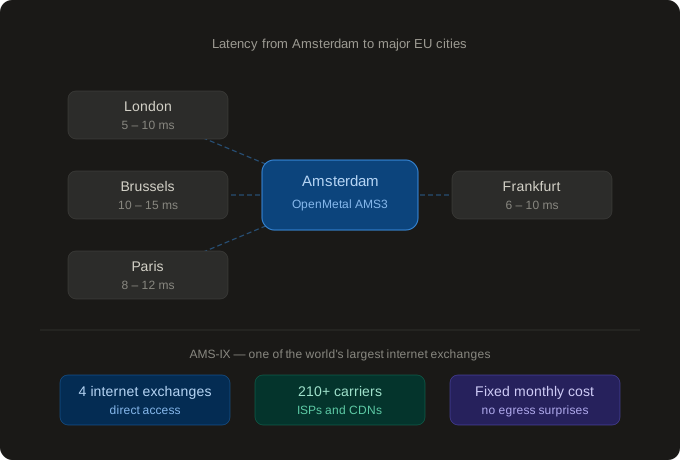 The broader regional patterns:
- Serving the UK: Amsterdam and Dublin both sit closer to UK network infrastructure than Frankfurt or Paris. Post-Brexit, UK-EU data transfer has additional legal complexity on top of the physical routing question, which we cover in more detail in our post-Brexit infrastructure article.
- Serving Africa: Amsterdam has strong subsea cable connectivity toward West Africa, making it a common choice for companies serving both European and African markets from one location. We go deeper on this in why Amsterdam works for companies serving both Africa and Europe.
- Serving the Nordics or Central Europe: Frankfurt’s central position and DE-CIX scale tend to produce a latency edge here.
- Serving Southern Europe or North Africa: Paris and Marseille’s Mediterranean cable landings can outperform both Amsterdam and Frankfurt for these routes specifically, though this is a narrower use case for most buyers.
The honest takeaway is that no single city wins latency across every region. The right answer depends on where your actual users or customers sit.
Data Residency and Compliance: Mostly Consistent, With Local Nuance
GDPR applies EU-wide, so the baseline data protection framework doesn’t change dramatically between Amsterdam, Frankfurt, Dublin, and Paris. All four are inside the EU’s regulatory perimeter, and the core Chapter V rules on international transfers apply the same way regardless of which member state you pick. For a deeper look at what data residency actually guarantees versus the separate, harder question of data sovereignty, see our breakdown of the two terms.
That said, there are country-level differences worth knowing:
- Germany has a reputation for stricter regulatory interpretation and enforcement culture around data protection generally, which some buyers weigh as an added layer of assurance, though it doesn’t change the underlying GDPR text.
- Ireland hosts the EU headquarters of several major US tech companies, which has occasionally made it a focal point in EU-US data transfer disputes and regulatory scrutiny, a dynamic worth knowing if your compliance team is sensitive to that history.
- The Netherlands and France don’t carry the same specific baggage in either direction, and both apply GDPR under standard EU supervisory authority structures.
None of this should be the deciding factor on its own. It’s more relevant as a secondary consideration once latency and connectivity have narrowed your shortlist.
Where OpenMetal Actually Operates
We run our EU data center in Amsterdam, and the reasoning tracks the factors above rather than a claim that Amsterdam wins every category. Amsterdam gives us strong routing for customers serving the UK, continental Europe, and West Africa from a single location, real GDPR-aligned data residency, and a mature, carrier-neutral connectivity environment, even if it isn’t the single largest exchange point on the continent.
If your traffic pattern is heavily weighted toward Central Europe or the Nordics specifically, it’s fair to ask whether Frankfurt would serve you better on paper. For most of the buyers we talk to, workloads spanning the UK, EU, and Africa, or straightforward EU data residency requirements without a narrow Central European focus, Amsterdam’s mix of connectivity and geography is the stronger fit, and it’s where we can actually deploy hardware today.
Current bare metal and hosted private cloud configurations available in Amsterdam are on our bare metal pricing page, and full facility details are on our Amsterdam data center specs page.
FAQ
Is Frankfurt or Amsterdam better for EU infrastructure?
It depends on your traffic pattern. Frankfurt’s DE-CIX is larger by peak traffic and connected networks, which favors Central European and intra-EU workloads. Amsterdam’s geography favors routing to the UK and West Africa alongside continental Europe.
Does data residency differ between EU countries?
The core GDPR framework applies consistently across all EU member states. Some countries have reputations for stricter enforcement culture or have been more central to EU-US data transfer disputes, but the underlying legal requirements don’t meaningfully change based on which EU country hosts your data.
Why does OpenMetal operate in Amsterdam instead of Frankfurt?
Amsterdam’s connectivity to the UK and West Africa, combined with strong continental European routing and GDPR-aligned data residency, fits the traffic patterns of most of our customers better than a Frankfurt-only footprint would.
Does Brexit affect data transfer to the UK from EU data centers?
Yes. UK-EU data transfers now involve additional legal mechanisms beyond intra-EU transfers. See our post-Brexit infrastructure article for more detail.
Schedule a Consultation
Get a deeper assessment and discuss your unique requirements.
Read More on the OpenMetal Blog