
























A production coding-agent fleet is the highest-token-burn workload most engineering organizations now run, and almost none of them budgeted for it as infrastructure. It arrived as a per-seat subscription or a metered API key, so it landed in software spend rather than on the cost-of-goods line where a sustained compute workload belongs. That accounting choice hides the shape of the cost. A developer running an agent through plan, tool-call, re-read, and retry loops all day does not generate the token profile of a chat user. They generate the profile of a batch inference job that never stops.
Key Takeaways
- For sustained coding-agent workloads billed against a premium API tier, a fixed-cost dedicated GPU reaches break-even at roughly 5-10 million tokens per month, or only 15-25% GPU duty-cycle.
- Most of an agent’s token bill is context overhead (system prompts, repo maps, re-reads), not the code it writes; individual agent tasks range from roughly $0.03 to $2.60 depending on how much codebase context loads.
- Output tokens bill 3-10x input across major APIs, and agentic loops are output-heavy by design, so the workload that makes agents useful is the same one that makes metered billing expensive.
- Open-weight coding models now carry the high-volume tier credibly: Qwen3-Coder-Next (80B total, ~3B active) fits a single card once quantized, while larger models like DeepSeek V4 (SWE-bench Verified near 80%) are cluster-scale.
- The controllable lever is duty-cycle, not headcount: a fleet that keeps a GPU busy converts a linear per-token bill into a flat monthly cost, and every additional agent hour after break-even is effectively free capacity.
Sources provided at the bottom of this article.
The number that matters to a CTO is the crossover point, and it is lower than most teams assume. Against a premium API tier, dedicated GPU inference for coding workloads reaches break-even at roughly 5-10 million tokens per month, according to Lyceum Technology’s 2026 analysis. Expressed as hardware utilization, the same threshold sits at 15-25%. Once your agents keep a GPU busy for a quarter of the day, owning the compute is mathematically cheaper than renting it by the token.
| Monthly token volume (premium API tier) | Equivalent GPU duty-cycle | Cheaper option |
|---|---|---|
| Under ~5M | Below ~15% | Per-token API |
| ~5-10M | ~15-25% | Break-even zone |
| Over ~10M | Above ~25% | Dedicated GPU |
Where the crossover sits for a sustained coding-agent workload. Thresholds follow Lyceum Technology (2026); your exact point depends on model, tier, and token mix.
Where the tokens actually go
The instinct is to assume an agent’s cost tracks the code it produces. It does not. Most of the bill comes from context overhead: the system prompt, the repository map, the files the agent re-reads on each turn, and the tool outputs it ingests before writing a single line. Agent frameworks routinely report per-task costs between $0.03 and $2.60, and the spread is driven almost entirely by how much codebase context gets loaded, not by output length.
Coding agents are the first workload where per-token billing turns your most productive engineers into your largest variable cost line.
This is why agents break the per-token cost model in a way chat never did. Output tokens already bill 3-10x input across major providers, with a median ratio near 4x. An agentic loop is output-heavy and re-reads its context on every iteration, so it compounds both the expensive token class and the volume. The workload that makes agents genuinely useful, long-horizon autonomous iteration, is precisely the workload metered billing punishes hardest.
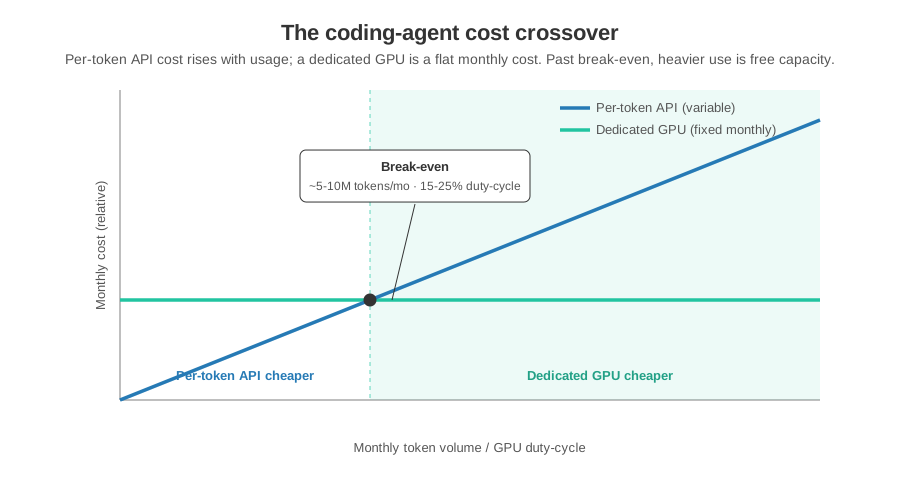
The crossover: a flat-cost dedicated GPU overtakes metered per-token billing once a coding-agent fleet sustains real volume. Axes are relative; no pricing implied.
The duty-cycle inversion
The usual objection to owning GPUs is the idle-silicon tax: buy a box, use it 8% of the day, and every token you serve carries roughly 10x the cost it would at full load because you are paying for the 90% of capacity you never touched. That objection is real for bursty, interactive workloads. It inverts for agents.
An agent fleet is close to the ideal duty-cycle profile. It runs continuously across a working day, across time zones if the team is distributed, and increasingly overnight as autonomous background agents take on refactors, test generation, and dependency upgrades. The utilization that makes dedicated hardware expensive for a chatbot is the same utilization that makes it cheap for an agent fleet. You are no longer fighting the idle-silicon tax. You are amortizing a fixed cost across a workload that was built to saturate it.
The economics only hold if the open-weight tier is good enough to carry real volume, and in 2026 it is.
- Qwen3-Coder-Next runs 80B total parameters with roughly 3B active and, once quantized, fits on a single card: about 40 GB at INT4, or around 80 GB at FP8 on an H200. Qwen reports its SWE-Bench-Pro results as comparable to models with far larger active parameter counts.
- Larger open models raise the ceiling further, at a cost: DeepSeek V4 posts SWE-bench Verified scores near 80%, but its flagship is a 1.6-trillion-parameter mixture-of-experts, which is a multi-node cluster deployment rather than a single-box one. That gap points straight at the sizing rule that trips up first-time self-hosters: a mixture-of-experts model must fit its total parameter count in memory, not its active count, so the box, or the cluster, is sized to the full model.
- Qwen3-Coder-Next sits on one card; DeepSeek V4 does not. The pragmatic architecture is a hybrid: the open model handles the high-volume, privacy-sensitive, cost-capped work, and a frontier API is reserved for the hardest tickets. The point here is that the high-volume tier no longer requires a frontier API to be credible.
How OpenMetal Fits the Agent-Fleet Cost Curve
For a team staring at an agent bill that scales linearly with adoption, the practical question is how to convert that variable cost into a fixed one without inheriting a new variable cost in its place. This is where the billing model matters as much as the hardware. OpenMetal offers GPU bare metal, including current-generation NVIDIA H200 and RTX PRO 6000, on flexible monthly billing with no per-GPU-hour meter and egress included in the plan. There is no spot-price volatility, no cross-AZ data transfer charge on the traffic your agents generate internally, and no usage meter that grows with every retry loop.
That structure is what makes the break-even real rather than theoretical. A metered GPU-hour cloud reintroduces the exact problem you left the token API to escape: cost that scales with how hard you work the machine. A fixed monthly rate does the opposite. Past the 15-25% utilization threshold where dedicated hardware overtakes metered billing, every additional agent hour is capacity you have already paid for, which is why a saturating workload like an agent fleet is the strongest possible case for dedicated, single-tenant hardware rather than shared, metered infrastructure. Teams evaluating the switch can request a proof of concept to benchmark their own model and token profile against a dedicated box before committing to a sizing. Contact the OpenMetal team to scope an agent-fleet deployment and get a quote for the current GPU lineup.
Size it before you commit
Before moving a fleet onto dedicated hardware, two questions decide the plan: does your chosen model fit the card, and how do you serve it. Our AI deployment guides walk through both without the sales layer.
- How AI Models Work covers the sizing math for self-hosted LLMs
- Will It Fit? maps specific models onto the H200, RTX PRO 6000, and XL v5, and
- AI Use Cases matches the right model and box to the job.
Together they turn the break-even argument here into a concrete sizing you can take into a proof of concept.
What This Means for CTOs
Reclassify agent inference. It is not a software subscription that happens to be expensive; it is a sustained compute workload sitting on the wrong billing model. Before renewing a per-token commitment, measure two numbers: your fleet’s monthly token volume and its GPU duty-cycle. If the fleet clears roughly 5-10 million tokens per month against a premium tier, or keeps a GPU busy more than 15-25% of the day, the metered bill is now the expensive option, and the gap widens with every engineer who adopts the tooling.
The strategic move is not to cap agent usage to control cost. Capping usage caps the productivity you bought the agents for. The move is to change the cost structure underneath so that heavy usage stops being a liability. Put the high-volume tier on a fixed-cost open model, reserve frontier APIs for the tickets that genuinely need them, and let duty-cycle work in your favor instead of against you.
If your coding-agent fleet clears a few million tokens a month, the metered bill is already the expensive option. OpenMetal’s Bare Metal GPU Servers and Hosted Private Cloud put the high-volume tier on fixed-cost hardware so heavy usage lowers your cost per request instead of raising your invoice. Talk to an OpenMetal infrastructure engineer about sizing a dedicated tier for your fleet.
Sources
- Lyceum Technology, “Inference Cost per Token: GPU Economics in 2026,” 2026. https://lyceum.technology/magazine/inference-cost-per-token-gpu-2026/
- Lyceum Technology, “Pay-Per-Token vs. Dedicated GPU Inference,” 2026. https://lyceum.technology/magazine/pay-per-token-vs-dedicated-gpu-inference/
- Kunal Ganglani, “AI Agent Cost per Task,” 2026. https://www.kunalganglani.com/blog/ai-agent-cost-per-task-2026
- Silicon Data, “LLM Cost per Token,” 2026. https://www.silicondata.com/blog/llm-cost-per-token
- DigitalApplied, “Best Open-Weight Coding Models to Self-Host: Hardware Match 2026,” 2026. https://www.digitalapplied.com/blog/best-open-weight-coding-models-self-host-hardware-match-2026