






















Q: What is the difference between Intel TDX and SGX on OpenMetal servers?
TDX isolates entire virtual machines at the hardware level, while SGX protects specific application code and data inside encrypted enclaves. Both run concurrently on OpenMetal servers.
Intel TDX (Trust Domain Extensions) operates at the VM boundary. Each trust domain is a full virtual machine whose memory is encrypted with a unique key managed by the CPU. The hypervisor can schedule the VM but cannot read its memory. TDX is designed for multi-tenant isolation, regulated data processing, and workloads where the entire VM environment must be protected from the host. On OpenMetal, TDX requires 1 TB of RAM (available on the XL v4, XXL v4, and XL v4 High Frequency by default, or via RAM upgrade on the Large v4 and Large v5).
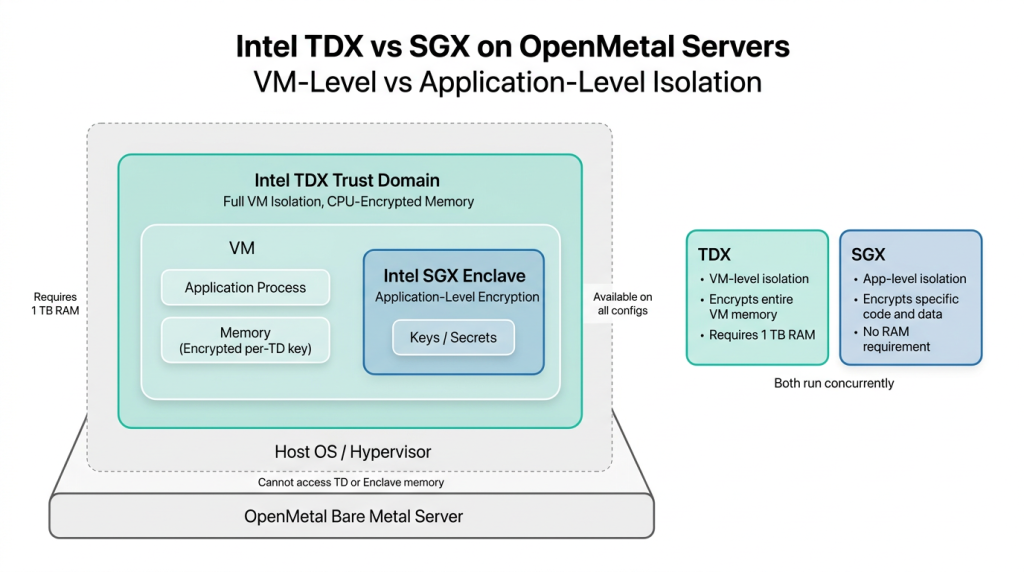
Intel SGX (Software Guard Extensions) operates at the application level. SGX creates encrypted enclaves within a process where code and data are inaccessible to the OS, hypervisor, and other applications. SGX is available on all current-generation OpenMetal servers regardless of RAM configuration. Typical SGX use cases on OpenMetal include key management (HashiCorp Vault), certificate authority operations, and privacy-preserving computation. In a TDX deployment, SGX enclaves can run inside trust domains for layered protection: TDX isolates the VM, SGX isolates sensitive operations within that VM.
Interested in OpenMetal Products?
Schedule a Consultation
Get a deeper assessment and discuss your unique requirements.