



















Q: What should prospects consider when comparing OpenMetal’s total cost of ownership against AWS, Azure, or GCP?
Prospects should evaluate five cost dimensions where OpenMetal and public cloud providers diverge: infrastructure pricing, egress fees, operational overhead, scaling economics, and long-term commitment requirements.
OpenMetal’s flat monthly model covers dedicated compute, Ceph-backed storage, and private network traffic in a single rate, while hyperscalers meter each resource independently and often require reserved instances or savings plans to approach competitive pricing.
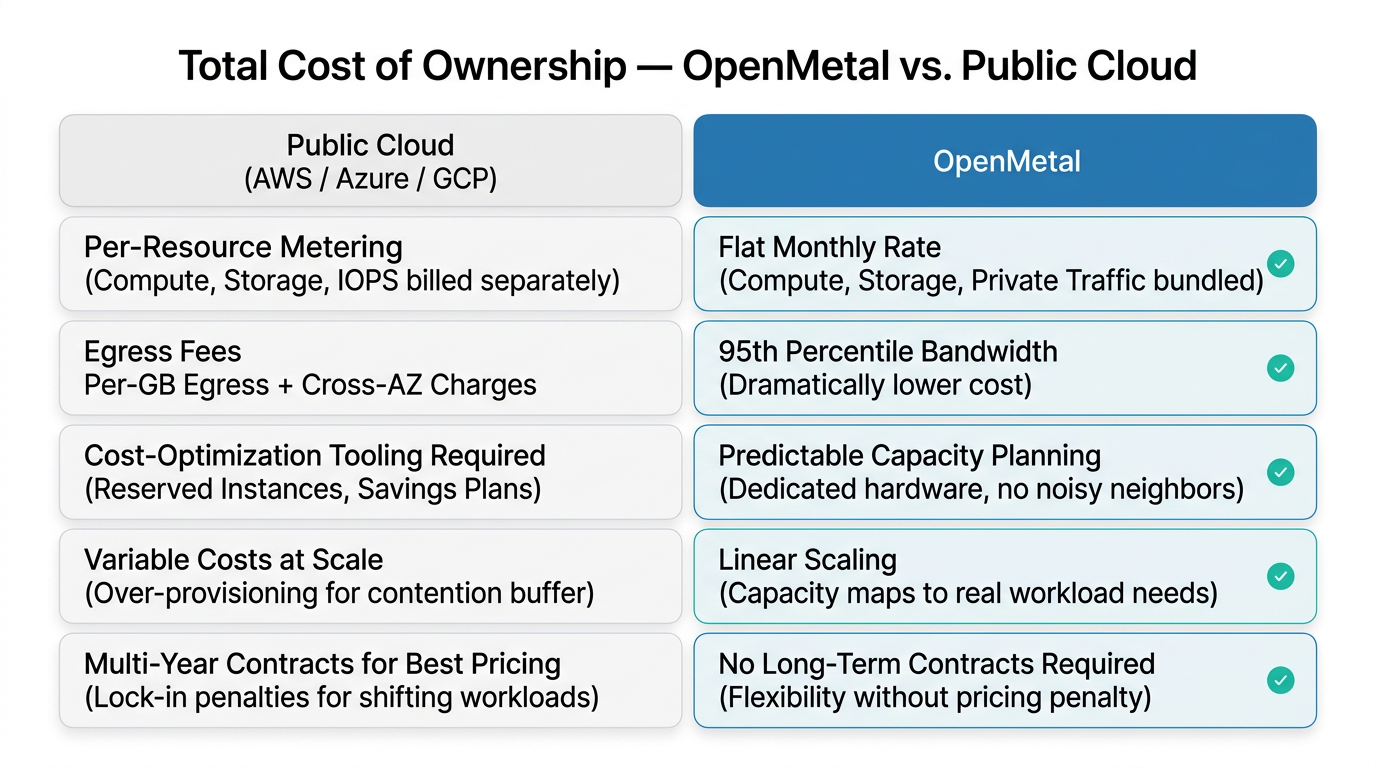
Egress is one of the largest hidden cost drivers in public cloud. AWS, Azure, and GCP all charge per-gigabyte fees for data leaving their networks, and cross-region or cross-AZ transfers add further line items. OpenMetal includes private network traffic at no additional cost and bills public egress using a 95th percentile bandwidth model that is dramatically lower than hyperscaler equivalents.
Operational overhead matters as well. OpenMetal delivers a production-ready Hosted Private Cloud on dedicated bare metal, so teams do not need to architect around multi-tenant performance variance or invest engineering time into complex cost-optimization tooling. Because there is no shared infrastructure, capacity planning reflects real workload needs rather than defensive over-provisioning against noisy neighbors.
Finally, OpenMetal does not require multi-year contracts to access its best pricing. Prospects comparing TCO should factor in the flexibility cost that hyperscalers impose through reserved instance lock-ins, where breaking a commitment or shifting workloads mid-term can erase projected savings.
Interested in OpenMetal Products?
Schedule a Consultation
Get a deeper assessment and discuss your unique requirements.