





















Q: Is OpenMetal’s XL v4 High Frequency server suitable for high-frequency trading infrastructure?
The XL v4 High Frequency is well-suited for co-located HFT infrastructure because its 3.6 GHz base clock is a hardware-guaranteed floor — not a burst ceiling — and Intel Speed Select Technology allows operators to dedicate a small number of cores to matching engine threads at up to 3.9 GHz.
Note: the XL v4 High Frequency is no longer in the OpenMetal catalog. The guidance below still applies to deployed units; for a new latency-sensitive build, the Large v5 is the closest current equivalent.
For tick-to-trade systems, the key requirement is deterministic per-thread execution speed rather than aggregate throughput. Speed Select Profile 2 reduces active cores to 8 per socket at 3.9 GHz base, concentrating compute into fewer threads and reducing interrupt-driven frequency variance. The 4 high-priority cores per socket (hardware-prioritized at 3.7 GHz) provide further isolation for the most time-critical threads without requiring real-time OS configuration.
Persistent order book data requires storage that stays out of the critical path. The Micron 7500 MAX NVMe used on XL v4 High Frequency servers delivers 15 us typical write latency and 400,000 random write IOPS — sufficient for sustained order book writes without pipeline stalls. Boot and data storage are isolated at the hardware level, keeping OS I/O off the NVMe data tier and ensuring storage writes remain predictable under background system activity.
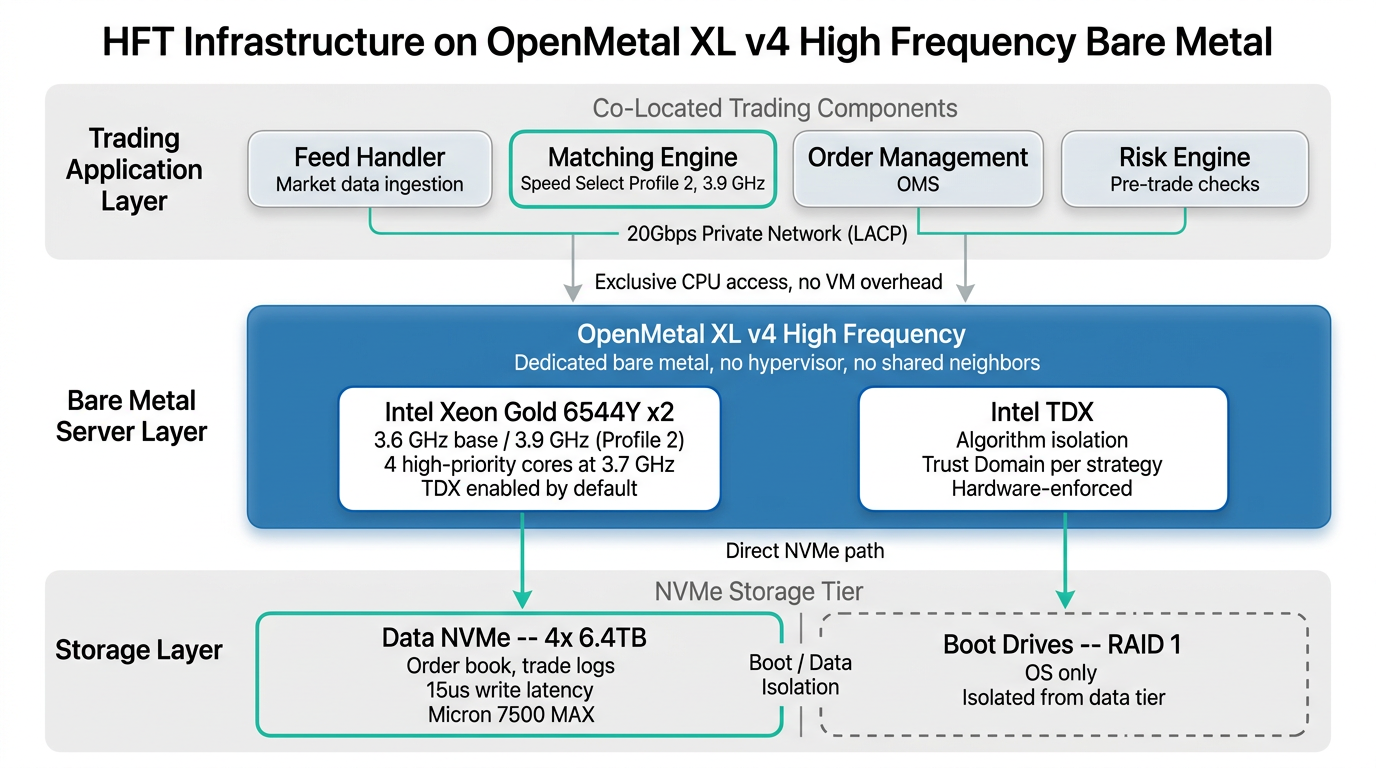
OpenMetal bare metal delivers dedicated hardware with no hypervisor overhead and no shared neighbors. For co-located trading components communicating over the private network — feed handlers, order management systems, risk engines — the LACP-bonded 20 Gbps private network provides a dedicated east-west path isolated from public egress. For strategies requiring confidential execution, all XL v4 High Frequency servers are TDX-capable at their base configuration (you enable Intel TDX in the server BIOS), providing hardware-level isolation for proprietary algorithm logic within Trust Domains.
Interested in OpenMetal Products?
Schedule a Consultation
Get a deeper assessment and discuss your unique requirements.