
























Q: XL v4 vs XL v4 High Frequency: which OpenMetal bare metal server should I choose?
Choose the XL v4 High Frequency when your workload’s critical path is serial — matching engines, real-time analytics, blockchain validators — and the standard XL v4 when your workload scales horizontally across many threads, such as OpenStack clusters, Kubernetes node pools, or batch ETL pipelines.
Both servers share the same 1TB DDR5, 25.6TB Micron 7500 MAX NVMe, 20Gbps LACP private networking, and Intel TDX support — both are TDX-capable at their base configuration, and you enable TDX in the server BIOS. The difference is entirely in the CPU: the standard XL v4 uses dual Intel Xeon Gold 6530 (32 cores per socket, 2.1 GHz base, 160MB L3 per socket), while the XL v4 High Frequency uses dual Gold 6544Y (16 cores per socket, 3.6 GHz base, 45MB L3 per socket). The HF base clock is 71% higher; the standard XL v4 has 2x the cores and 3.5x the L3 cache.
The standard XL v4 is the right choice for parallelizable workloads: Hosted Private Cloud clusters where vCPU density matters, Proxmox or KVM hosts running many VMs, Kubernetes worker nodes, PostgreSQL under high concurrent connection load, and batch processing pipelines. The 320MB total L3 cache also benefits workloads with large hot datasets — in-memory databases, graph processing, or JVM applications with large heaps.
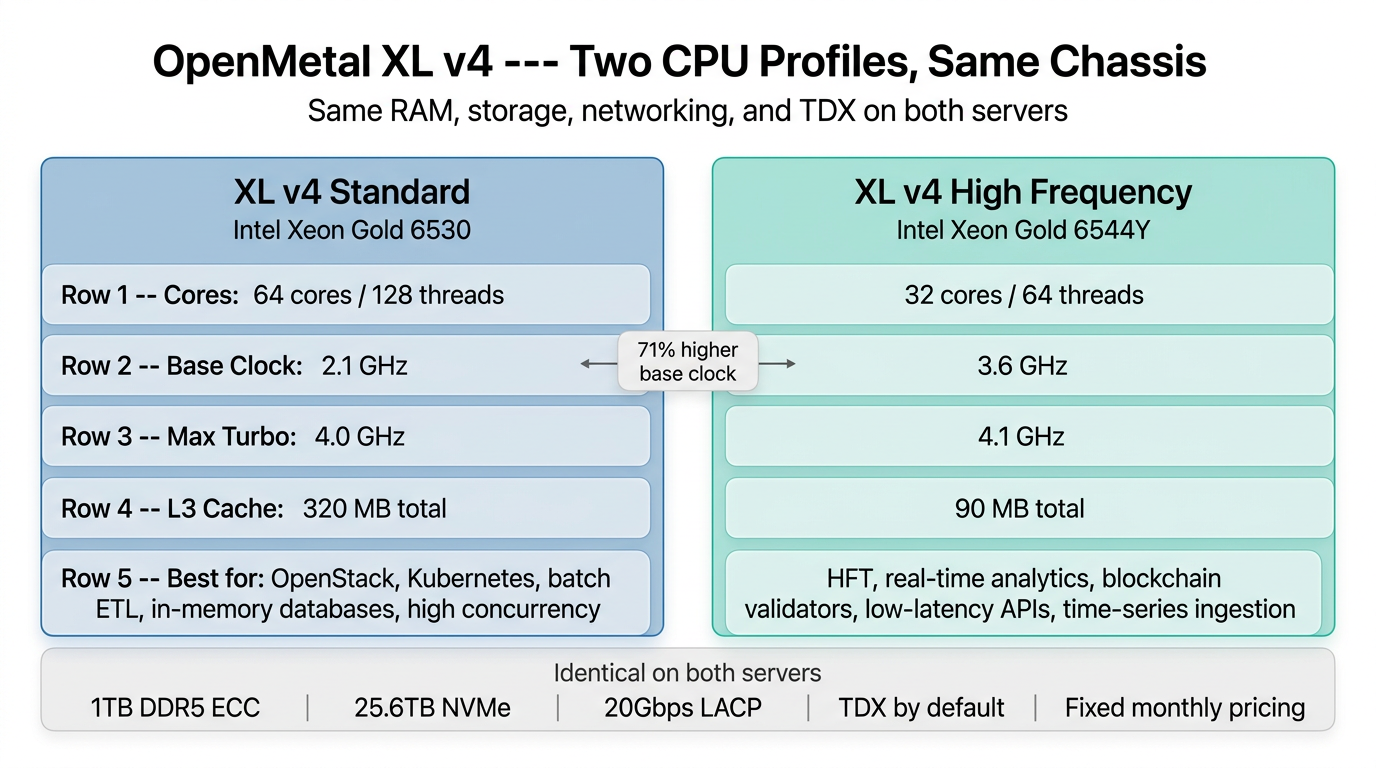
The XL v4 High Frequency is the right choice when individual thread execution speed determines outcome: HFT order book processing, tick-to-trade pipelines, ClickHouse or Druid queries where per-query latency matters more than concurrent query count, time-series write ingestion at sustained high rates, or blockchain validators with strict consensus timing. Intel Speed Select Technology lets operators configure the HF server for up to 3.9 GHz at 8 active cores per socket for the most latency-critical scenarios.
Interested in OpenMetal Products?
Schedule a Consultation
Get a deeper assessment and discuss your unique requirements.