
























Q: What is the difference between OpenMetal’s persistent NVMe and AWS i4i ephemeral instance storage?
OpenMetal Large v5 ships with 12.8 TB of local NVMe that persists across reboots and OS reinstalls; AWS i4i instance NVMe is ephemeral and loses contents on stop or terminate, requiring EBS at additional cost and latency for persistent state.
The persistence behavior changes the architecture you build around the storage. On the Large v5, the 2x 6.4 TB Micron 7500 MAX NVMe drives behave like local storage on any conventional server — they survive power cycles, IPMI-driven reboots, OS reinstalls, and BIOS resets. State persists for the lifetime of the server. Databases, blockchain chain state, container registries, ClickHouse tables, and Ceph OSDs all live on the local NVMe without needing a separate persistence tier or backup-replicate-restore loop on every host event.
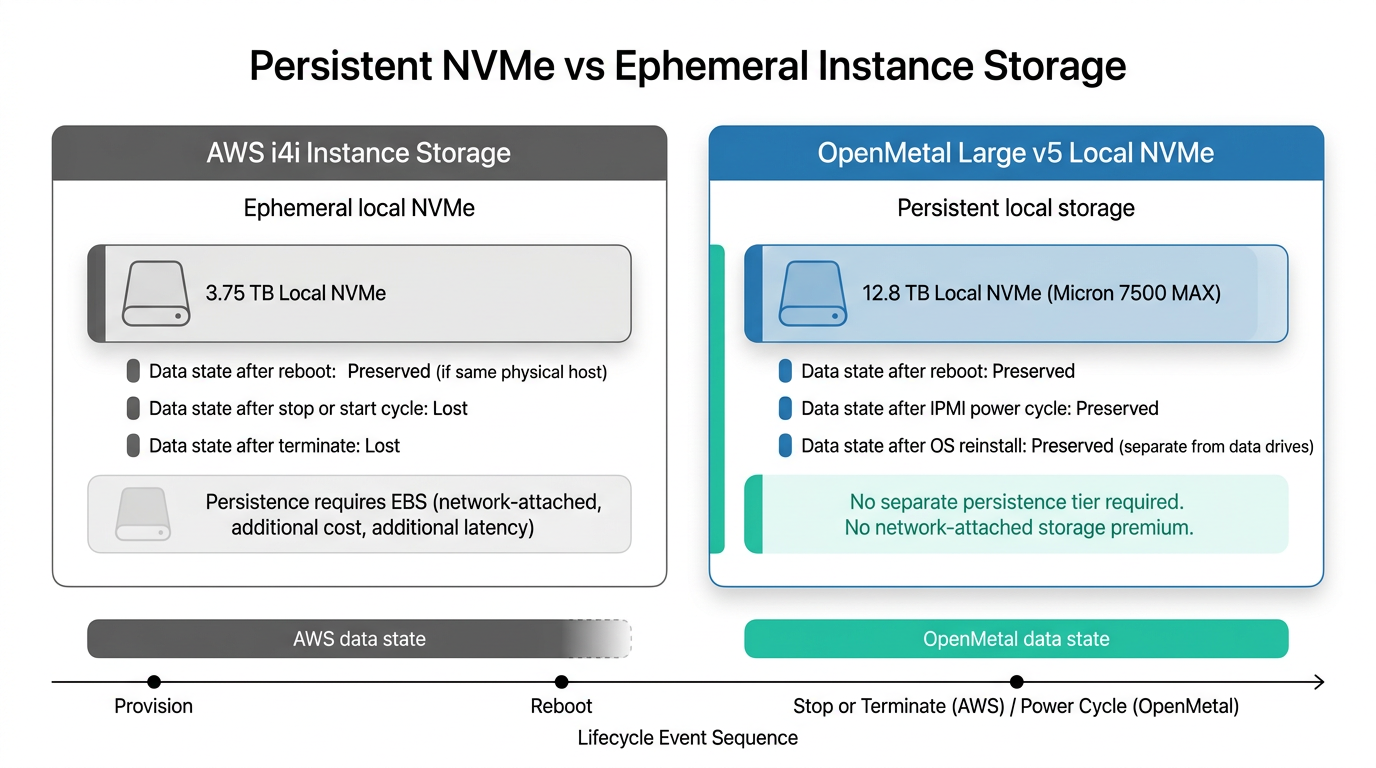
AWS i4i instance storage is ephemeral by design. The local NVMe drive(s) attached to the instance lose contents whenever the instance is stopped or terminated — not just on hardware failure but on routine lifecycle events including maintenance reboots initiated by AWS, instance type changes, and stop/start cycles used to migrate to a different physical host. Workloads needing durable state on AWS i4i typically pair the instance with EBS volumes (gp3 or io2), which adds three things: a per-GB-month storage charge, per-IOPS provisioning for io2, and network latency relative to local NVMe because EBS is network-attached rather than physically local.
The cost and latency implications matter for storage-heavy workloads. The Large v5’s 12.8 TB of persistent NVMe is included in the base monthly price — no separate per-GB charge, no IOPS provisioning, no network round-trip. An AWS i4i deployment with equivalent durable storage pays for the instance hourly rate plus EBS per-GB-month plus EBS IOPS plus the latency penalty on every persistent I/O. For PostgreSQL with large data sets, ClickHouse columnar storage, blockchain archive nodes, and container registries, the architectural and cost gap is significant. The Micron 7500 MAX’s 6-nines QoS at 99.9999% for 4KB random read up to QD128 is also stronger than typical EBS performance envelopes.
Interested in OpenMetal Products?
Schedule a Consultation
Get a deeper assessment and discuss your unique requirements.