


























Q: What is Intel Speed Select Technology and how does it improve latency on OpenMetal bare metal servers?
Intel Speed Select Technology (SST) is Intel’s hardware mechanism for defining multiple performance profiles on a Xeon processor, each with a different active core count, base frequency, and TDP — allowing operators to trade thread count for higher sustained clock speed on a per-deployment basis.
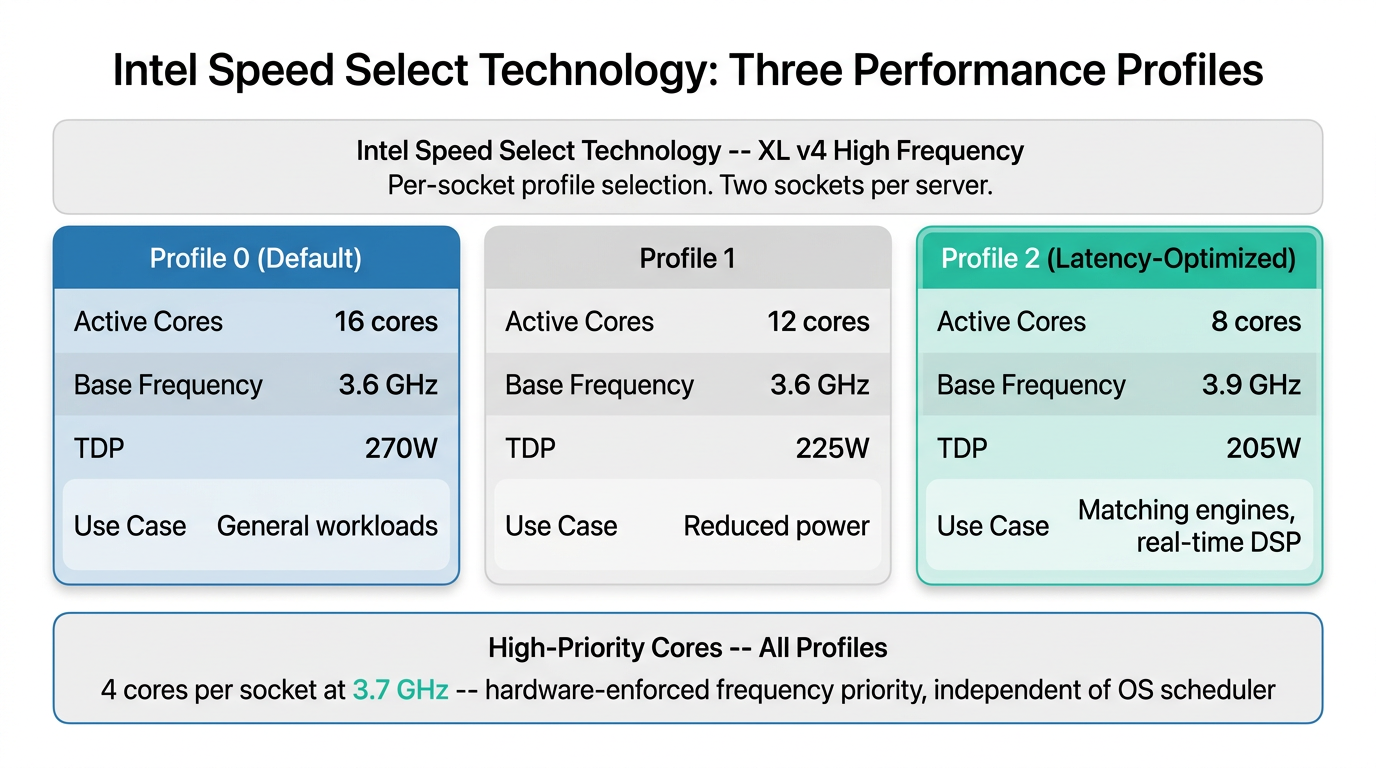
On OpenMetal’s XL v4 High Frequency servers (dual Intel Xeon Gold 6544Y), SST provides three factory-defined profiles per socket. Profile 0 (default) activates all 16 cores at 3.6 GHz base and 270W TDP. Profile 1 reduces to 12 active cores at 3.6 GHz with TDP dropping to 225W. Profile 2 reduces further to 8 active cores, raising the base frequency to 3.9 GHz at 205W. Additionally, 4 cores per socket are designated as high-priority cores at 3.7 GHz — these receive preferential frequency allocation from the processor’s power management hardware independent of the OS scheduler.
For latency-sensitive workloads — matching engine threads, real-time DSP pipelines, consensus algorithms — SST Profile 2 concentrates compute into fewer, faster-running cores. At 3.9 GHz versus 3.6 GHz default, each sequential instruction cycle completes in 256 ps instead of 278 ps. At the throughput rates of high-frequency trading or real-time event processing, this compounds across millions of operations. Unlike OS-level CPU pinning or taskset isolation, SST profile configuration is enforced at the silicon level — frequency and power limits apply regardless of OS scheduler decisions.
On OpenMetal bare metal, SST profiles take full effect without hypervisor overhead. A VM on a shared cloud instance competes for the physical core’s frequency budget with neighboring VMs; an OpenMetal bare metal server gives the workload exclusive access to the configured profile. SST is available on all XL v4 High Frequency bare metal deployments.
Interested in OpenMetal Products?
Schedule a Consultation
Get a deeper assessment and discuss your unique requirements.