



















Q: What is boot and data drive isolation on OpenMetal servers?
OpenMetal separates OS boot storage from application data storage using physically distinct drive pools, preventing system-level I/O from contending with workload I/O on the same drives.
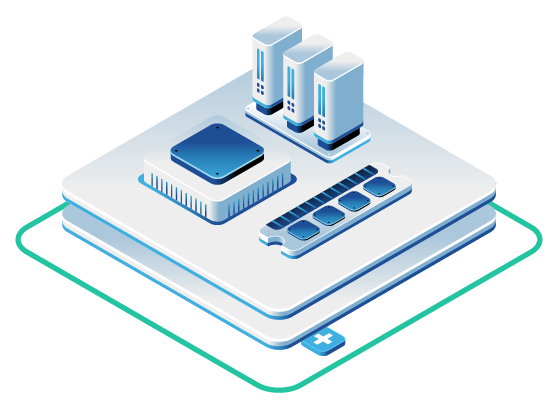
Current-generation OpenMetal servers ship with two dedicated boot SSDs mirrored in RAID 1 for OS redundancy. These handle logging, package management, monitoring agents, and system updates. The data NVMe drives (Micron 7500 MAX on v4 and v5 servers) are reserved entirely for application workloads: database files, container volumes, blockchain chain state, analytics datasets.
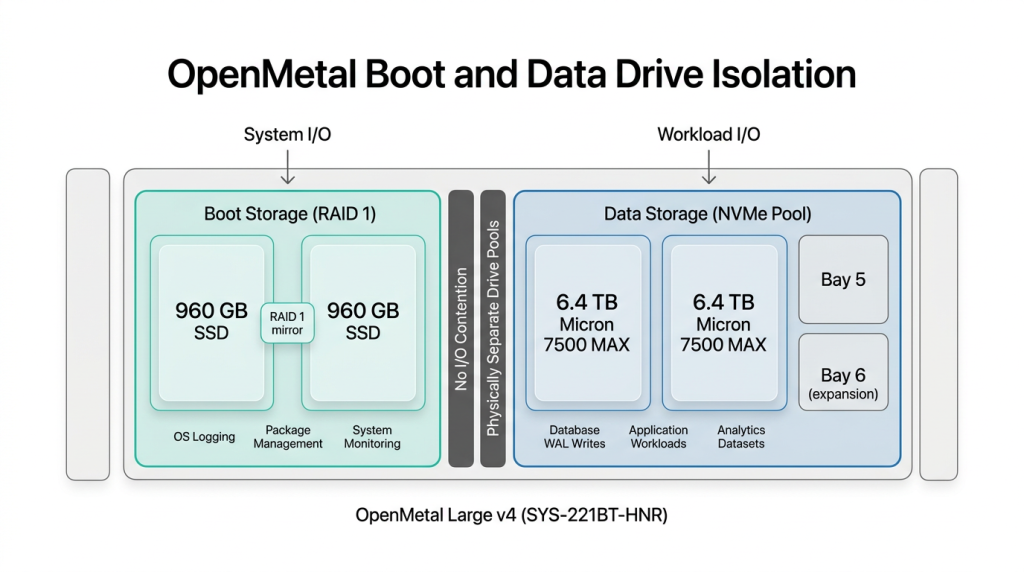
This isolation matters most for I/O-sensitive workloads. A database running PostgreSQL WAL writes on the same drive as the OS would compete with system log flushes and package manager operations for IOPS and write bandwidth. With boot/data separation, the NVMe data pool delivers its full rated throughput (7,000 MB/s sequential read, 1.1M random read IOPS on the 7500 MAX) without OS interference. The RAID 1 boot mirror also means a single boot drive failure does not take the server offline. Earlier generations like the Large v3 shipped with a single boot drive, so this isolation and redundancy is a v4-generation improvement across the OpenMetal lineup.
Related Answers
- OpenMetal Large v3 vs Large v4 Comparison
- Kubernetes on OpenMetal Bare Metal Servers
- OpenMetal Large v4 NVMe Drive Specs
Interesting Articles
Interested in OpenMetal Products?
Schedule a Consultation
Get a deeper assessment and discuss your unique requirements.